
Objection handling in B2B,
8 techniques from real deals
Not from a textbook. From over 100 discovery calls, lost deals and won negotiations in the DACH region. Each technique with a script and context, when it works and when it doesn't.
Read for free~12 min read, practical, with copy-paste scripts
Why most objection handling fails
Most B2B sellers react to objections like attacks: defend, argue, convince. The problem, the prospect didn't ask for an argument. They sent a signal.
The prospect says "Too expensive" and you fire three ROI arguments at them. Result: they don't feel heard.
"Yes, but let me show you...", the objection comes back three minutes later, twice as strong.
"I completely understand your concerns...", the prospect immediately notices you're applying a technique.
"OK, get in touch when you're ready." You never reach out again and the deal dies quietly.
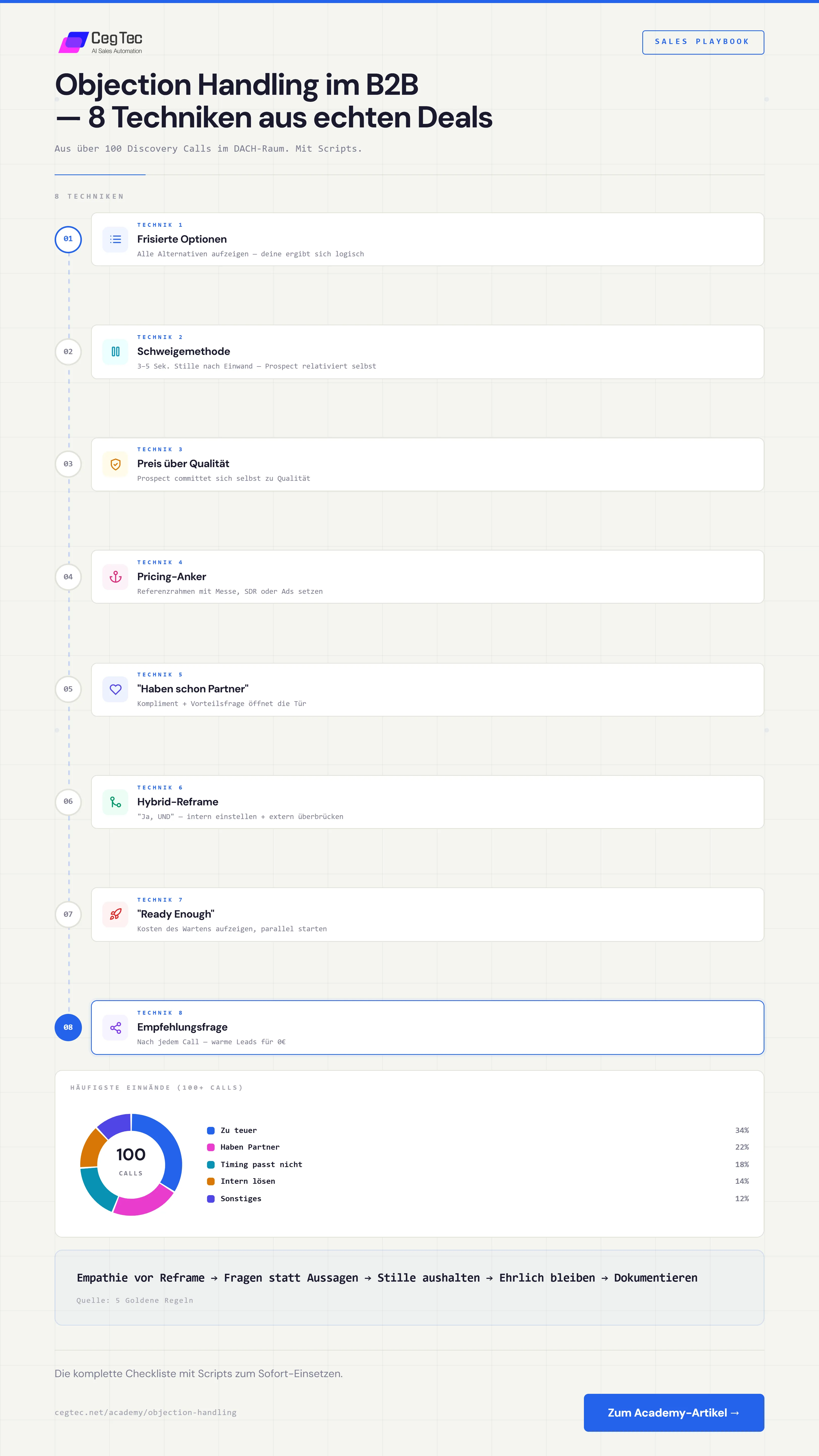
Framed options
You lay out all the alternatives, transparently showing why each one has drawbacks. Your solution isn't pitched, it emerges as the logical conclusion.
"What options do you currently have for winning new customers?"
(Prospect answers)

"The typical options we see:
- Paid ads: works, but expensive and dependent.
  Once budget is gone, pipeline is gone.
- SEO: powerful long term, but 6-12 months until results.
- Content marketing: great, but requires consistent
  effort over months.
- Trade shows: high investment, and the leads are usually
  unqualified.
- Outbound: automated, scalable, data-driven,
  but only when set up properly.

Where do you see yourselves at the moment?"When it doesn't work: if you misrepresent the alternatives. The prospect knows their market. Stay honest.
The silence method
The prospect says "That's too expensive" or "I'm not convinced." Instead of reacting immediately, you stay silent. 3-5 seconds is enough. The prospect fills the silence themselves.
Prospect: "That's too expensive for us."
You: (3-5 seconds of silence)
Prospect: "...but actually we do need to do something about it."When it doesn't work: on a phone call with a bad connection (the prospect thinks you're gone). And never after one of your own questions, only after a prospect's objection.
Anchor price to quality
You frame the price as a deliberate choice FOR quality, and let the prospect commit themselves to it.
Prospect: "That's pretty expensive."

You: "Glad you bring that up directly.
We decided when we founded the company: better justify
the price once than have to defend the quality forever.
How important is quality to you on this topic?"

Prospect: "Very important, of course."

You: "So I'm reading you correctly?"

Prospect: "Yes, absolutely."When it doesn't work: if your product objectively isn't better than cheaper alternatives. Then it's not a technique, it's a lie.
The pricing anchor
You set a reference frame using a channel the prospect knows, and show the cost-per-result comparison.
"For context: a trade show booth costs €15-30k and
typically yields 5-10 leads, most of them unqualified.

Targeted outbound delivers qualified meetings for a
fraction. Cost per meeting is typically about a tenth
of what a trade show costs per lead."Variant for software: compare to the salary of a full-time hire. "A new employee costs €8-12k per month plus 3-6 months of ramp-up. Our solution delivers from day 1 for a fraction of that."
"We already have a partner"
Instead of trashing the existing partner, give a compliment, and still open the door.
Prospect: "We already have someone for that."

You: "I figured someone like you would already be set up.
What would be a benefit you'd still consider for?"

Prospect: (mentions a concrete pain point)

You: "That's exactly what I'll show you in 10 minutes.
Either we'll see that you're already in good shape,
or that there's significant optimisation potential.
When works best for you?"When it doesn't work: if you can't actually deliver the benefit they mentioned.
The hybrid reframe
Instead of arguing against the idea, make it part of your offer.
Prospect: "We'd rather hire someone in-house."

You: "Understood, in-house gives more control and the person
learns your product properly. Valid point."
(Pause)

"The question is timing: hiring takes 2 months, ramp-up
another 4-6. That's 6-8 months until consistent
pipeline. Can you afford that?"
(Prospect hesitates)

"Hybrid approach: we start pipeline now. In parallel you hire
in-house. In 6 months we hand learnings, processes
and data over to your new person. Best of both worlds.""Ready enough" beats perfect
You validate the objection, but contrast it with the cost of waiting.
Prospect: "We need to fix our sales process first."

You: "Yes, process optimisation matters, nobody wants
to push bad leads into a broken process."
(Pause)

"The question is: does the process really need 6 months
to fix? Or could you start with 5-10 qualified meetings
per month and optimise in parallel?

Sometimes 'ready enough' beats 'perfect in 6 months'."When it doesn't work: if the process really is broken and leads would genuinely be wasted. Then honest advice beats a push.
The referral question
Don't ask whether the prospect wants to buy. Ask who in their network has a similar problem.
"One last question, regardless of whether we work together:

Who in your network might have a similar problem
right now, too little pipeline, too much manual effort
in acquisition?"When it doesn't work: if the call went badly and the prospect is annoyed. Only ask when the conversational atmosphere is right.
Which technique when
Quick reference for your next call.
5 rules that connect all the techniques
Every technique starts with validation. "Understood." "Valid point." "Glad you bring that up." Whoever doesn't take the objection seriously first loses the conversation.
"How important is quality to you?" beats "Our product is high quality." Questions activate the prospect. Statements activate their resistance.
After a reframe, don't keep talking. Give the prospect 3-5 seconds. Most deals aren't won by talking, they're won by listening.
No technique works long term if it's built on untruths. If a cheaper alternative really is better, say so. Long-term trust beats a short-term deal.
Which objection came up? Which technique did you use? What worked? Without documentation you repeat the same mistakes. A CRM field "main objection" is enough.
How objection handling fits in the funnel
Objection handling is never isolated. It's the result of everything that happened before, and shapes what comes next.
If your outreach sequence was clean, fewer objections come up. The prospect already knows why you're calling.
Documented objections become data. Which objections come up for which ICP? That feeds better playbooks.
Objection handling is wasted if your CRM is full of stale records. Clean data = better preparation.
Quality checklist
Before your next sales call, 6 points.
GTM Goat, when objections never come up in the first place
The best objection handling is the one you don't need.
You've just learned 8 techniques for the moment a prospect says "no". But what if most objections never come up, because the prospect is reached at the right time, with the right message, on the right channel?
Reactive vs. proactive
Signal-based outreach means: you only contact prospects with a relevant trigger right now, new role, hiring signal, expansion, budget approval. When the timing is right, 80% of typical objections never come up.
You still need the 8 techniques from this guide. But instead of using them in 8 of 10 calls, you only need them in 2 of 10.
Frequently asked questions
Do these techniques also work in cold calling on the phone?
Yes, especially technique 1 (framed options), 5 ("already have a partner") and 2 (silence method) are designed for the phone. On video calls all 8 work.
How do I practise objection handling?
Roleplays with colleagues, recording real calls (with consent) and reviewing them. Reviewing 2-3 calls per week beats any book.
What if the objection is justified?
Then say so. "You're right, we can't do that today." Honesty builds more trust than any technique. If you can solve 7 out of 10 objections, that's enough.
How many techniques should I practise at once?
At most 2 per week. Try one new technique per call, then note what worked. After 4 weeks you'll have a solid repertoire.
Are these techniques manipulative?
Any technique can be used manipulatively. The difference is intent. If you genuinely believe your product helps the prospect, structured conversation isn't manipulation, it's respect for both sides' time.
Master objections, or avoid them
Apply the 8 techniques
Use the scripts and the checklist from this guide. Prepare your next 5 calls and document the results.
Back to the startAvoid objections instead of handling them
Signal-based outreach, automatic personalisation and timing that fits. You'll still need the 8 techniques, but a lot less often.
Request setup