Your CRM already knows
what works. You're just not asking.
How to use Claude + HubSpot MCP to build an outreach playbook in 2 hours, based on real data instead of gut feel.
Read for freeHundreds of data points in your CRM show which industries convert, which channel performs, which angles get replies. In 5 steps that becomes a finished playbook.
Playbooks based on gut feel
Most B2B teams build their playbooks on assumptions:
Why? "Always has been." Nobody segmented the won deals from the last 12 months by company size.
Based on feel, not on conversion data. Maybe cold email converts 3x better in certain industries.
But which angle actually tipped the last 20 won deals? That's in the deal notes, just nobody reads them.
Yet a glance at win rate per pipeline stage shows that 60% of deals die in stage 2. And nobody knows why.
Meanwhile your CRM holds hundreds of data points showing what works. Nobody asks, because nobody knows how.
Claude + HubSpot MCP: your CRM gets chatty
MCP = Model Context Protocol. An open standard from Anthropic. Claude connects directly to your HubSpot and reads your CRM in real time. No CSV export, no copy-paste, no manual dashboard clicking.
Claude reads deals, contacts and companies straight from HubSpot. Always up to date.
No CSVs, no pivot tables. You ask questions in natural language.
Claude analyses hundreds of deals at once and surfaces patterns you'd miss manually.
The end result: a finished document, ICP, channels, messaging, sequences.
- Claude Pro or Team, so MCP connections are available
- HubSpot MCP connector, enable it in Claude settings (Anthropic's official connector)
- HubSpot CRM with at least 6 months of deal history
Setup takes 5 minutes. After that, Claude can read your HubSpot.
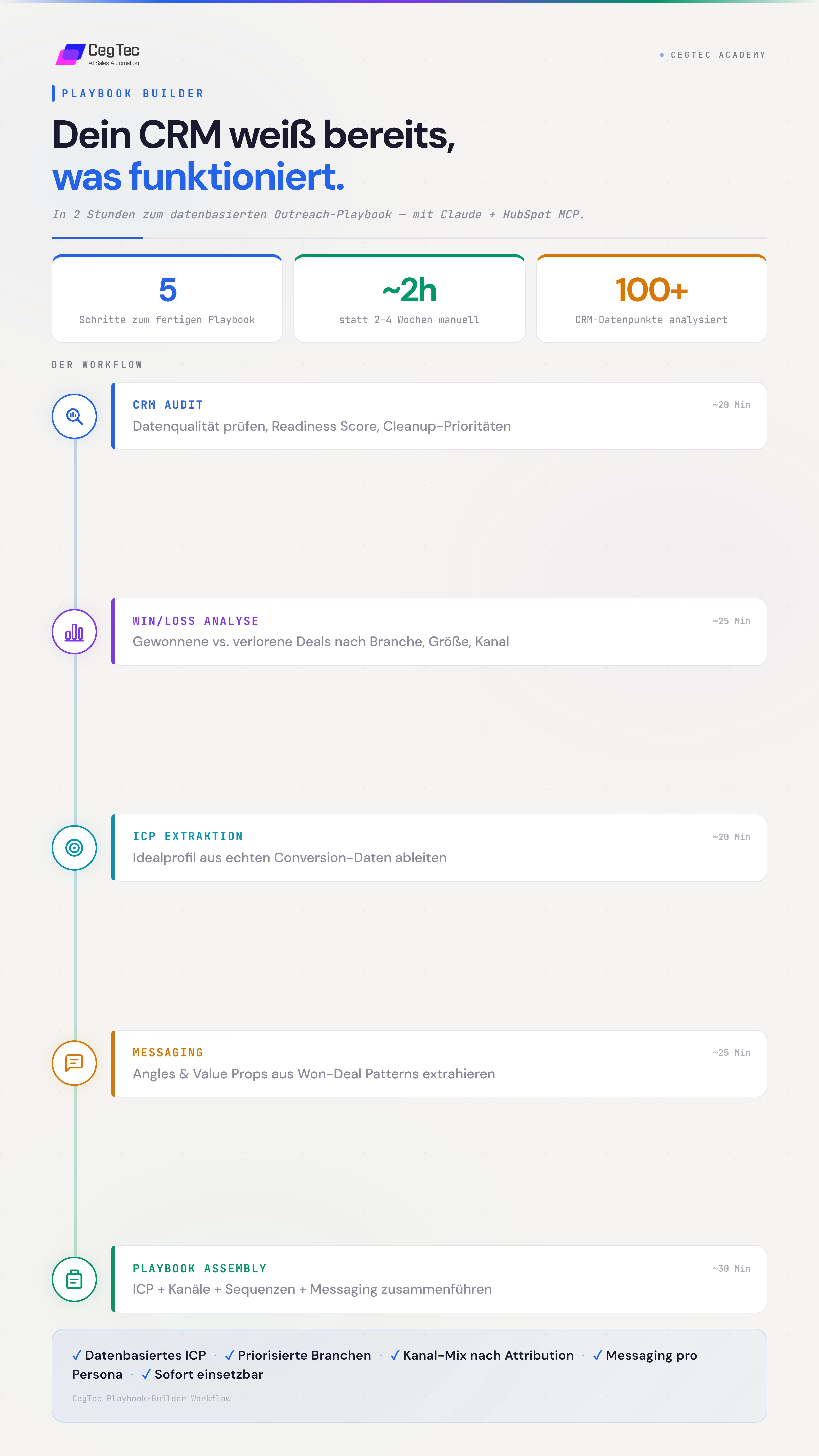
The workflow in 5 steps
From raw CRM data to a finished outreach playbook. Each step builds on the previous one.
CRM audit, check data quality
Before you analyse, you need to know whether your data can be trusted. Deal stages clean? Companies linked? Properties maintained?
Run a CRM audit of my HubSpot:
1. How many deals are there in total? How many have a pipeline stage?
2. How many contacts have no email address?
3. How many companies have no domain?
4. How many deals have no close date?
5. Give me a readiness score from 1-10 and a prioritised cleanup list.Win/loss analysis, find patterns
Compare won vs. lost deals. By industry, company size, channel, sales cycle length. This is where the first real patterns emerge.
Show me all closed-won deals from the last 12 months, grouped by industry.
Compare with closed-lost:
- Where is the win rate highest?
- Which industries have the shortest sales cycle?
- Are there correlations between company size and deal size?
Show this as a table with win rate, avg deal size, avg sales cycle by industry.ICP extraction, data-driven ideal profile
Derive the ideal customer profile from the win patterns. Not from gut feel, but from real conversion data.
Based on closed-won deals from the last 12 months:
1. What are the top 3 industries by win rate?
2. Which company size (employees) converts best?
3. Which job titles of decision-makers appear most often?
4. Is there a common trait in the top 10 deals by deal size?

Build an ICP definition with: industry, size, title, region, revenue.Messaging derivation, what resonates with winners?
Which touchpoints did the won deals have? Which angles and value props show up across the best deals? The answers sit in your deal notes, activities and email logs.
Analyse the touchpoint history of the top 20 closed-won deals:
1. Which channel produced the first contact (Inbound, LinkedIn, Cold Email, Referral)?
2. How many touchpoints to close?
3. Which themes/angles appear in the deal notes?
4. Is there a messaging pattern that appears more often in won than lost deals?

Summarise into a messaging framework: primary angle, supporting points, proof points.Playbook assembly, bring it all together
ICP + channel mix + sequence recommendation + messaging per persona. All in a document your sales team can use starting tomorrow.
Build a complete outreach playbook based on our analysis:

1. ICP definition (from step 3)
2. Channel strategy: which channel for which segment? (based on step 4)
3. Sequence recommendation: how many touchpoints, what spacing, what mix?
4. Messaging per persona: tailored to the top 3 job titles
5. Qualification criteria: when is a lead sales-ready?

Format: structured document I can hand directly to my sales team.Gut feel vs. data
- "Our ICP is mid-market", because someone said so once
- All industries treated the same, no prioritisation
- Same message to everyone, generic and forgettable
- Channel choice based on personal preference
- Playbook exists as gut feel in the sales lead's head
- ICP based on win rate, deal size and sales cycle data
- Top 3 industries prioritised by conversion likelihood
- Messaging per persona, derived from real won-deal patterns
- Channel mix based on first-touch attribution of won deals
- Written playbook every team member can execute on
Typical insights
What teams discover when they systematically analyse their CRM data for the first time:
Next level: from document to execution
With this guide you have a solid, data-driven playbook. But a document alone doesn't generate pipeline. The next step: automated execution.
Internally we use GTM Goat, an AI-driven outbound system that plugs straight into the playbook:
Your ICP definition becomes search filters directly. Leads are found and qualified automatically.
Your messaging framework becomes personalised emails and LinkedIn messages, per lead, not per segment.
Multi-channel sequences (email + LinkedIn) run automatically. You only step in for replies.
Reply rates, open rates, conversion per angle, the playbook improves with every touchpoint.
Frequently asked questions
How many deals do I need at minimum?
Ideally 50+ closed-won and 50+ closed-lost in the last 12 months. From 30 deals per category you start to get usable patterns. Below 20, results are hypotheses rather than facts.
Does this work with Salesforce instead of HubSpot?
The workflow is identical, you just need the Salesforce MCP connector instead of the HubSpot one. Prompts stay the same, only the data field names differ.
What if my CRM data is poorly maintained?
That's exactly what step 1 (CRM audit) is for. Claude shows you where the gaps are. If the readiness score is below 5, we recommend a CRM cleanup first, we have a dedicated guide for that.
Does Claude see my sensitive CRM data?
Yes, Claude reads personal CRM data (names, emails, company data) via the API. With Claude Team, Anthropic states that data is not used for model training. Even so: sending personal data to a US API is GDPR-relevant. Check internally whether a data processing agreement (DPA) with Anthropic is required and whether your data protection policy permits the transfer. When in doubt: involve your data protection officer before you start.
Can Claude write data too, or only read?
The HubSpot MCP connector can both read and write. For this playbook workflow you only need read access, Claude analyses your data, doesn't create new records.
Read the guide again
All 5 steps with prompts and expected outputs. In 2 hours you'll have your playbook.
Back to the startPlaybook + GTM Goat setup
We build your data-driven playbook and configure it directly in GTM Goat, CRM analysis, ICP, messaging, sequences and automated outbound execution. Live in a week.
Request now