
LinkedIn outreach without the cringe,
personalised sequences that get replies
Why 90% of all LinkedIn messages get ignored, and how signal-based targeting, the engager playbook and a clean sequence architecture get you reply rates above 10%.
Read for freeBased on real playbooks and sequence frameworks from the DACH region. Signal-based, with clear character limits and a structure that works.
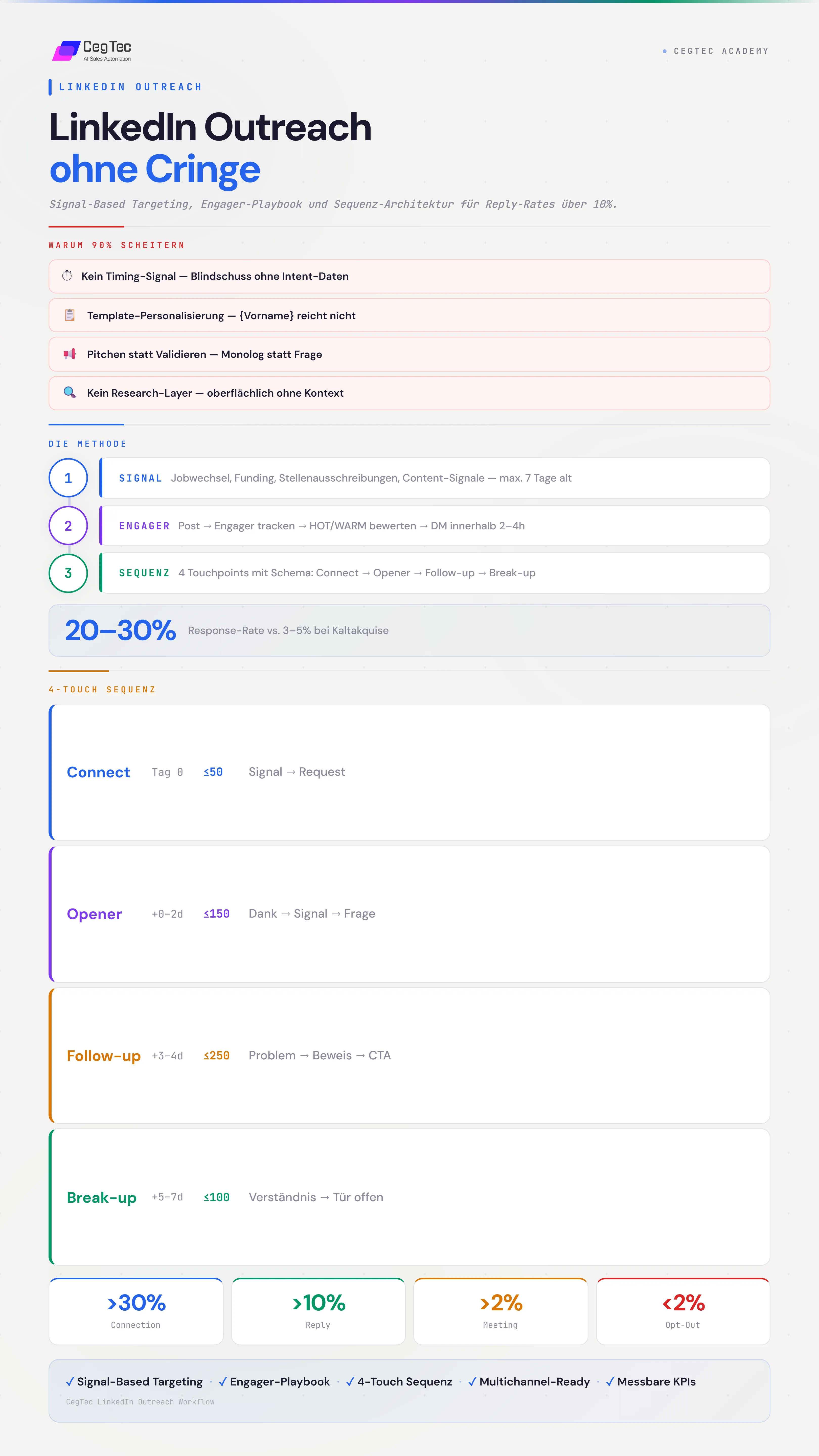
Why LinkedIn outreach fails
Every B2B founder knows the feeling: an inbox full of generic LinkedIn messages. "Hi {FirstName}, I saw you work at {Company}...", delete.
You contact people who don't currently have a need. Without intent data (job changes, funding, tech changes), every message is a shot in the dark.
Inserting {FirstName} and {CompanyName} isn't personalisation. Recipients spot templates in 2 seconds.
"We help companies like yours with..." isn't a conversation opener. It's a monologue. Good outreach asks a question that validates the pain, without selling.
Without context on the person (current projects, pain points, tech stack), every message stays surface-level. Words like "exciting", "innovative" or "synergies" are a death sentence.
Before you write: 5 questions to think through
Before you draft a single message, answer these:
Which signals do you see in your best customers before they find you?
In their own words, not in marketing speak.
Concrete customer, concrete number, concrete timeframe.
What do they get immediately, with no commitment?
The perfect CTA isn't a request for a meeting, it's a question that shows you understand the context.
Step 1, signal-based targeting
Before contacting someone, you need a reason. And "they fit my ICP" isn't a reason. A signal is a concrete event showing the person is currently open to your topic.
New Heads of Sales/Marketing actively rebuild during their first 90 days
After a Series A/B, sales and marketing get investment
Whoever is hiring "Channel Manager" or "SDR" has outbound on their radar
Whoever posts or comments about a topic on LinkedIn has it actively on their mind
Step 2, the engager approach
Instead of cold outreach: generate warmth through content engagement. The strongest playbook for warm leads.
A LinkedIn post on a topic relevant to your ICP
Who interacts? Likes, comments, especially substantive comments from decision-makers
HOT (decision-maker, substantive engagement), WARM (right role, like), IRRELEVANT (not in ICP)
HOT leads receive a message 2-4 hours after their interaction, referencing their comment
You post about "Why 80% of B2B leads never get contacted". A VP Sales likes and comments "Exactly the issue at our place." -> 3 hours later: DM referencing their comment + a validating question.
Step 3, the sequence architecture
A good LinkedIn sequence has 4 touchpoints with clear character limits. LinkedIn isn't a blog post.
The structure per message:
Messages that work, with structure
Connect
Your post on {{intent_topic}} caught my eye.
Connect?No pitch. No "I help companies like yours". Just a reason.
Opener
Thanks for connecting, {{lastName}}.
I saw {{signal}}, are {{pain}}
playing a role at {{companyName}} right now?You ask a question instead of pitching. If the pain isn't there, the person says no, and you save yourself the follow-ups.
Follow-up
Quick & concrete, {{lastName}}:
{{caseCustomer}} achieved {{benefits}} in {{timeframe}}.
For you: {{quick_win}} with no risk.
15 min to check whether it fits?Concrete customer, concrete result, low commitment.
Break-up
Understood, {{solution}} isn't a priority at
{{companyName}} right now. I'll let it rest.
If anything changes: a message is enough.No guilt trips, no "last chance". Exit gracefully.
Multichannel: LinkedIn + email as one system
LinkedIn alone is rarely enough. The strongest combination: 3 emails + 4 LinkedIn touches, timed in parallel.
For the email side you need a cold-email tool, Instantly, Lemlist, Smartlead or similar. Important: do not send from your main domain. Set up a separate sender domain and warm it up for 2-3 weeks before launching the first campaign. The tool handles sending, warm-up and tracking, you write the copy following the same modular structure as on LinkedIn.
Copy examples from the field
SaaS for e-commerce
Hi Sarah,
saw your CX Manager opening, returns
seem to be on your mind right now.

ABOUT YOU cut returns by 43%, runs on
Shopify and fits your shop size.

15 min to compare? Wed/Thu afternoons free?HR tech for scale-ups
Hi Thomas,
10 roles posted at once, I know that chaos.

N26 cut time-to-hire by 60% during
Series B, even at 50-200 headcount growth.

20 min for a recruiting check?Cybersecurity for fintech
Hi Marcus,
your post on GDPR challenges hits a nerve.

Trade Republic became compliant in <6 weeks,
without an in-house security team.

Quick technical deep dive? Friday morning free?KPIs: how you know it's working
If lower: review signal quality
If lower: review persona or pain
If lower: review CTA or proof
If higher: review frequency or tone
Quality check before sending
Before any message goes out:
Next level: GTM Goat
You've just learned the full workflow: spot signals, track engagers, research per account, write structured messages, coordinate email + LinkedIn, measure KPIs, optimise copy.
It works. Manually it's doable at 10-15 leads per week.
GTM Goat does exactly that, just automatically:
FAQ
Do I need LinkedIn Sales Navigator?
For signal-based targeting, yes. The filters (job changes, company size, job postings) are the core of step 1. The investment (~€80/month) pays for itself with the first qualified meeting.
How many messages per day are safe?
20-25 connection requests per day and 50-80 messages are in the safe range. Ramp new accounts up slowly (2-3 weeks of warm-up). More important than volume: no pattern that looks like a bot.
Is automated LinkedIn outreach allowed?
LinkedIn forbids automation in its ToS. Tools like HeyReach use dedicated browser profiles and human delays to minimise risk. Recommendation: only use accounts that aren't business-critical, and configure the automation so it behaves like manual usage.
Does this work for small niches (<500 target accounts)?
Especially then. With small niches you can invest much more research per account. The sequence stays the same, the personalisation goes deeper. And the engager approach works regardless of niche size, you just need content your ICP cares about.
What if my reply rate is below 10%?
Don't tweak the template. Check in this order: 1) signal quality (are signals <7 days old?), 2) persona fit (are you reaching the right people?), 3) pain articulation (do you speak their language?). Only then optimise the messaging.
Ready for outreach that works?
Start with the engager approach
One LinkedIn post per week, track engagers, manually message the best 5-10. After 2 weeks you'll have a feel for signals, timing and which formulations land.
Read againLive in a week
Signal detection, engager scraping, AI research, HeyReach sequences, multichannel orchestration, the same process you just learned, only automatic.
Free GTM audit