




Free strategy consultation?
Book an intro call →

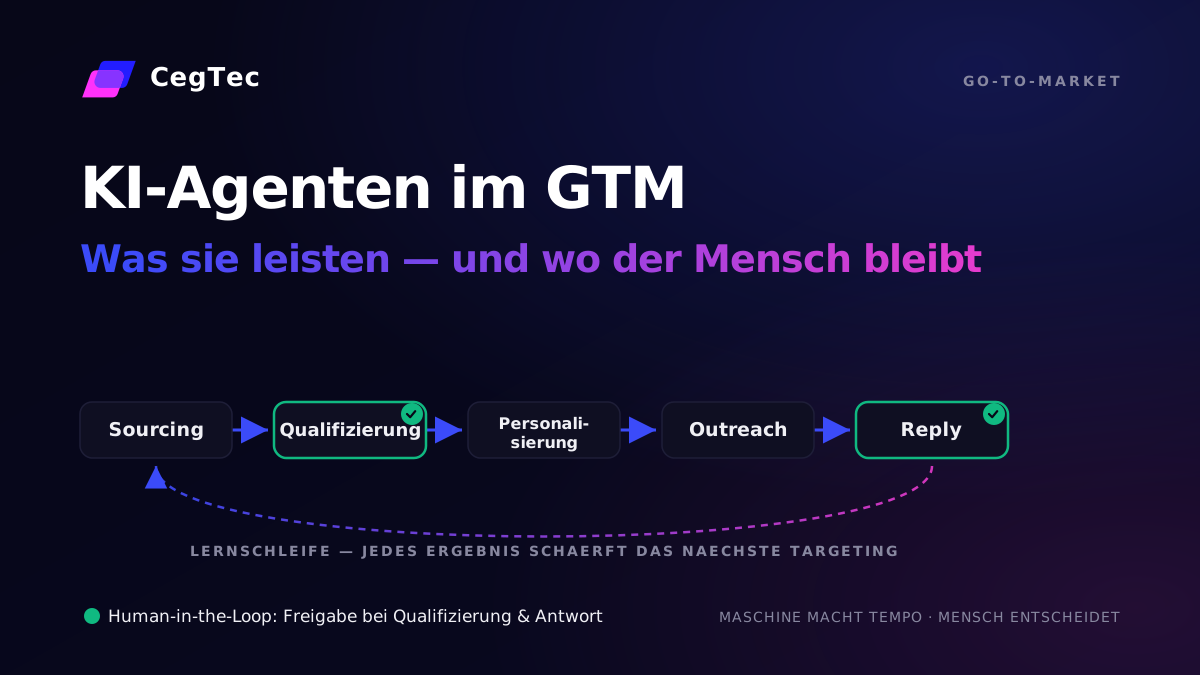
Most B2B teams have upgraded their go-to-market stack in recent years: a database, a sequencer, a LinkedIn tool, an enrichment service, a CRM. The result is rarely more pipeline — but more tools, more interfaces, and a human in the middle holding it all together. The next stage isn’t another tool. It’s AI agents that take over the GTM process itself — and a human who no longer executes, but decides.
This article lays out what “AI agents for GTM” concretely means, where the human stays, what such a system looks like in everyday operation, and how to spot a good solution — without hype and without vendor jargon.
The term “AI agent” is used inflationarily, so first the distinction:
| Automation / workflow | AI agent | |
|---|---|---|
| Logic | fixed if-then rules | evaluates the individual case in context |
| Edge cases | break the chain | are understood and handled |
| Example | ”If industry = SaaS, then sequence A" | "Does this company fit our offer — and why?” |
| Maintenance | someone rewrites rules | learns from feedback and outcomes |
A workflow does what it was taught once. An agent makes a judgment — researches a company, evaluates fit, drafts an outreach message, classifies a reply. Exactly where human judgment used to be required — but in seconds instead of minutes, and across hundreds of cases in parallel.
The misunderstanding behind this: it’s not about replacing the human, but about separating grunt work (researching, building lists, typing first-touch messages, timing follow-ups) from judgment work (does this fit? is this reply good? is this meeting worth it?) — and automating only the former.
An agent-driven GTM system typically covers the entire upper funnel — each step a capability that used to be its own role or its own tool:
The difference from the classic stack isn’t that these things are new — it’s that they converge in one system that learns from the whole picture, instead of living in seven separate tools that nobody fully orchestrates.
The most important question in agent-driven GTM isn’t “how much does the system automate,” but “where does the human sit.” Full autonomy is a mistake in sales — it reliably fails in two places: judging whether a company is genuinely a fit, and replying to a real prospect.
A well-built system deliberately places the human at the decisive control points:
This creates the division of labor that actually makes such systems productive: speed and volume from the machine, judgment from the human. And because every human decision flows back in as a signal, the system gets better with use — not through a separate “training” step, but through normal operation.
Concretely, the sales rep’s role shifts from list-worker to operator. Instead of maintaining eight dashboards, they work through a prioritized feed: here are the hottest leads (why: signal X), here three replies are waiting for approval, here’s a suggestion to sharpen a campaign.
From our own experience — we have run our sales on this principle for three years, now on our own platform: a single person can run a good dozen parallel campaigns across multiple industries with it, because the research, writing, and timing work no longer sits with them. Their time flows into the conversations that count. That’s the realistic reading of the “10x sales rep” thesis: not ten times more manual activity, but the same person steering a machine room ten times larger.
The honest caveat belongs here too: such a system scales a working offer. Whoever has no product-market fit or no sharp ideal customer profile only automates the speed at which the market says “no.”
The market for “AI sales agents” is loud and confusing. Five questions separate substance from buzzword:
Three paths lead to agent-driven GTM, and they fit different situations:
We’ve written up the make-or-buy logic in detail here: Hiring an SDR or an AI sales agent and Outbound tools vs. service.
Self-service software solves no problem as long as nobody operates it properly — and “nobody” means two things here: neither a human without the time or RevOps know-how, nor an AI agent that lacks the integration. The half-used tool is the most expensive line item in the GTM stack: paid for, but ineffective. What matters isn’t what a tool can do, but whether it actually gets operated day to day — by an operator or by an agent that reliably drives it.
That leads to a second, often overlooked point for tool selection. Whoever builds a system, instead of running individual tools side by side, needs three things from every building block:
A tool without a clean API and without MCP integration is a disqualifier in the agent era: it can’t be hooked into an orchestrating system and becomes a dead-end investment. So the question for every tool decision isn’t just “what can it do?” but “does it stay integrable — for my operator and for the agents meant to operate it?”
GTM Goat closes exactly this gap. Instead of being another self-service tool sitting unused in the stack, GTM Goat is the orchestrating layer above it: operable both by a human (an operator steers the whole process) and by AI agents — directly from Claude, ChatGPT, Cursor, or Slack via MCP, in natural language. The underlying tools (sender, CRM, data sources) remain interchangeable adapters, connected via their APIs. This means no more paid-but-unused tools accumulate — instead, a system emerges that actually runs — because it can be operated by both human and agent.
AI agents don’t change GTM by adding another tool, but by turning the tools beneath them into interchangeable building blocks and taking over the orchestration — plus learning from every outcome. The human doesn’t disappear in this; they move to where judgment matters. Whoever starts today should pay less attention to the shiniest demo and more to three unspectacular things: clean approval gates, ownership of your own data, and honest handling of DACH legal requirements. The rest is execution.
CegTec builds and operates such agent-driven GTM systems for the DACH region — as a done-for-you service or as a self-service platform. Read about how the learning mechanism behind it works in Closed-Loop Outbound.