
GTM for your customers.
One system, many client accounts.
A self-improving GTM Operating System as your engine: it understands every client’s customer profile from that client’s own tools, executes on it and learns back from every result. The platform carries our brand — you get a dedicated workspace per customer with separated data, playbooks, credits and billing, plus volume pricing across your entire portfolio. GDPR-first, hosted in the EU.
 GDPR-compliant · EU hosting
 Built in Germany
Your margin shrinks the bigger you get.
Not because you work badly — but because every client account needs the same manual work from scratch and none of it stays behind.
Every new client costs you people
Client eleven runs like client one: research by hand, copy by hand, replies by hand. Revenue grows, margin shrinks — because your output hangs on man-hours and man-hours do not get cheaper.
Every customer has their own stack
One client on HubSpot, one on Pipedrive, plus three sequencers, two enrichment tools and a separate mailbox for each. None of it talks to anything else. Every campaign is a rebuild, every report is manual work.
What works sits in two heads
Which angle lands with which persona is known by your best strategist. After they offboard, nobody knows any more. Six years of experience are in no system — they walk out with the resignation.
A client is no longer a project. It is a workspace that learns.
Three layers that together carry the stretch from signal to booked conversation — cleanly separated per client, with your people at the sign-off point.
Data layer: the customer profile, not the list
Per client, the CRM, website analytics, LinkedIn, mailboxes and market signals are brought together into one picture: who buys, why, and who is ready to buy right now. Not an exported list, but a model of your client’s ideal customer.
Agents & workflows: the execution
That understanding turns into action: research, qualify, reach out, classify replies, book the meeting, write to the CRM. Your people decide and sign off — they no longer type it up.
Analysis loop: it gets better per client
Every reply, every rejection, every meeting flows back into the data layer. A client’s playbook sharpens week by week — instead of starting from zero with every campaign.
A tool owns one step
The sequencer sends. Enrichment enriches. The database delivers rows. Whoever connects the steps, judges them and owns the handover is still your people — for every client, again.
Man-hours own everything — and keep nothing
A good team can run the whole stretch. It just cannot run it twice without costing twice. And what it learned ends up in heads, not in the operation.
The system owns the stretch — and keeps what it learns
From signal to booked conversation: one chain, one data model, one sign-off point for your people. And every result stays in the system, for every client account in that market.
A single tool owns one step. This is about the whole chain per client — and about it getting better with every result. Your people stay the architects and sign off on what goes out.
Six chains you can run for customers from day 1.
Every play has a trigger, a flow and an outcome. You choose per client which ones run — the system takes on the execution, the sign-off stays with you.
Job posting → account → research → outreach
- Trigger
- A target company is hiring for the role your client addresses.
- Flow
- The account is checked against the ICP, the right contacts are identified, researched and written to with reference to the signal.
- Outcome
- Outreach at the moment of need, not from the calendar.
LinkedIn engagement → automated outreach
- Trigger
- Someone reacts to a post by your client or by their market.
- Flow
- The person is resolved, matched to the company, qualified and moved into the matching sequence.
- Outcome
- Reach turns into pipeline — the flagship play, LinkedIn audience to pipeline.
Website signal from the connected analytics tool → qualified → contacted
- Trigger
- Your client’s analytics or intent tool reports a signal — we do not identify anonymous visitors ourselves.
- Flow
- The reported signal is checked against the ICP and personas, enriched and, where it fits, translated into outreach.
- Outcome
- Interest gets worked instead of fizzling out in a dashboard.
Job change → new company → outreach
- Trigger
- A known contact moves to a new employer.
- Flow
- The new account is qualified, the relationship history carried over, and the outreach built on it.
- Outcome
- A warm entry into a company that was not one before.
Closed-lost → reactivation
- Trigger
- A lost deal in your client’s CRM reaches the right time window — or the company shows new signals.
- Flow
- The loss reason and context are read, the contact checked and approached again with the matching occasion.
- Outcome
- Pipeline from data your client has already paid for.
CRM → find new opportunities automatically
- Trigger
- The won deals in the CRM are the best definition of the ideal customer.
- Flow
- The system reads what actually converted and continuously looks for companies with the same pattern — enriched and qualified.
- Outcome
- A target list that emerges from results instead of from filters.
Three plays, as they are wired up in the system.
From the trigger to the record in your client’s CRM — one flow, not seven tools with seven handovers.
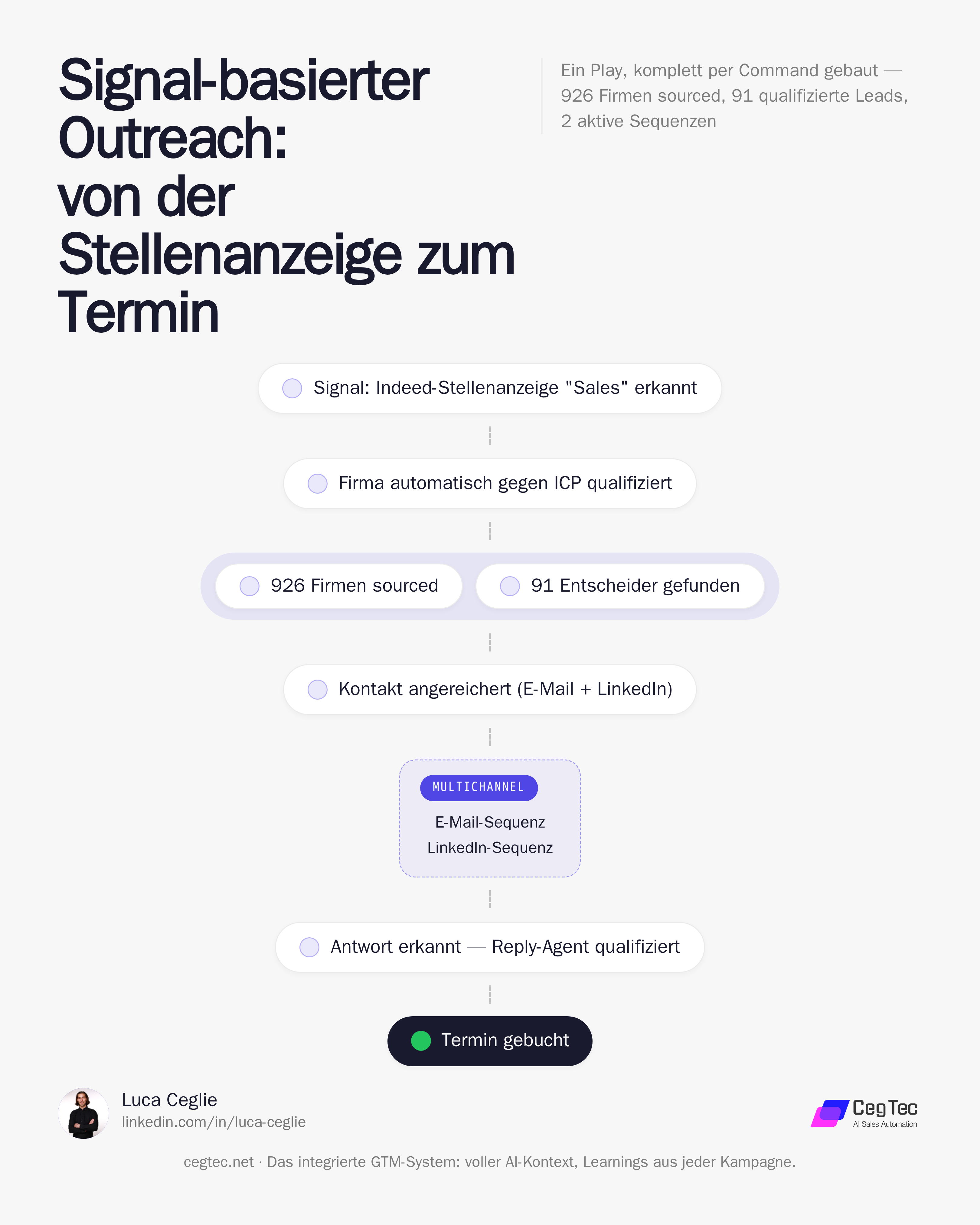
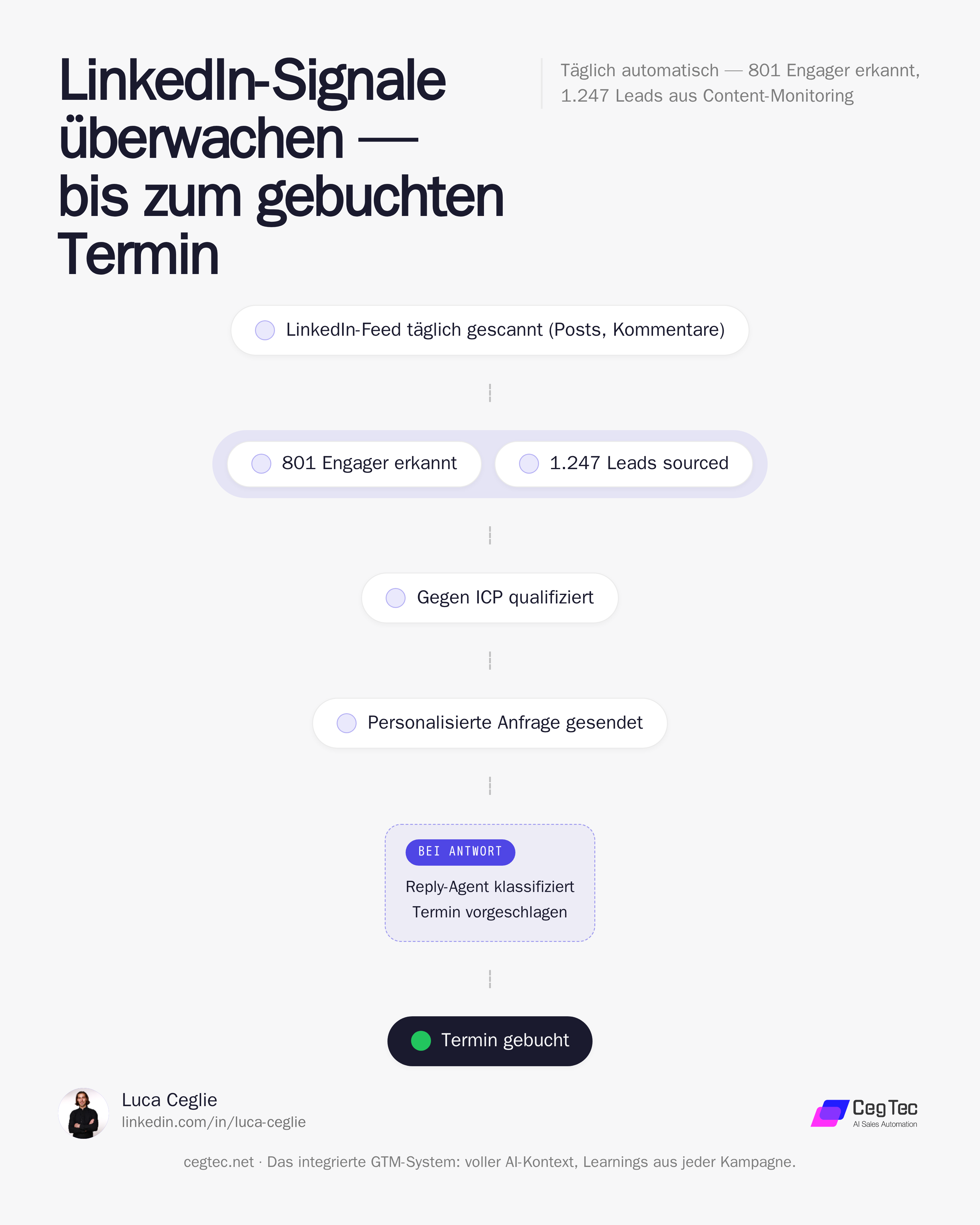
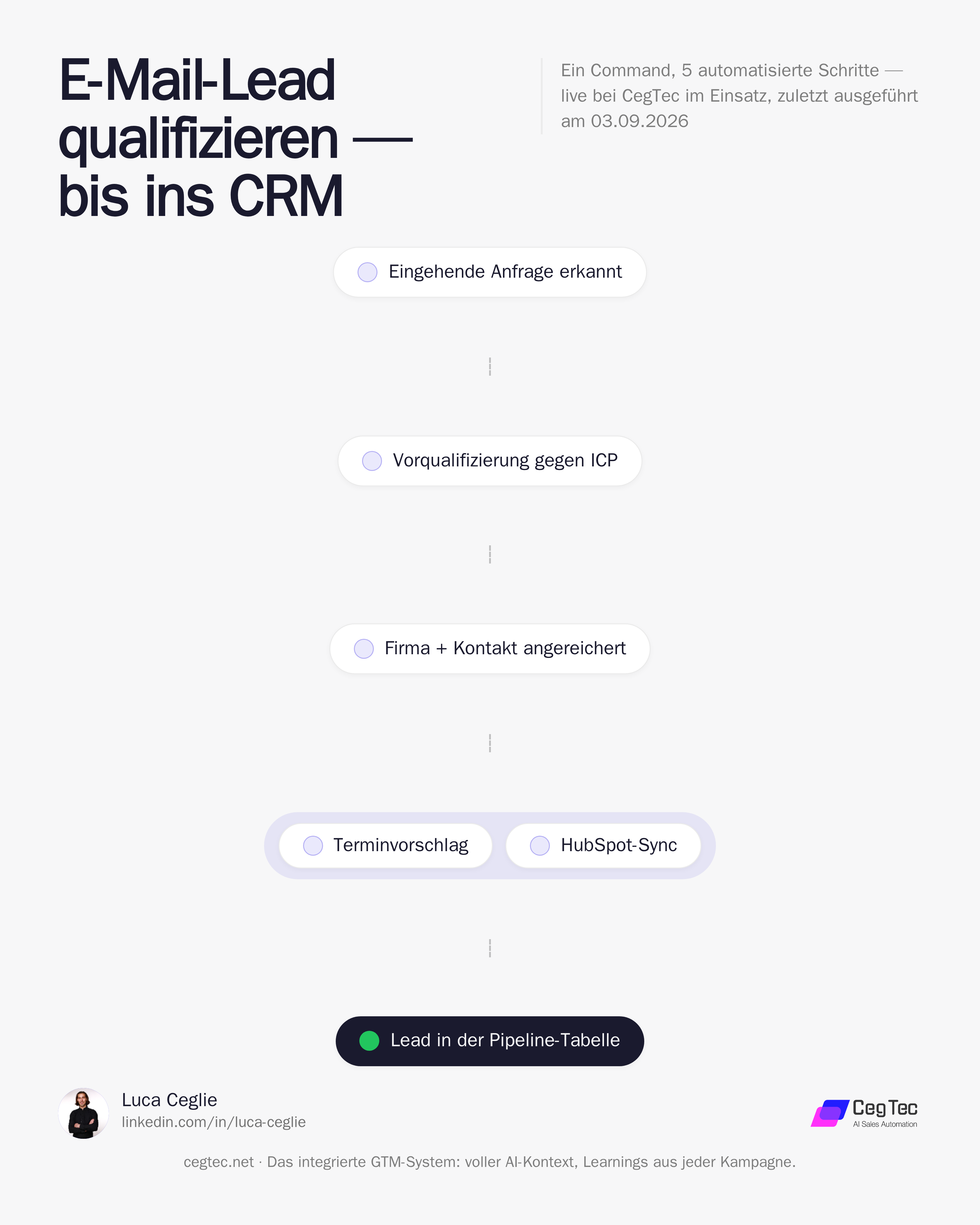
One operating system — its own memory per market.
You do not run six systems for the six industries of your customers. You run one that carries its own market knowledge for each market. Exactly what today sits in the heads of your best people becomes something that stays in the operation: in the agents, not in notes.
The effect for you: the second client in a market starts on what the first one learned. Your experience becomes sellable instead of hanging on individuals.
Markets where real results exist
- 112 leads in 3 h
- 17% response
- 7 meetings
- 22x ROI
- 2,777 contacts
- 9.9% reply
- 41 SQLs
- 2,728 contacts
- 6.3% reply
- 1.0% unsubscribe
In other markets — defence or finance, for instance — the market knowledge is something that first has to be built, not a result we claim. We tell you beforehand whether evidence exists for your client or whether we build it together.
One operating system. Five layers. GDPR-first.
Not a tool, not a CRM, not an agency. A layered, agentic GTM operating system — the way winning teams now run go-to-market. Every layer swappable, every outcome feeding back.
GDPR & Governance EU hosting · human-in-the-loop sign-off · full auditability. Wraps every layer — not a footnote. Run the whole system from one surface: Command Center, chat, API, or the MCP client you already use, Claude Code, Codex, Cursor, OpenClaw or any other.
Swappable large language models under the hood, chosen per task rather than fixed across the board.
Agents, workflows and sequences do the execution: demand detection, enrichment, multi-channel outreach, reply handling, meeting booking. A human approves what goes out.
The versioned ontology of your market: leads, accounts, signals, ICP, personas, playbooks. Every reply and every meeting feeds back what works for whom.
28+ sources into one relational data model: CRM, mailboxes, LinkedIn, enrichment providers, your own MCP servers. We plug into your tools, with zero vendor lock-in.
Interactive live demo of the platform
Click through Command Center, playbooks, pipeline and more. No account needed.
The interactive demo is optimised for desktop screens.
Explore the platform live →An operating system that turns your agency into a product.
The same engine we run for our own client accounts — for any number of customers, at a price that drops with the portfolio.
One system, any number of clients
One dedicated workspace per customer: separated data, its own playbook, its own credits, its own billing — centrally managed. You create new client accounts instead of building a new stack.
Four stack building blocks fewer per customer
The enrichment workbench, the sequencer, LinkedIn automation and the agent/LLM work are included instead of being rented separately per client. The email infrastructure stays separate — GTM Goat does not provide domains and mailboxes.
Margin instead of man-hours
Agents take on research, personalisation and reply classification. One operator runs many client accounts — your people become architects of the playbooks instead of operators of tools.
The client knowledge becomes your asset
ICP, personas, signals, angles and benchmarks live in the system, not in someone’s head. A strategist who leaves takes no playbook with them — and a new client in the same market starts on what has already been learned.
Multichannel without spam risk
Email, LinkedIn and WhatsApp with domain and inbox management per client. No deliverability wildfire where one customer costs you the next.
No vendor lock-in
Interchangeable models under the hood, 28+ open integrations. You connect your customers’ tools instead of migrating them.
Up to 40% discount from the tenth workspace.
One workspace per client: its own data, its own playbook, its own credits, its own billing. You are billed on usage per workspace, not per seat — and from the tenth active workspace onwards the monthly fee drops across your entire portfolio.
| Active workspaces | Discount | Growth per workspace | Starter per workspace |
|---|---|---|---|
| 1–9 | — | €499 | €149 |
| 10–25 | 20 % | €399 | €119 |
| 26–49 | 30 % | €349 | €104 |
| 50+ | 40 % | €299 | €89 |
What that means in practice
Calculated with Growth workspaces at €499 list.
| Portfolio | List | With tier | Saving / month | Saving / year |
|---|---|---|---|---|
| 10 clients | €4,990 | €3,990 | €1,000 | €12,000 |
| 25 clients | €12,475 | €9,975 | €2,500 | €30,000 |
| 50 clients | €24,950 | €14,950 | €10,000 | €120,000 |
Three things to be clear on before you do the maths
Active means: a plan is assigned
A workspace in a running trial does not count towards the tier and costs nothing. The trial comes once per account on self-registration, with 2,000 credits, one seat and API/MCP access.
Not combinable with the term discount
The volume tier and the term discount are mutually exclusive; the higher of the two applies. The tier works on the monthly fee per workspace, not on credit packages.
No shared credit pool
Every client carries their own volume. That is deliberate — it keeps every rebill cleanly attributable.
The tier calculates on the base plans — Starter €149 and Growth €499 per workspace and month. Both are on the pricing page with their full scope. The platform always carries CegTec branding; operating it under someone else's brand is not part of the offer.
4 weeks free for your first workspace
Create a workspace, build the playbook, run the first campaign, four weeks without an invoice and without a credit card, with 2,000 credits, one seat and access to the platform API and the MCP server. The trial runs once per account, so you test the system on a real mandate before committing. Every further client workspace starts on a paid plan, the volume tier applies from ten active workspaces, and because you can bill monthly your risk per mandate stays limited to one month.
Four stack building blocks fewer per client
The enrichment workbench, the sequencer, LinkedIn automation and the agent and LLM work are included instead of being rented separately per client. The email infrastructure stays outside: we do not provide domains and mailboxes, we connect your client’s sending accounts. Those costs stay with your client.
Three steps to your own GTM machine.
Set up the agency account
Set up the account, operator access and billing once. From then on you create client accounts instead of systems.
Create client accounts
One workspace per customer: ICP, personas, signals and playbook defined — and the customer’s tools connected, not replaced.
Scale without hiring
New client accounts run on the same engine and on what it has already learned. From ten active workspaces your price per client account drops at the same time.
Built for agencies that sell results.
If you run pipeline as a service for your customers, this is your foundation.
- Lead-gen & appointment-setting agencies
- Sales-as-a-service / outbound agencies
- Growth & demand-generation agencies
- Recruiting & staffing agencies with outreach
- Resellers & system integrators with their own GTM service
When it does not work for a client
The system amplifies a message that works, it does not invent one. If a client has no product-market fit or sells "to everyone", outbound will not deliver with us either — with nobody. We tell you that in the discovery call, before you set the client account up: better one client fewer than a burnt result you have to answer for.
You do not run GTM for customers, but for yourself?
Make GTM the scalable product of your agency.
Three ways in — you decide how deep you go.