
You run it.
The system learns along.
The self-learning GTM operating system in your hands: your tools connected, a workable playbook from day 1, plays from the signal through to the booked conversation. No agency retainer, no new head in the team. GDPR-first, hosted in the EU.
 GDPR- and UWG-compliant · EU hosting
  Built in Germany
 Your sales team is at capacity. The calendar is not.
Four conditions that almost always occur together in the DACH mid-market — and none of them can be solved with one more tool.
Pipeline hangs on two or three people
Who gets contacted next is decided by the manual research of your best people. If they are on holiday, in a client meeting or have resigned, the pipeline stops.
What worked last quarter is written down nowhere
The angle that brought the replies lives in one mailbox and in one head. Next time round you start from gut feeling again.
Every new tool is a new silo
CRM, sequencer, enrichment, LinkedIn, analytics — each knows a piece and none knows the whole. Reconciliation happens by export, copy-paste and memory.
The team is busy, the calendar is empty
Lists get built, messages get written, fields get maintained — and at the end of the week there are two conversations in the diary. Activity is there, the outcome is not.
A tool owns one step. Here the whole stretch belongs together.
An AI SDR writes messages. An outbound tool sends sequences. A Clay workflow enriches rows. Each of them ends where its step ends. What you run here holds the stretch from the signal to the booked conversation in one hand — and gets better with every result. You are the architect, not the operator.
The data layer understands who buys from you
CRM, website analytics, LinkedIn, mailboxes and market signals hang off one model of your ideal customer — instead of sitting in five tools. You see which accounts are relevant now, before anyone starts researching.
Agents and workflows turn that into execution
A signal becomes research, qualification, outreach and follow-up — as a play that runs when you are not watching. You sign off on what goes out; the execution sits with the system.
The loop writes the experience back
Every reply, every rejection, every meeting re-scores the ICP, the personas and the angles. What worked is afterwards in the system — not in one person’s head.
One operating system. Seven layers. GDPR-first.
Not a tool, not a CRM, not an agency. A layered, agentic GTM operating system — the way winning teams now run go-to-market. Every layer swappable, every outcome feeding back.
GDPR & Governance EU hosting · human-in-the-loop sign-off · full auditability. Wraps every layer — not a footnote. Operate the whole system from one surface — Command Center, chat or API. No new tool to adopt.
Demand detection, enrichment, multi-channel outreach, reply handling, meeting booking.
The versioned ontology of your market — ICP, personas, playbooks, angles — that updates itself: every reply, meeting and close feeds back what works for whom.
28+ sources into one relational data model. We plug into your tools — zero vendor lock-in.
Agents source, research, write and classify replies. A human approves what goes out.
Swappable large language models under the hood — never locked to one vendor.
What you do yourself — and what the system takes on.
Self service does not mean "an empty tool, good luck". You connect, sharpen, sign off and read the loop. Research, personalisation and follow-up run underneath.
Connect your tools
Connect CRM, mailboxes, LinkedIn, analytics and automation. Your stack stays as it is — it only gets a shared layer on top.
Adopt the playbook
ICP, personas, buying signals and messaging angles come as a workable playbook, built on what demonstrably converts in DACH B2B. You sharpen instead of starting from zero.
Arm the plays
You decide which triggers are worth an outreach and sign off on the sequences. From then on the play runs — you review replies, not lists.
Read the loop
You see per play which trigger and which angle bring conversations — and turn one dial that the system then applies everywhere.
Six plays that can run from day 1.
Every play has a trigger, a flow and an outcome. You decide which triggers count for you — and sign off on what goes out.
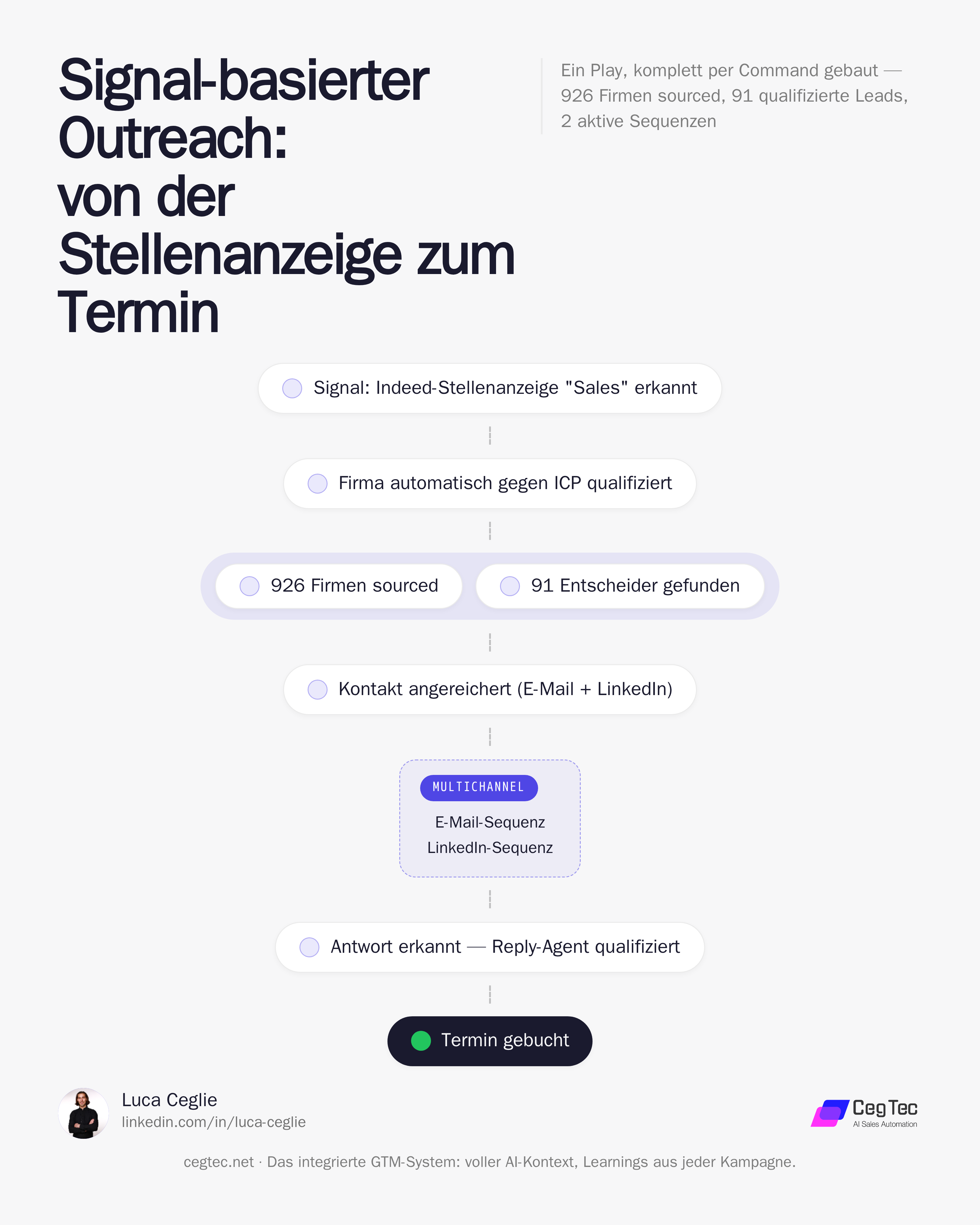
Signal → account → research → outreach
An observed trigger — a job posting, a technology change, a tender — is matched to the account, enriched, checked against your ICP and approached with reference to exactly that signal.
Outcome: a first contact with a reason, instead of cold outreach into the void.
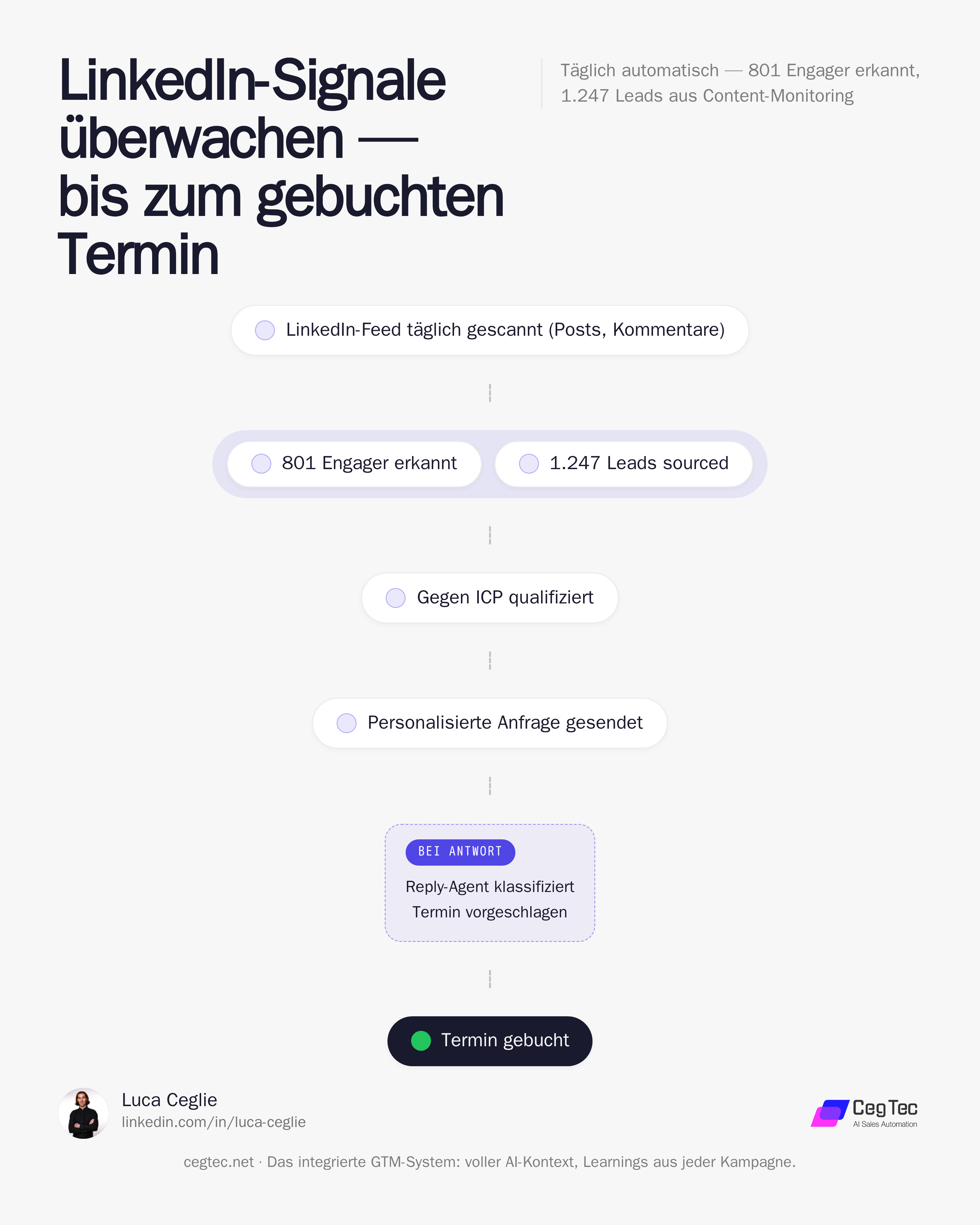
LinkedIn engagement → automated outreach
Whoever comments on or likes your posts is resolved, checked against your ICP and moved into a matching sequence. Replies are classified and prepared, you sign off.
Outcome: reach turns into conversations, instead of a list of likes.
Website signal → qualified → contacted
The signal comes from your connected analytics tool — what is captured there is qualified against your ICP, enriched and prioritised here. The system does not identify anonymous visitors itself; it turns an existing signal into a clean next step.
Outcome: interest that would otherwise fizzle out in a dashboard gets addressed.
Closed-lost → reactivation
Lost opportunities are checked for change — a new contact person, a new budget, a new priority — and approached again with knowledge of the old history.
Outcome: your CRM archive becomes a source instead of data waste.
CRM → find new opportunities
Existing accounts are mirrored against your learned ICP: comparable companies, missing decision-makers in the buying committee, upsell and cross-sell occasions among existing customers.
Outcome: new opportunities from data you have had all along.
Meeting → follow-up → CRM → next step
After the conversation, a follow-up draft, a CRM update and the next step are created — including a reminder if nothing comes back.
Outcome: no deal fizzles out because the follow-up got lost.
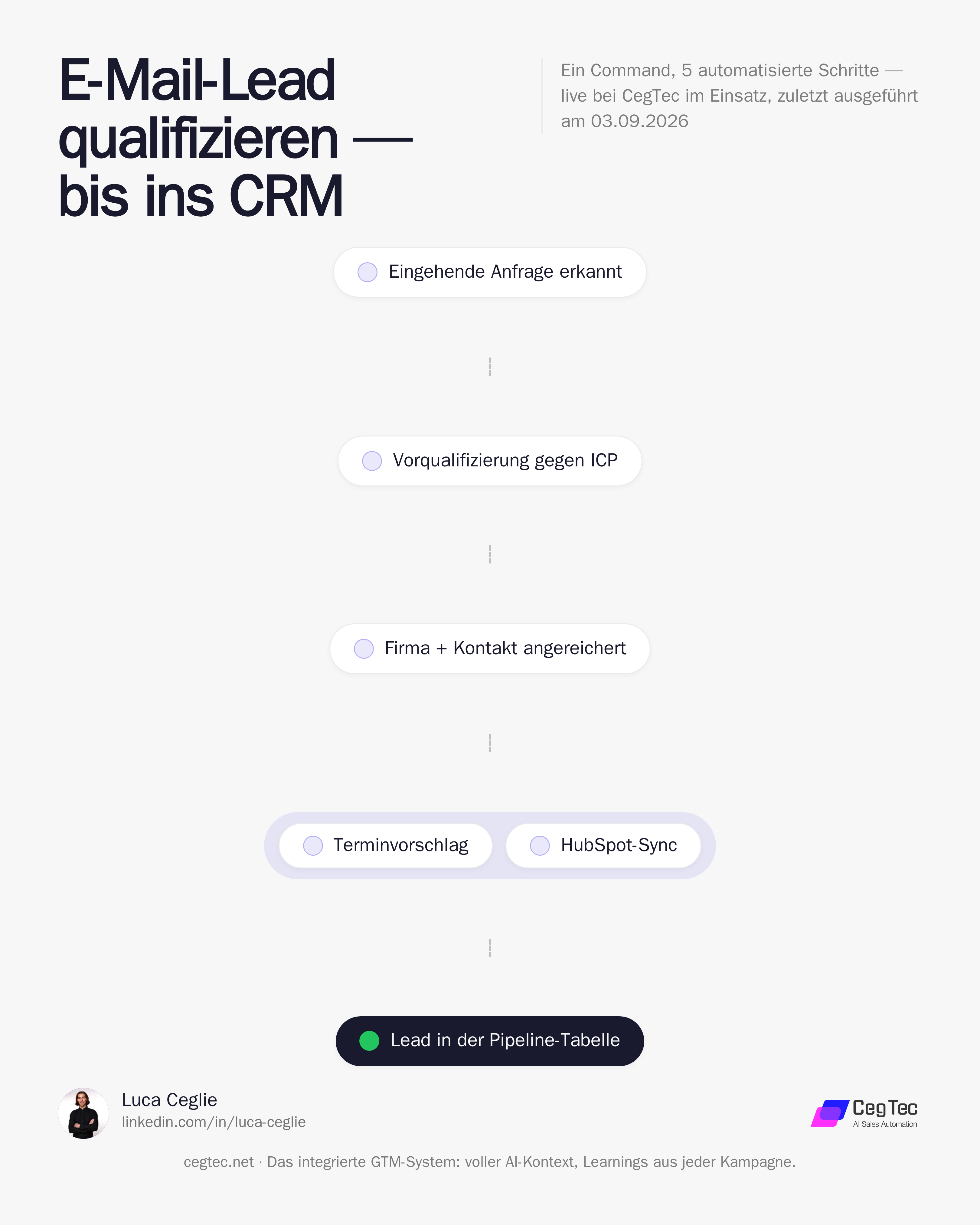
Three plays, step by step.
The same flows that are configured in the system — from the trigger at the top through to the meeting and the write-back into the CRM.
See for yourself what you have in front of you every day.
Command Center, playbooks, replies, pipeline: the interface in which you sign off and read the loop. No account, no sign-up.
Interactive live demo of the platform
Click through Command Center, playbooks, pipeline and more. No account needed.
The interactive demo is optimised for desktop screens.
Explore the platform live →Operable in natural language. No tool training.
You do not have to train anyone on an interface. You ask, you sign off, and you get the status where your team already works.
AI assistant in the Command Center
"Show me all open replies from the solar play" — asked, not clicked.
Slack, Teams or email
The daily status comes to you, with the most urgent replies in the thread.
Claude Code and MCP
The platform is MCP-native and can therefore be operated from your AI tools.
Command Center in the browser
Everything consequential — launching a campaign, sending a reply — runs through your sign-off.
You start on experience that has already been paid for.
6+ years of DACH outbound and 50+ B2B clients sit inside the playbooks you begin with. Evidenced results from real campaigns:
- Solar · Jomavis 112 leads in 3 h · 17% response · 7 meetings · 22x ROI
- B2B SaaS · ProSeller 2,777 contacts · 28.7% reply · 41 SQLs
- Premium brands · Jochen Schweizer mydays 2,728 contacts · 6.3% reply · 1.0% unsubscribe
Results depend on the vertical and the offering. These numbers document what was achieved in those markets — not what your case will deliver.
We say upfront when it does not work.
Self service rewards companies that know who buys from them — and punishes those still trying to find out.
Fits
- A validated offering with paying customers
- A clear vertical and a sharply describable ICP
- Someone in-house who wants to own the system — management, head of sales or head of growth
- DACH market, GDPR and UWG compliance as a given
Does not fit (yet)
- No product-market fit — outreach amplifies a message that works, it does not invent one
- An unclear vertical or "we sell to everyone"
- Nobody to take on the sign-offs and the loop — then done-for-you is the more honest route
From €149 per month and workspace.
You are billed for usage per workspace, not per seat: Starter €149 with 5,000 credits, Growth €499 with 25,000 credits. Any number of team members at no extra charge, and every new workspace starts with 4 weeks free — no credit card.
You would rather not run it yourself?
Take the wheel.
Three ways in — depending on how far along you are.