



Free strategy consultation?
Book an intro call →

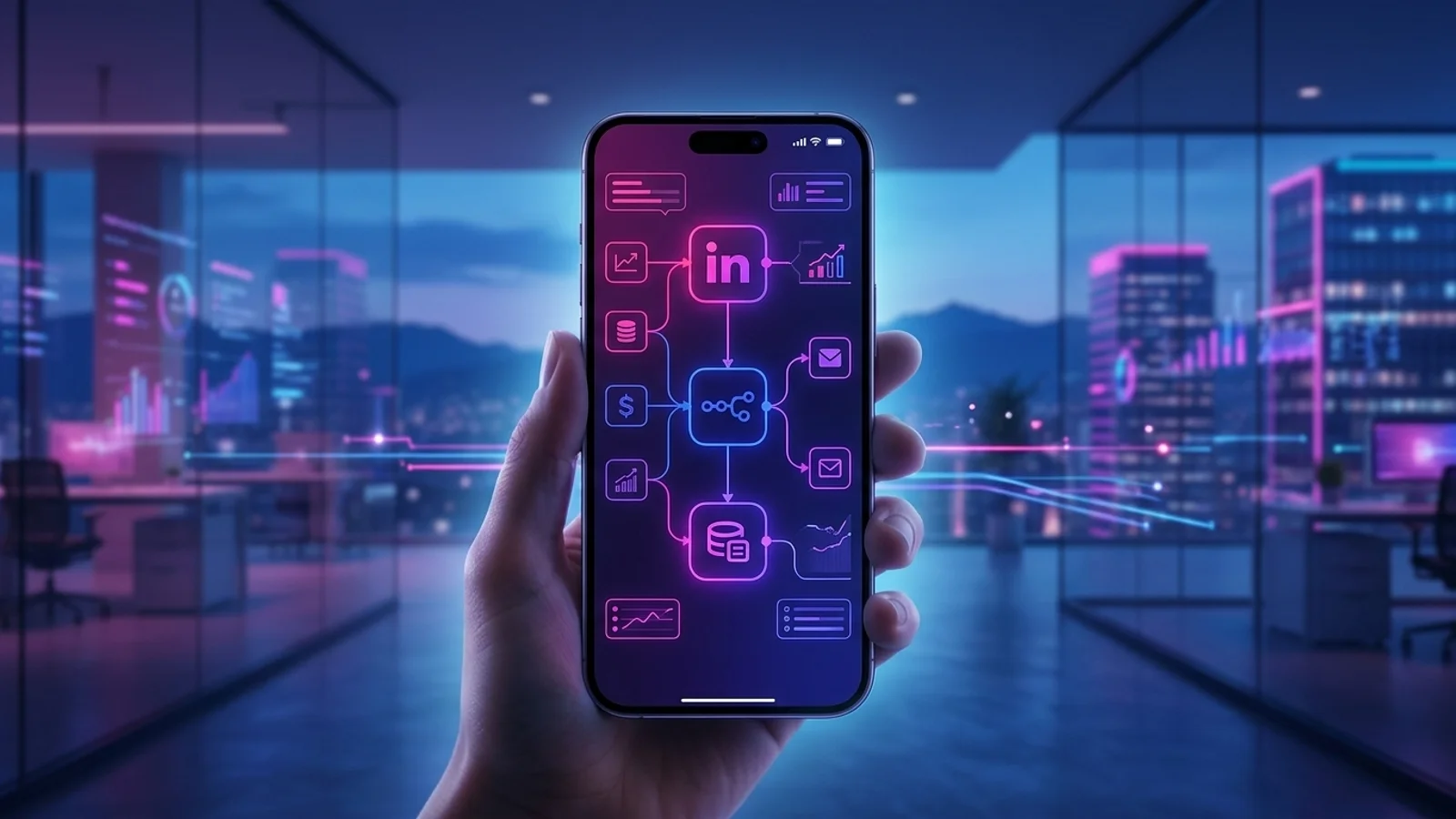
In short: LinkedIn outreach automation refers to using software and processes to deploy connection requests, profile visits, direct messages, and email follow-ups on LinkedIn in a semi- or fully automated way — controlled by sequences, triggers, and audience filters. The goal: systematically generating qualified B2B meetings. With 22 million LinkedIn users in Germany alone, the platform is the most relevant cold outreach channel in the DACH region — and at the same time the most regulatorily sensitive.
A pure tool list doesn't answer the decisive question: how does a DACH B2B team properly assemble data sources, legal bases, sequence logic, and KPIs? Tools show features. They don't show where the data comes from, which GDPR basis applies, or when a sequence counts as successful. That's exactly where most teams fail — not because of the tool, but because of the missing workflow.
Ilya Azovtsev, Growth Advisor at Expandi (an AI-driven LinkedIn automation tool), puts it succinctly:
"Understanding of your audience is the key to success! ... Building your real list and building the right list of contacts that you want to reach out to is like almost 80% of your success." Ilya Azovtsev, Growth Advisor at Expandi
In other words: according to this view, the tool handles the smaller part of the work — around 20%. The workflow — ICP definition, a cleaned data base, a clear legal basis, a measurable meeting rate — does the rest.
The difference is fundamental: a tool automates clicks. A workflow governs which data comes from where, which legal basis applies, when which message goes out, and what counts as success.
Typical gaps in tool-centric approaches in the DACH region:
This article delivers a workflow approach: from ICP definition through a GDPR-compliant data base to a measurable meeting rate. Not a tool comparison, but a blueprint for B2B teams who want to sustainably integrate LinkedIn automation into their sales pipeline.
LinkedIn automation is in Germany neither generally forbidden nor freely usable. The legal framework derives from two sources: the Act Against Unfair Competition (UWG) and the GDPR. Whoever knows and documents both can run automated outreach in a legally sound way.
A LinkedIn direct message is not, legally speaking, an informal message between friends. German courts and data protection authorities classify social media direct messages as electronic mail within the meaning of § 7 (2) no. 3 UWG — on par with email. That means: promotional messages without express or implied consent are generally impermissible.
The difference from phone-based acquisition is relevant. For business contacts, telephone marketing in the B2B space is already considered legally viable with presumed consent — provided a factual interest is plausible. LinkedIn DMs sit closer to email than to the phone here. A double opt-in is not a mandatory format for LinkedIn outreach, but the complete absence of documented consent or a solid balancing-of-interests assessment makes any automated message with promotional content vulnerable to challenge.
No reason to panic — but a clear mandate: whoever automates outreach sequences needs a legally solid basis before the first message goes out.
Legitimate interest is the legal basis DACH B2B teams rely on most often. It's not a free pass — the European Data Protection Board (EDPB) requires three cumulative conditions that must all be met simultaneously:
In practice, the third point is the most critical. Direct marketing to a person with no recognizable professional connection to the offer fails this balancing test. A cleanly documented balancing-of-interests record — capturing ICP criteria, data basis, and proportionality — is therefore not a bureaucratic luxury, but the safeguard for the entire workflow.
The following comparison gives a clear overview of the three channel types in DACH B2B:
| Channel | Legal classification | Consent requirement |
|---|---|---|
| LinkedIn DM | Electronic mail (UWG § 7(2) no. 3), subject to GDPR | Express consent or a documented balancing-of-interests assessment under GDPR Art. 6(1)(f) |
| Cold email | Electronic mail (UWG § 7(2) no. 3), subject to GDPR | On par with LinkedIn DM; impermissible without consent or a balancing-of-interests assessment |
| B2B telephone acquisition | UWG § 7(2) no. 2, but a lower threshold in B2B | Presumed consent is sufficient if a factual interest in the offer is plausible |
Whoever budgets B2B lead generation needs solid numbers, not gut feeling. Cost per lead (CPL) — the average cost per qualified contact — varies considerably by channel in DACH B2B and determines which approach fits your pipeline strategy.
According to the CPL benchmarks for B2B lead generation in the DACH region 2026, self-service LinkedIn automation positions itself at €80–200 per lead, sitting directly between inbound marketing and agency models — while offering high scalability and a short time-to-pipeline.
| Channel | CPL range (DACH B2B) | Scalability | Legal effort |
|---|---|---|---|
| Inbound marketing | < €100 | High — after ramp-up | Low (consent via form) |
| LinkedIn automation self-service | €80–200 | High — instantly scalable | Medium (balancing-of-interests assessment, GDPR documentation) |
| LinkedIn outreach via agency | €200–500 | Medium — ICP cleanup included | Low (agency handles documentation) |
| Telephone acquisition | €150–500 | Limited — labor-intensive | Low (presumed consent possible in B2B) |
| Trade show leads | €1,000–2,000 | Very limited — seasonal | Medium (document on-site consent) |
LinkedIn automation pays off when a qualified ICP exists and fast pipeline visibility is needed. Inbound marketing does arithmetically deliver the cheapest CPL, but requires significant content investment and a long ramp-up of typically six to twelve months — both factors that don't apply to automated B2B lead generation.
The decisive legal difference lies in the consent requirement. Phone allows presumed consent in B2B as soon as a factual interest is plausible. LinkedIn direct messages, by contrast, count as electronic mail and are subject to the same promotional restrictions as email — which noticeably increases the documentation burden.
Maryna Nikitchuk (Head of Sales at Expandi, an AI-driven LinkedIn automation tool) describes the channel's strategic significance from practice:
"Outbound is a significantly important part of this pipeline generation effort for any sales development team. LinkedIn, once I've joined the SaaS company, became 30% of a pipeline achieved by the cross-functional teams." Maryna Nikitchuk, Head of Sales at Expandi
The agency model at €200–500 CPL justifies itself through included ICP cleanup, sequence design, and GDPR documentation. For teams without dedicated sales-ops know-how, this premium is often cheaper than the internal effort needed to reach the same quality level.
Automation tools like Expandi (an AI-driven LinkedIn outreach tool) or Linked Helper (a browser-based LinkedIn automation tool) operate across three clearly distinguishable risk dimensions simultaneously: violating LinkedIn's terms of service, GDPR-non-compliant data collection, and UWG-compliant message design. Whoever only watches one of these dimensions isn't safe — all three must be covered in parallel.
The LinkedIn User Agreement explicitly prohibits the use of scripts, bots, crawlers, and browser plugins to scrape profile data. Violations can lead to an immediate account ban — even for tools marketed as "cloud-based" and thus seemingly inconspicuous.
What many underestimate: LinkedIn doesn't set fixed daily limits. Giles Garnett, Head of Professional Services at Dux-Soup (a LinkedIn automation service), explains the mechanism:
"Nobody knows [what the limits are] and it is dynamic; it is not static. Every single account has its own characteristics: number of first-degree connections, the amount you've posted, the number of interactions you've had." Giles Garnett, Head of Professional Services at Dux-Soup
The risk is thus not a fixed, calculable figure, but account-specific and dynamic. New accounts with little activity history get flagged noticeably faster than established profiles.
Garnett therefore recommends an approach that mimics natural usage behavior:
The practical consequence for DACH teams: build up daily limits gradually, schedule pauses, vary time windows — and never launch at full throttle from a fresh account.
Terms-of-service compliance only protects the account, not the company. Whoever collects, stores, or transfers LinkedIn profile data into CRM systems is processing personal data within the meaning of the GDPR — regardless of whether the tool itself is certified as GDPR-compliant.
The critical risk points at a glance:
A tool assumes no legal responsibility — that lies exclusively with the company processing the data. Whoever uses LinkedIn outreach automation must legally secure the entire data path from profile to CRM record before the first sequence starts.
"I recommend Phantom Buster or Expandi to automate the outreach. LinkedIn is going to cap you at the number of messages you can send per day, so it's better to get this set up sooner rather than later." Colleen Schnettler, Founder @ SaaS Marketing GymImportant: regardless of the tool chosen, responsibility for data provenance rests with the processing company — not the tool vendor.
Every DACH outreach process is subject to six documentation duties: legal basis per processing step, data source per contact, the balancing-of-interests record, an opt-out register, retention periods with a deletion routine, and privacy information at first contact. This list isn't a recommendation — it's the minimum requirement for your workflow to withstand a regulatory review.
The opt-out register isn't a CRM feature you set up eventually. It's a legal obligation that must be functional before the first sequence launch.
Minimal structure for teams without a dedicated privacy setup:
A team lead can use these six points directly as an audit basis: if a completed document exists for every point, the outreach workflow is secured across the essential GDPR dimensions.
LinkedIn outreach automation only works reliably when legal, process, and measurement are in the right order. These three steps make the priorities clear.
We at CegTec accompany B2B teams from workflow setup through GDPR documentation to tool-independent sequence optimization. Our automation consulting for B2B teams helps you set up your pilot workflow in a structured way and make it scalable. Talk to us — before the first tool goes live.
Promotional LinkedIn direct messages without prior express consent are generally impermissible under § 7 UWG, because they are classified as electronic mail. Legitimate interest under GDPR Art. 6(1)(f) can be relied upon under the narrow conditions set by the European Data Protection Board (EDPB) — but it doesn't protect against a parallel UWG violation. Automation doesn't change this legal position; it merely multiplies the liability risk when consent is missing.
In self-service, the CPL typically runs around €80–200; agency-led campaigns range between €200 and €500 per lead. For comparison: telephone acquisition typically costs €150–500 per lead, trade show leads reach €1,000–2,000. What actually determines the CPL is less the tool used than the quality of the Ideal Customer Profile and the sequence design.
Yes — the LinkedIn User Agreement explicitly prohibits scraping and any form of automated use. Cloud-based tools and browser extensions reduce the probability of detection but don't fully eliminate the ban risk. Volume limits, human-like activity patterns, and dedicated IP addresses are the central safeguards professional users rely on to practically minimize the risk.
Publicly viewable profile data may be transferred into the CRM under legitimate interest per GDPR Art. 6(1)(f) — provided a documented balancing-of-interests assessment exists, the intended use is reasonably expectable for data subjects, and an uncomplicated objection is possible at any time. Without these three conditions, the storage is vulnerable to challenge, even if the data was publicly accessible.
The four core KPIs are acceptance rate (connection requests), reply rate, SQL rate (Sales Qualified Leads), and CPL. A baseline phase before scaling is advisable: first run a statistically significant sequence test with a few variants before increasing volume and budget. Without this measurement foundation, you're optimizing on gut feeling instead of solid data.