
AI-agent-driven GTM: the operator model
What an AI-agent-driven GTM system delivers for a B2B team, and why the human shifts from working lists to operating a learning system.
The question is no longer whether AI helps in sales
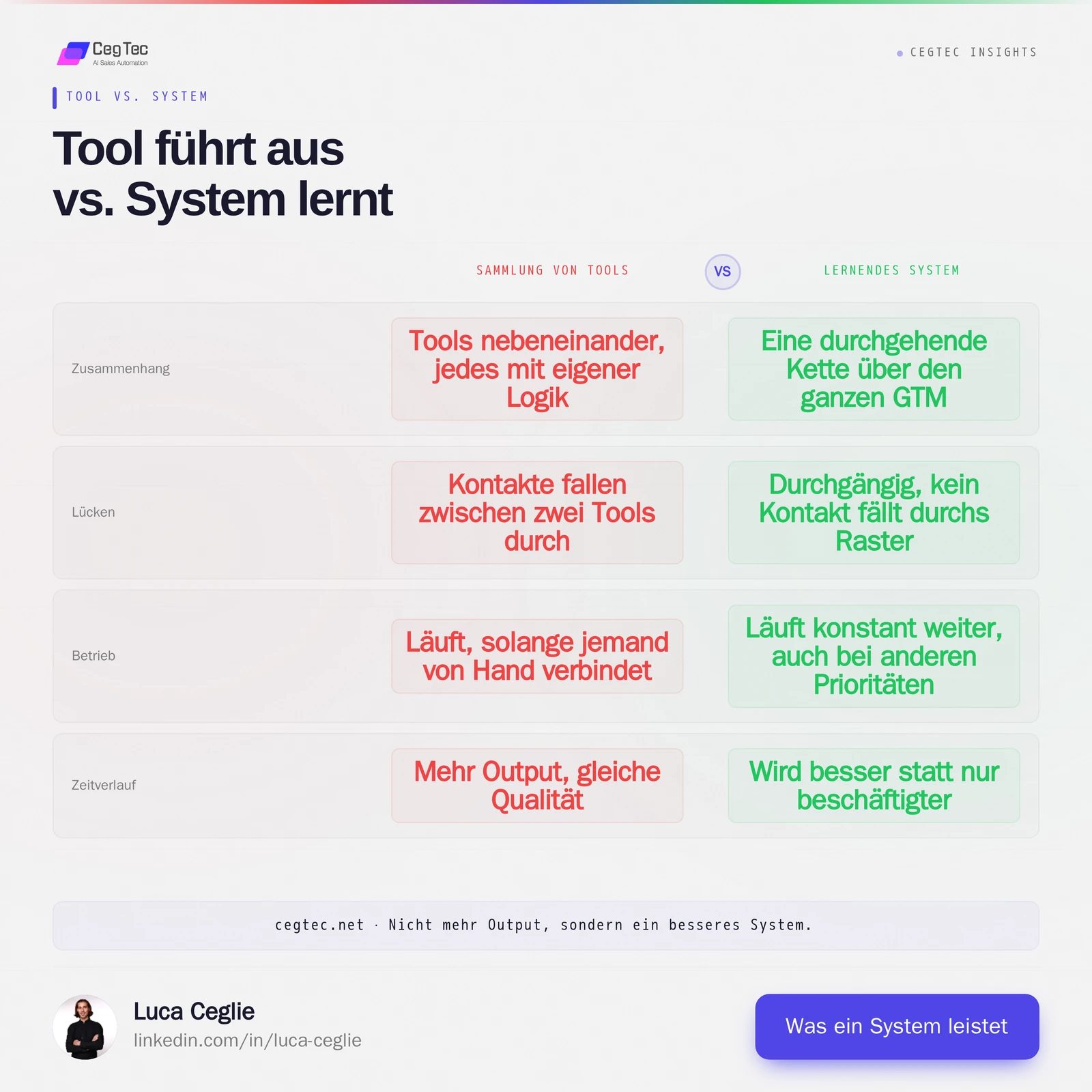
Most B2B teams now use AI tools: one writes emails, another researches companies, a third summarises replies. The result is more output but rarely a better system. The tools sit side by side, each with its own logic, and the person at the wheel spends the day connecting them by hand.
An AI-agent-driven GTM system inverts that relationship. Instead of one human operating many tools, one coherent system takes over the recurring work along the entire go-to-market, and the human steers it at the few points where judgement genuinely matters. This article describes what such a system does, how it shifts the human role, and why exactly that shift is the real progress.
What an agent-driven GTM system delivers
The difference from a collection of tools is not a single capability but the fact that the work is conceived as one continuous chain. The relevant steps in sales hang together:
- Finding target accounts: instead of a static list, the system continuously identifies companies matching the ideal customer profile and keeps the inflow alive.
- Qualifying against the profile: every company is checked against the defined criteria before anyone invests time in it. What does not fit drops out early.
- Enriching and personalising: context on company and contact is assembled, and outreach is written on that basis rather than as a form letter.
- Reaching out across channels: the message reaches the persona where they actually reply.
- Understanding replies: incoming reactions are classified by intent, tone and objection so the right response is prepared.
- Learning from outcomes: what worked and what did not flows back into the next steps.
For a B2B team this means three things. First, continuity: a contact no longer falls through the cracks because a gap opens between two tools. Second, consistency: the engine keeps running even when the team has other priorities. Third — and this is decisive — the system gets better over time rather than merely busier, because every interaction is a data point for the next one.
From working lists to operating a system
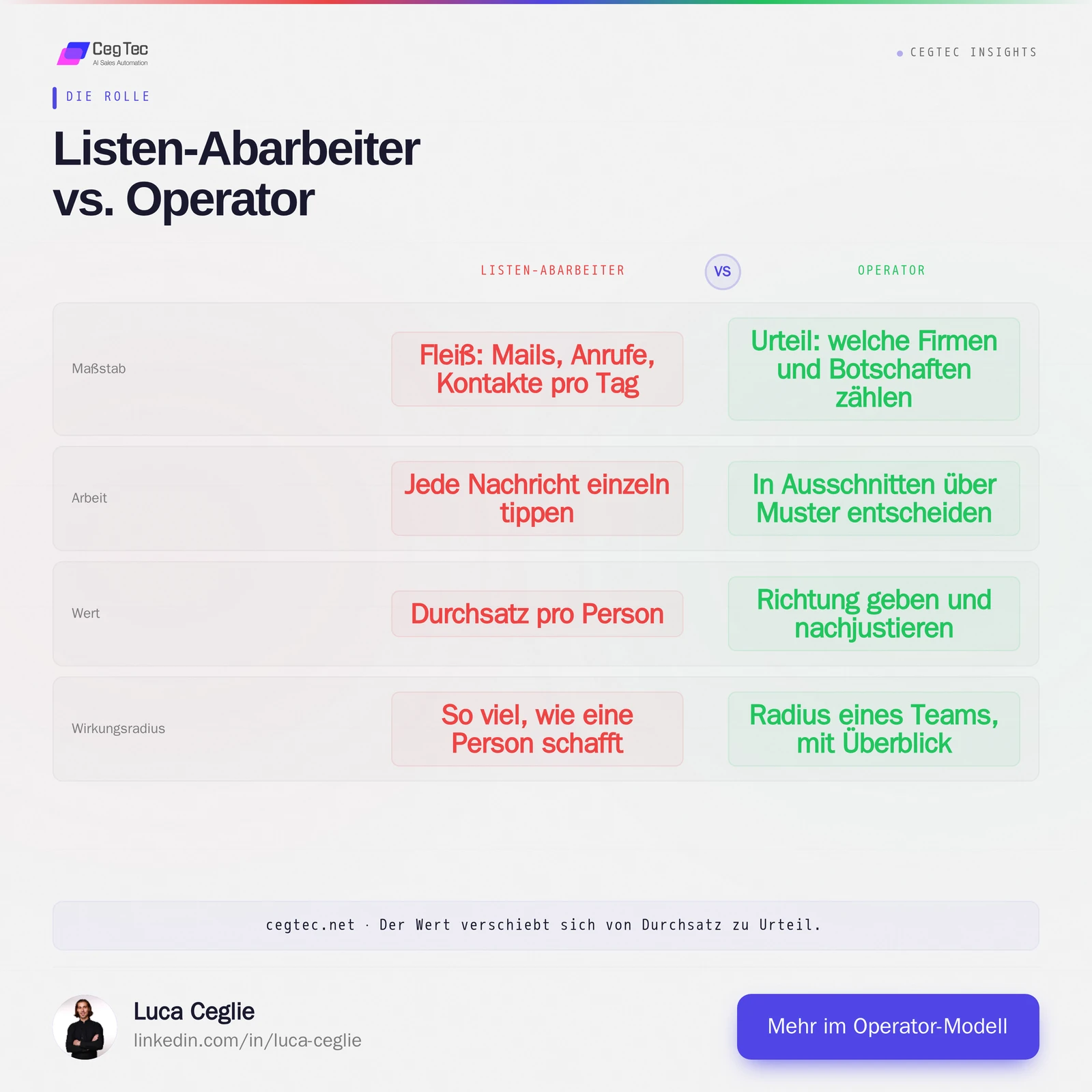
Classic sales measures diligence: how many emails, how many calls, how many contacts per day. That work is necessary, but it is repetitive — and repetition is exactly what a system can take over. As soon as it does, the human role changes fundamentally.
The human stops working lists and becomes the operator of a system. That role consists of three jobs:
- Setting direction: who do we address, with what promise, in what order? That is strategy, and strategy stays human.
- Deciding in batches: instead of typing every single message, the operator reviews bundles and makes decisions about patterns rather than individual cases.
- Course-correcting: where is it working, where is it stuck, which assumption was wrong? The operator reads the system’s signals and adjusts.
The value of a person therefore shifts from throughput to judgement. What makes someone valuable is no longer sending the most emails but deciding best which companies count, which message carries, and when a strategy needs changing. That is a more demanding role, not a loss of significance. A single operator can cover a reach that used to require a whole team — while keeping the overview a team often loses.
Why human-in-the-loop is mandatory
It would be technically tempting to leave such a system entirely to itself. We deliberately do not, and that is not a transitional arrangement but a principle. Human-in-the-loop means a person approves at the consequential points before anything goes out.
There are three reasons:
- Reputation: every message that reaches a customer speaks on behalf of your company. A single misjudged tone can cost what a hundred good messages built. That responsibility is not delegated to an automation.
- Context only humans have: a system knows the data but not the tacit knowledge of why a particular prospect is sensitive right now, or why a phrasing lands differently in one industry. The approval point is where that knowledge enters.
- Learning from correction: the real gain appears when the human does not merely approve but corrects. Every correction is a signal the system learns from. Human-in-the-loop is therefore not the brake on the system but its teacher.
Set sensibly, these control points are few and precise: where a decision reaches the outside world or changes strategy. Everything in between runs without anyone sitting next to it. That keeps approval a lever for quality rather than a bottleneck that stalls the whole operation.
Two example prompts show what these human control points look like in practice. Both are deliberately generic and illustrative: they describe the decision, not the mechanics behind it. Copy them and fill in your context.
The first sits at the approval point and checks a draft before it goes out.
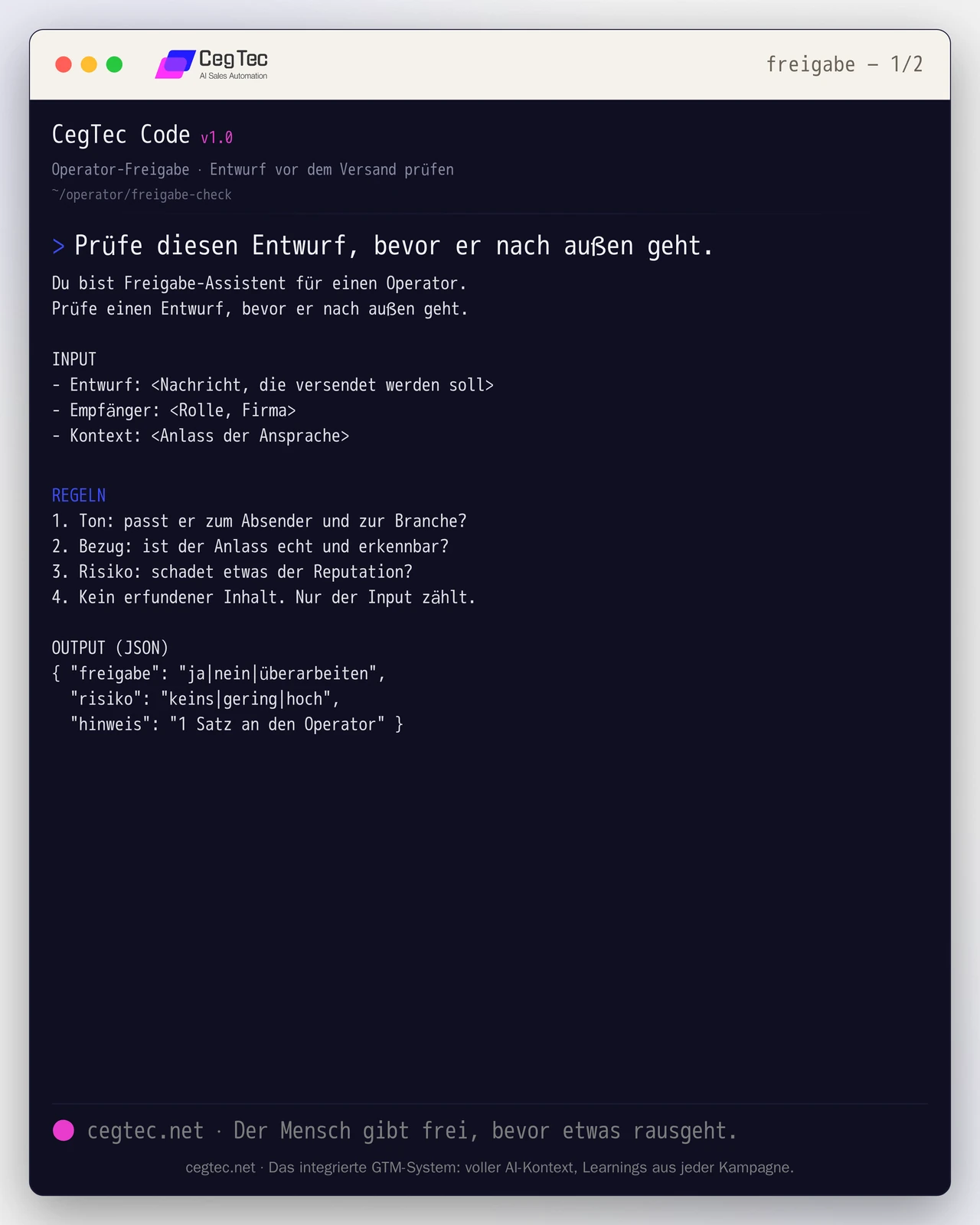
You are an approval assistant for an operator.
Check a draft before it goes out.

INPUT
- Draft: <message to be sent>
- Recipient: <role, company>
- Context: <reason for the outreach>

RULES
1. Tone: does it fit the sender and the industry?
2. Reference: is the trigger real and recognisable?
3. Risk: does anything damage reputation?
4. No invented content. Only the input counts.

OUTPUT (JSON)
{ "approval": "yes|no|revise",
  "risk": "none|low|high",
"note": "1 sentence to the operator" }The second sits one level up: it helps the operator adjust course from the system’s signals instead of processing individual cases.
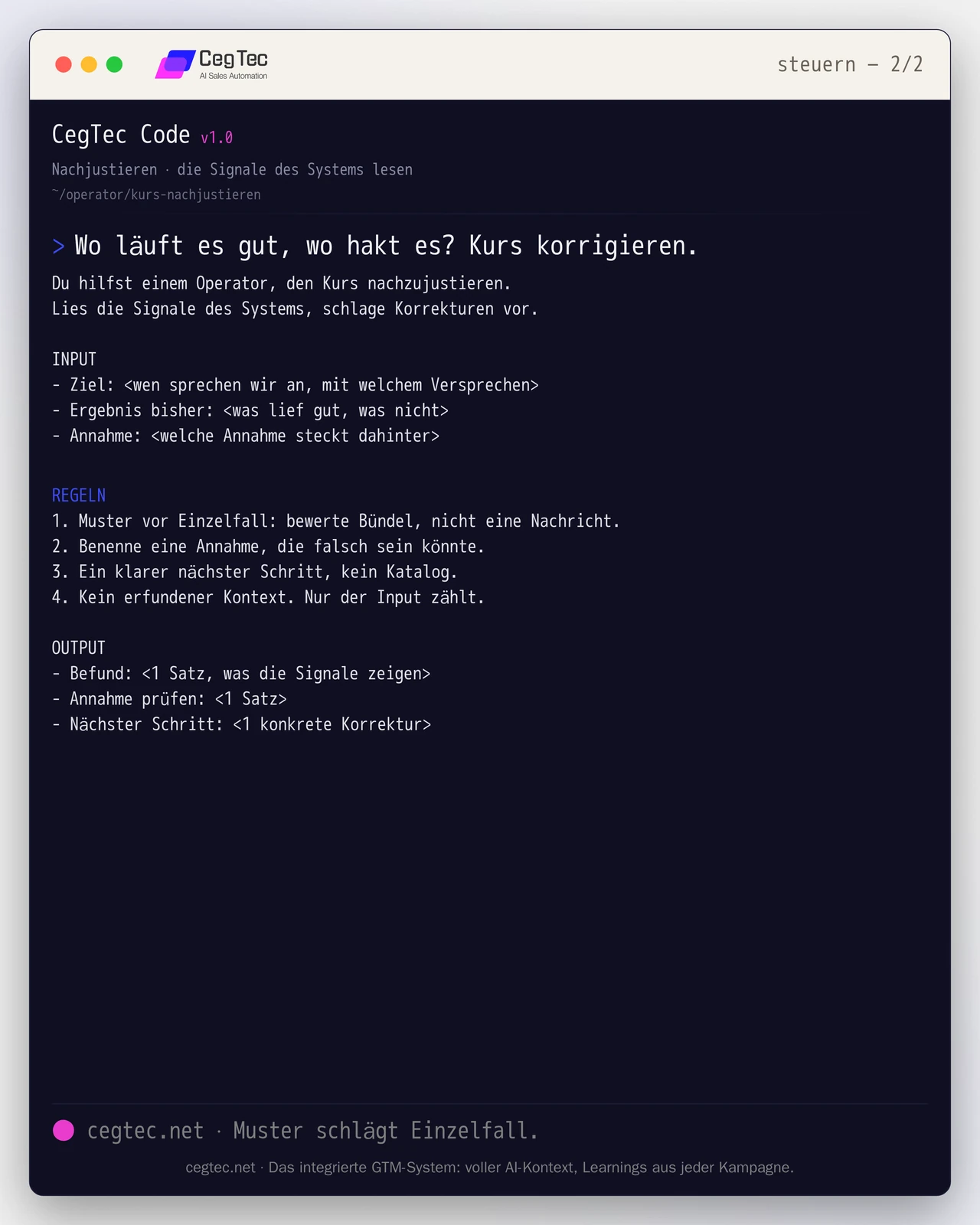
You help an operator adjust course.
Read the system's signals, propose corrections.

INPUT
- Goal: <who we address, with what promise>
- Results so far: <what worked, what did not>
- Assumption: <which assumption sits behind it>

RULES
1. Pattern before individual case: assess bundles, not one message.
2. Name an assumption that could be wrong.
3. One clear next step, not a catalogue.
4. No invented context. Only the input counts.

OUTPUT
- Finding: <1 sentence on what the signals show>
- Assumption to test: <1 sentence>
- Next step: <1 concrete correction>What this concretely changes for a B2B team
Three shifts sum up the benefit:
- From capacity to focus: the question is no longer how many contacts the team can handle but how good the decisions are that steer the engine.
- From repeatability of the person to repeatability of the system: what works is no longer trapped in one employee’s head but stored in the system — and therefore handover-ready.
- From gut feel to traceability: why a company was approached and what followed can be reconstructed, not just remembered.
How to generate pipeline with this (in the GTM stack)
So far this has been about the model. Concretely, pipeline emerges when the connected roles of a GTM stack mesh. These roles can be described neutrally, regardless of which tools you use:
- Signals and data: the stack detects which companies are becoming relevant and keeps the inflow of context alive.
- Enrichment: the necessary background is assembled for every company and contact so outreach rests on substance.
- Orchestration and decision: the steps are put in a sensible order, and at the consequential points the operator approves instead of handling every case personally.
- Outreach channels: the message reaches the persona where they actually reply.
- CRM: what happens lands traceably in one place instead of fragmenting into scattered notes.
- Learning loop: results and corrections flow back so the next steps get better.
These roles need something to connect them. A category-agnostic orchestration layer such as GTM Goat can take that role and address the remaining building blocks by category rather than being tied to one vendor. Human-in-the-loop then sits exactly where something reaches the outside world. Which stack you choose underneath is up to you; the model stays the same.
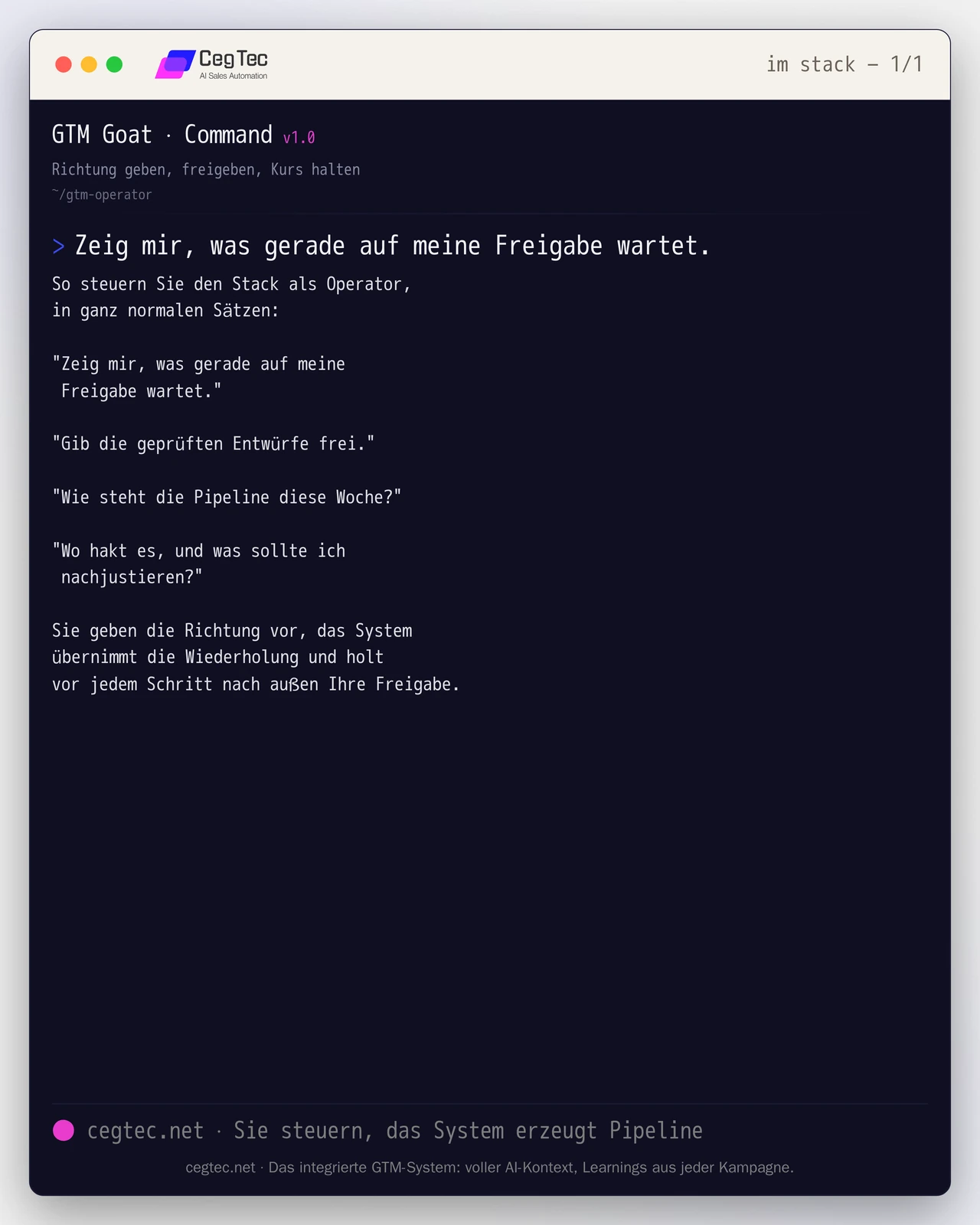
In practice you steer such a layer in ordinary sentences. The following examples are deliberately generic and illustrative: they show how an operator sets direction, approves and corrects course.
How you steer the stack as an operator,
in ordinary sentences:

"Show me what is waiting for
 my approval."

"Release the drafts I reviewed."

"How does the pipeline look this week?"

"Where is it stuck, and what should
 I adjust?"

You set the direction, the system handles
the repetition and asks for your approval
before every outward step.You will find a concrete entry point in the quickstart.
Honest limits
Such a system does not run itself. The quality of the targeting decides the quality of the result: if the ideal customer profile is vague, the system will simply approach the wrong companies faster. Human approval scales with volume — that is the price of quality and it remains real. And the ability to cover many tasks is not the same as proof that each of them already runs perfectly. An agent-driven system is a tool whose value depends on the judgement of the person steering it.
Where to go from here
If you want to know how the operator model transfers to your team, take a look at GTM Goat or talk to us. We will show you where a system takes over the work and where your judgement makes the difference.
Next step
GTM Goat runs exactly what you just read.