
From lead to meeting: the closed loop in 7 steps
The complete 7-step playbook B2B teams use to turn company research into predictable booked meetings: reproducible, measurable, and with a learning loop.
A meeting is not luck, it is the end of a chain
Most outbound setups build only the first few links: list, sequence, send. Everything after that is treated as chance. That is exactly why the output is unpredictable, and why every month starts again from close to zero.
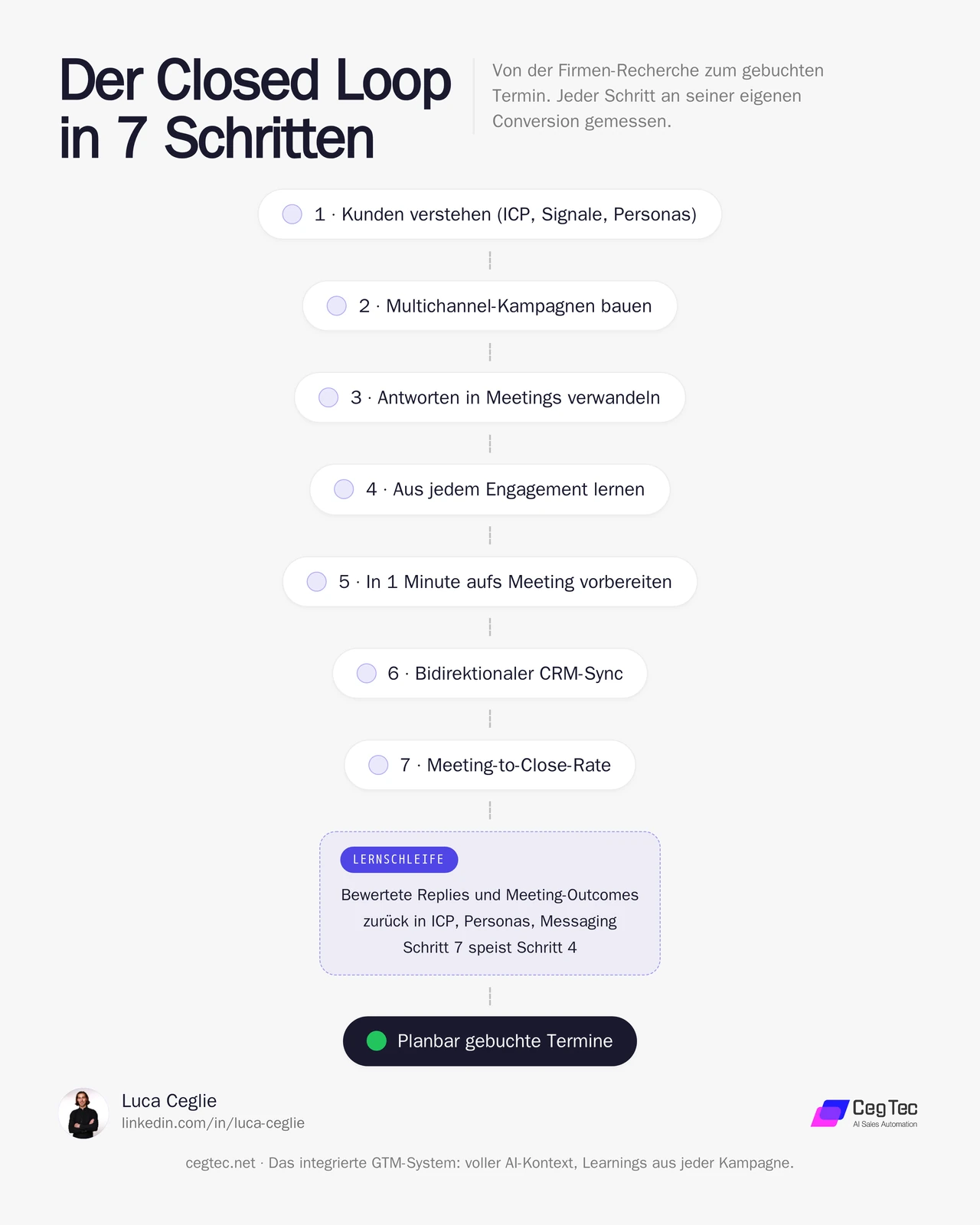
This playbook describes the complete chain, the way we run it across all campaigns. Seven steps, each with exactly one job: conversion to the next link. What you end up with is not a linear process but a loop that makes the system better every week.
The reference is a real SaaS funnel: 2,777 contacts, 786 connections, 263 replies, 41 SQLs. The numbers are not a promise but an example of how to read conversion along the chain.
Step 1: Understand the customer before anyone is contacted
Goal: before the first message goes out, it is documented who buys and why.
- Sharpen the ICP: vertical, company size, legal form, region — and the exclusion criteria along with it.
- Define buying signals: what makes a company relevant now — hiring, funding, a tech switch, a website visit?
- Personas with real pains instead of job titles: what does the problem actually cost the decision-maker?
Metric: the ICP fit rate of sourced companies, i.e. the share that survives qualification. Below roughly 60 per cent, the ICP is too vague. The answer then belongs back in step 1, not in more volume.
Step 2: Build multichannel campaigns
Goal: the message reaches the persona on the channel they actually reply on.
- Email as the backbone, because it scales and is measurable. LinkedIn for seniority and visibility. WhatsApp where it suits the vertical, for instance local audiences with fast cycles.
- One messaging track per persona, not one sequence for everyone.
- Sending infrastructure before volume: limits, warmup and domain hygiene decide whether the message is delivered at all.
Metric: reply rate per channel and persona. Not open rates — that is a vanity metric.
Step 3: Generate replies and turn them into meetings
Goal: no reply is left lying around, none is burned.
- Every incoming reply is classified by intent, sentiment and objection.
- Reply drafts are written with full context: the thread so far, the persona, the offer. Sending happens after human approval.
- The meeting proposal with a calendar link comes in the first follow-up to a positive signal, not after three rounds of politeness.
Condense to real intent
Not every reply is worth the same. Website and profile visits, clicks and repeated opens show who is actually paying attention right now. Those contacts get prioritised follow-up while the rest stays on the normal cadence.
Metric: reply-to-SQL conversion. In the reference funnel, 263 replies produced 41 qualified sales leads — around 16 per cent.
Step 4: Learn from every engagement
Goal: the system gets smarter with every interaction, not the slide deck folder.
- Rated replies, qualification decisions and meeting outcomes flow back into ICP, personas and messaging as learnings.
- Winning angles are reinforced, losers retired. Based on data, not on opinion in the weekly.
- Rejections are data: which objection appears how often, and what demonstrably defuses it?
Almost every team skips this step. Anyone who does not classify replies and does not rate meetings repeats the same mistakes every month, only faster.
Metric: the share of campaign decisions on angle, persona and channel that rest on measured learnings rather than assumptions.
Step 5: Prepare for a meeting in one minute
Goal: the rep enters the conversation with context, not with an empty CRM record.
- Before every meeting a briefing is assembled from existing data: company, persona, thread so far, identified pains, matching proof points.
- The actual research happened long before, in steps 1 to 3. The briefing only condenses it.
Metric: preparation time per meeting. Target: under a minute of reading instead of 30 minutes of research.
Step 6: Bidirectional CRM sync
Goal: sales and system work from the same state, automatically.
- Qualified contacts, threads and meetings land in the CRM, for instance HubSpot. Deal updates flow back.
- No copy-paste, no duplicate maintenance — and therefore no gap between what outbound knows and what sales sees.
Metric: the share of SQLs that arrive complete in the CRM without manual rework.
Step 7: Meeting-to-close rate — closing the loop all the way to revenue
Goal: the loop does not end at the meeting but at the result of the meeting.
- Every meeting gets an outcome: won, lost, postponed — plus the reason.
- The meeting-to-close rate shows whether the chain is producing the right meetings. Many meetings at a low close rate means step 1 (ICP) or step 3 (qualification) is too loose.
- These outcomes are the most valuable input for step 4. That closes the circle: research, outreach, meeting, revenue, learnings, better research.
Metric: meeting-to-close rate as the north star. Origination KPIs instead of activity theatre.
Why the loop makes the difference
Without steps 4 to 7, outbound is a linear process: volume in at the front, meetings out at the back, and every month starts again from close to zero. With the loop closed, the same effort becomes cumulative. Every reply, every meeting and every lost deal makes the next campaign measurably better.
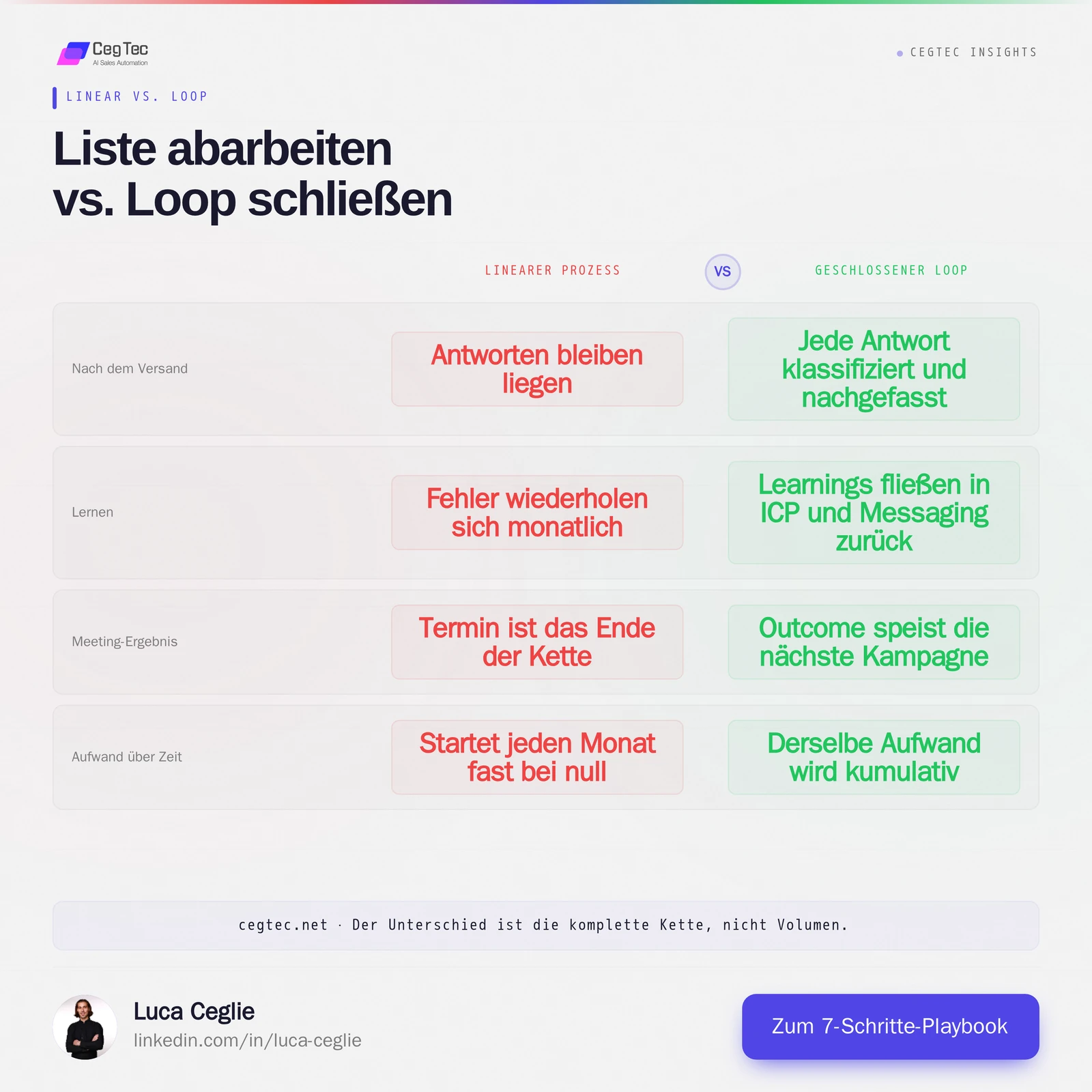
The difference rarely lies in the subject line or the volume. It lies in whether the chain is built completely and every step is measured on its own conversion. A team that builds only the first three links will never learn which of its meetings actually lead to revenue — and therefore cannot get better on purpose.
Prompts: the two that carry the loop
Two reusable prompts handle the decisions that come up most often in the chain: does this company fit right now, and how does a reply become a meeting. Both are deliberately generic. Copy them, fill in your ICP, your offer and your calendar link, done.
1. Company research by ICP and signal
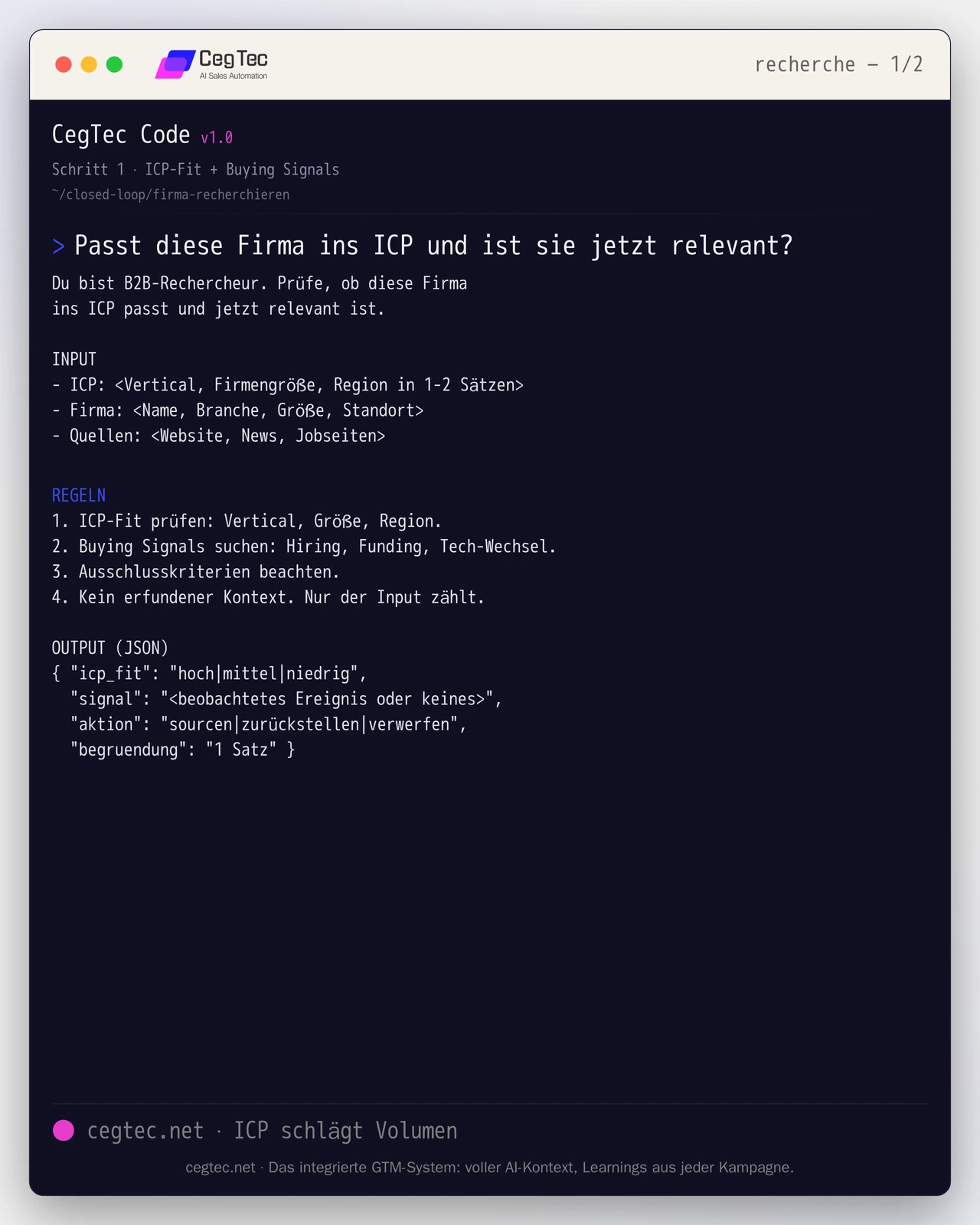
Belongs to step 1. Takes ICP, company and sources, returns a clean “source / defer / discard” with a reason. If the ICP fit rate of sourced companies stays below roughly 60 per cent, the ICP is too vague — the volume is not too small.
You are a B2B researcher. Check whether this company fits the ICP and is relevant now.

INPUT
- ICP: <vertical, company size, region in 1-2 sentences>
- Company: <name, industry, size, location>
- Sources: <website, news, job pages>

RULES
1. Check ICP fit: vertical, size, region.
2. Look for buying signals: hiring, funding, tech switch.
3. Respect exclusion criteria.
4. No invented context. Only the input counts.

OUTPUT (JSON)
{ "icp_fit": "high|medium|low",
  "signal": "<observed event or none>",
  "action": "source|defer|discard",
"reason": "1 sentence" }2. Reply to meeting
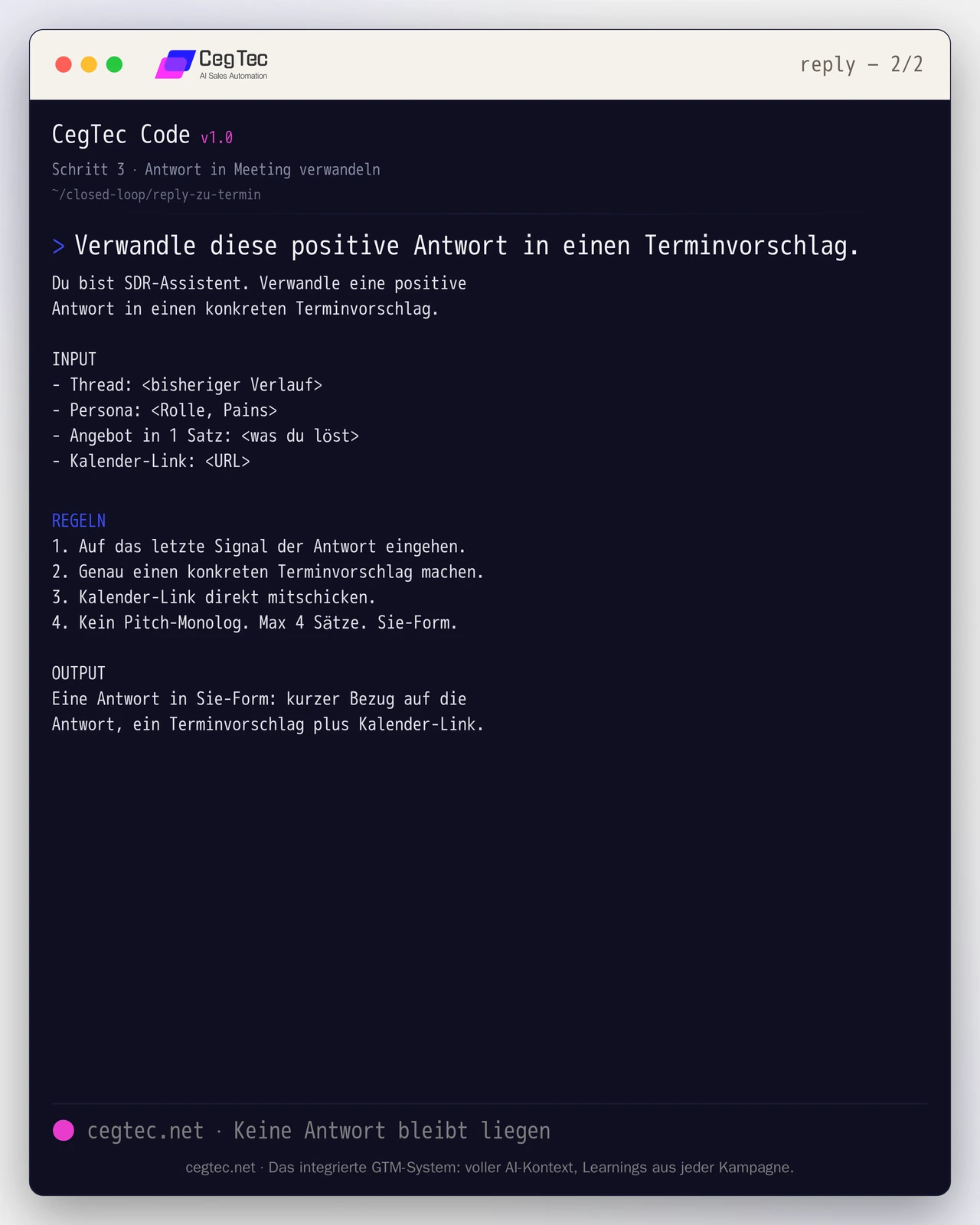
Belongs to step 3. Forces the meeting proposal with calendar link to follow a positive signal directly, not after three rounds of politeness.
You are an SDR assistant. Turn a positive reply into a concrete meeting proposal.

INPUT
- Thread: <conversation so far>
- Persona: <role, pains>
- Offer in 1 sentence: <what you solve>
- Calendar link: <URL>

RULES
1. Respond to the last signal in the reply.
2. Make exactly one concrete meeting proposal.
3. Include the calendar link directly.
4. No pitch monologue. Max 4 sentences.

OUTPUT
One reply: brief reference to their message, one meeting proposal plus calendar link.How to generate pipeline with this (in the GTM stack)
The seven steps demand different roles, and none of them carries the pipeline alone. A stack distributes them across specialised components that share the same data, so a company never loses context between research and booked meeting.
- Research and signal: find companies, enrich them, check for buying signals.
- Qualification: decide against the ICP whether a company is relevant now.
- Orchestration and decision: determine the next step and obtain approvals.
- Sending via email and LinkedIn: deliver the message on the channel the persona replies to.
- CRM: keep qualified contacts, threads and meetings in bidirectional sync.
- Learning loop: feed replies, qualifications and meeting outcomes back into ICP, personas and messaging.
So that these roles do not remain six separate tools, a layer connects them into one process with a single north-star metric: meeting-to-close rate. A category-agnostic orchestration layer such as GTM Goat can take that on and address the remaining roles by category rather than by fixed vendor. Which concrete stack you choose behind it is up to you — no rip-and-replace.
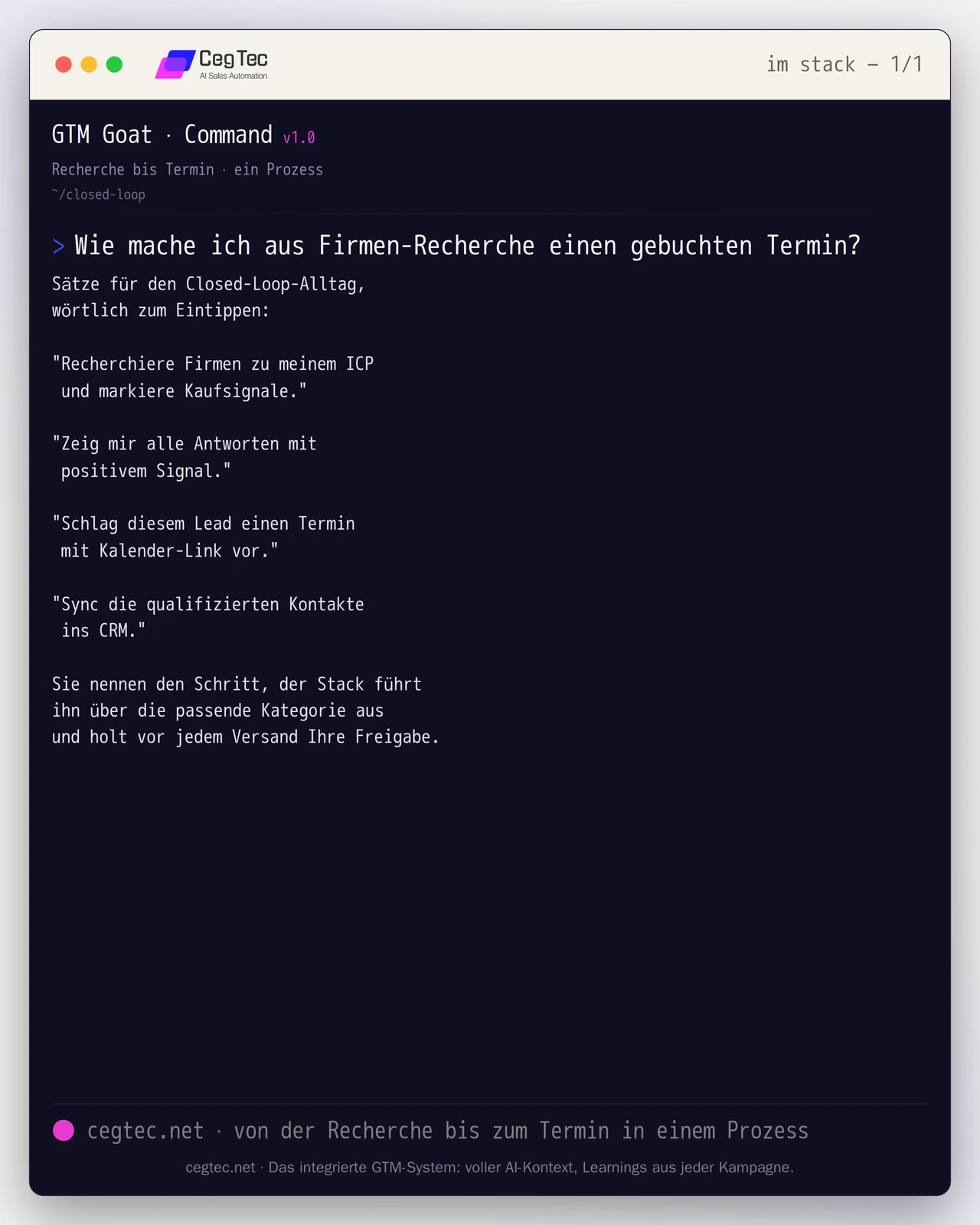
In practice you run this process through a single chat interface. You describe the step in plain language, the layer picks the right category and asks for your approval before every send. A few sentences from everyday use:
"Research companies matching my ICP and flag buying signals."
"Show me all replies with a positive signal."
"Propose a meeting to this lead with a calendar link."
"Sync the qualified contacts to the CRM."The quickstart shows what such an entry point looks like.
Next step
If you want to see this chain running in your own sales organisation instead of assembling it piece by piece: book an intro call or look at the GTM Goat system. Deliberately not a cold free start — implemented and coached beats licensed and left alone.
Next step
GTM Goat runs exactly what you just read.