
Content skills for GEO: becoming visible in AI search
How versioned, structured content blocks increase your visibility in AI search, so ChatGPT, Perplexity and others cite you.
Visibility is no longer decided at Google alone
More and more of your buyers start their research not with ten blue links but with a question to ChatGPT, Perplexity, Claude or the AI summary at the top of Google search. The answer they get is already pre-filtered: the AI system has read a handful of sources, summarised them and cited some of them by name. If your content is missing from that selection, you simply do not exist for that buyer — no matter how good your classic ranking is.
This new discipline is called GEO, generative engine optimization. It does not replace SEO but extends it: you are no longer optimising only to be found, but to be understood, trusted and cited by an AI. This article shows the underlying principle we work with at CegTec: structured, versioned content blocks instead of individual campaign articles.
Why AI systems prefer certain content
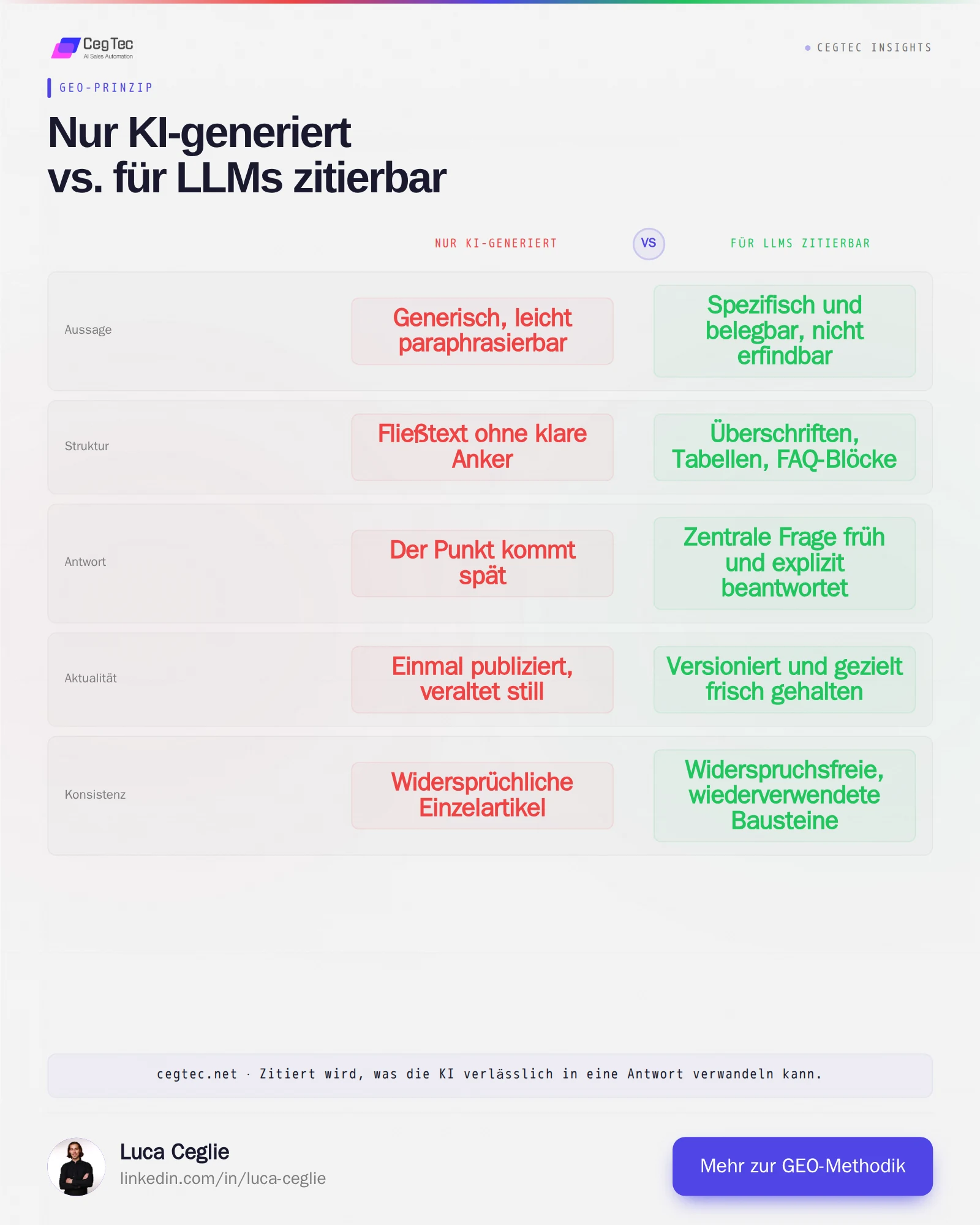
A language model does not cite the prettiest page but the one it can most reliably turn into a defensible answer. In practice, generative engines prefer content with four properties:
- Specific and evidenced. Generic advice gets paraphrased and disappears into the mass. Concrete numbers, clearly named methods and traceable examples get cited, because they give the AI something it cannot invent itself.
- Answering a question directly. Models break a user question into sub-questions and look for passages that answer exactly one of them. Content that cleanly answers a question in the first paragraph is more likely to be used than content that gets to the point after 800 words.
- Machine-readably structured. Clear headings, short paragraphs, tables, lists and FAQ blocks let a system extract the relevant passage exactly instead of guessing.
- Consistent and current. A brand that publishes regularly and without contradiction on its topic is recognised as an entity with authority. A single good article is not enough for that.
Take those four points seriously and you notice quickly: GEO is not a trick applied to a finished text but a question of how content is produced in the first place.
The principle: content blocks instead of individual articles
The most effective lever is to treat content not as a loose collection of blog posts but as versioned, structured blocks. A block is a clearly bounded, reusable unit of knowledge: a definition, a comparison, a step-by-step method, an evidenced data point. Every block has a fixed format, a traceable origin and a history showing when and why it was updated.
This approach pays into GEO directly, for several reasons:
- Reusability creates consistency. When the same definition or the same data point appears identically across blog, knowledge base and specialist articles, you produce exactly the contradiction-free signal AI systems read as authority.
- Versioning keeps content fresh. Outdated numbers are one of the most common reasons a source stops being cited. If you track the state of each block, you can update deliberately instead of guessing.
- Structure is built in, not retrofitted. When every block is conceived from the start as an answerable unit, the headings, tables and FAQ blocks that generative engines can extract emerge automatically.
- A feedback loop becomes possible. Blocks can be checked individually for whether they are actually being cited, and sharpened accordingly. Content becomes a measurable operation instead of a heroic effort.
At its core this is a stance: content is treated like product components, not like disposable campaigns.
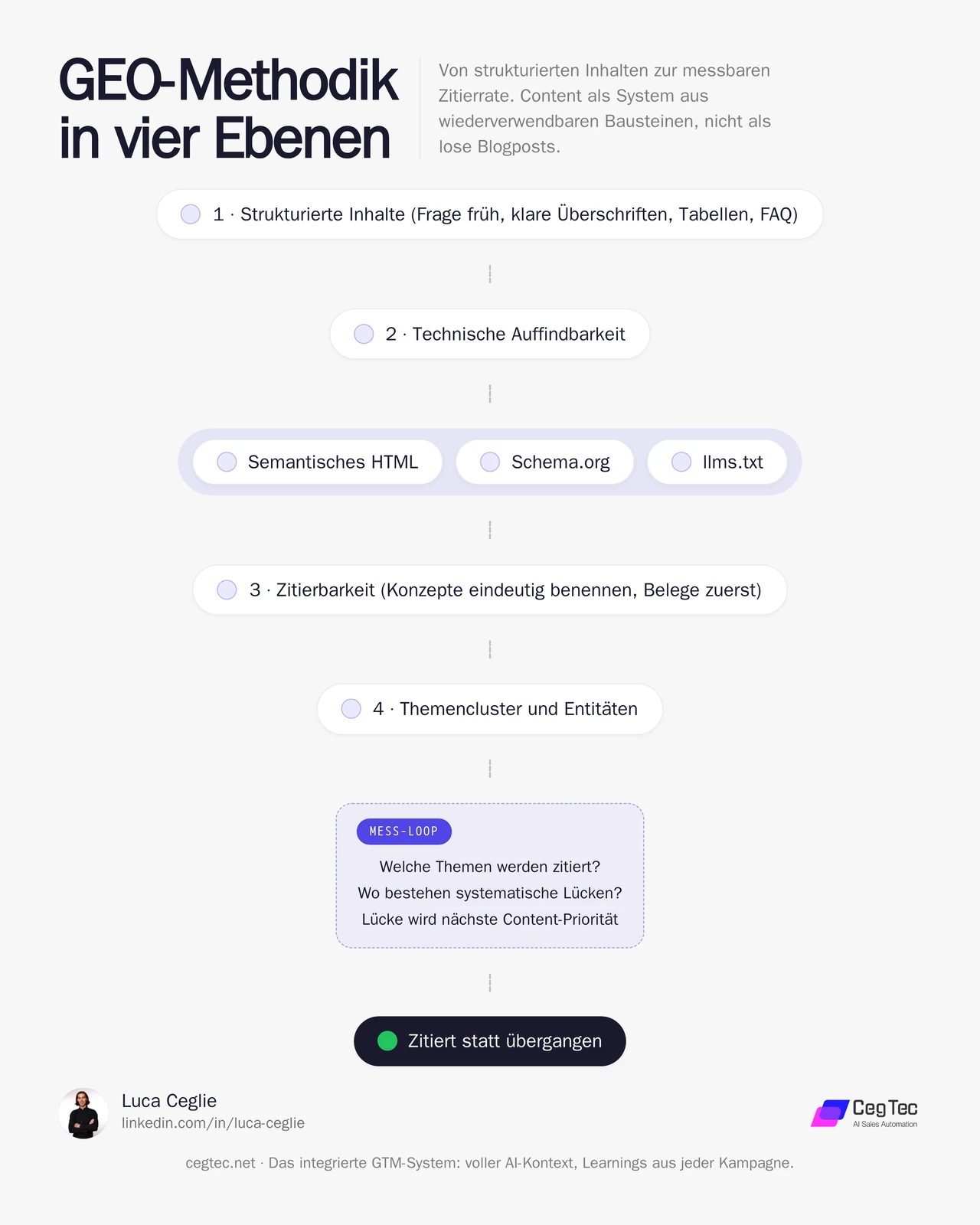
The four levels to work on
1. Structured content
Write so that a machine finds the answer without interpretation. Answer the central question early and explicitly. Use meaningful headings that themselves sound like search queries. Build comparisons as tables, processes as numbered lists, and recurring questions as FAQ blocks. Each of these forms is an invitation to the AI to take exactly that passage.
2. Technical discoverability
For an AI system to read and classify your content at all, it needs technical foundations: clean semantic HTML, structured data via Schema.org, a fast and crawlable site. Increasingly an llms.txt is also becoming established — a simple file that acts as a signpost for AI systems through a domain’s most important content. These signals decide whether your page qualifies as a reliable source or is not considered at all.
3. Citability for language models
Make it easy for the AI to cite you correctly. Name concepts unambiguously. Put evidenced statements at the beginning of a section, not at the end. Avoid marketing language that carries no verifiable information. The more clearly a statement stands on its own, the more likely it is lifted out of context and used in a generated answer.
4. Topic clusters and entities
AI systems think in entities and their relationships, not in individual keywords. So bundle your content into clearly delineated topic clusters: a central overview page surrounded by deeper blocks that consistently reference each other. That way a model recognises that your brand covers a topic comprehensively and authoritatively rather than touching it by chance.
Two prompts for practice
The two prompts below show how the principles apply concretely. Both are deliberately generic and illustrative: they describe the decision, not a finished recipe. Copy them and fill in your own context.
The first helps build a single piece of content so that an AI can cite it: answer first, structure built in, evidence included.
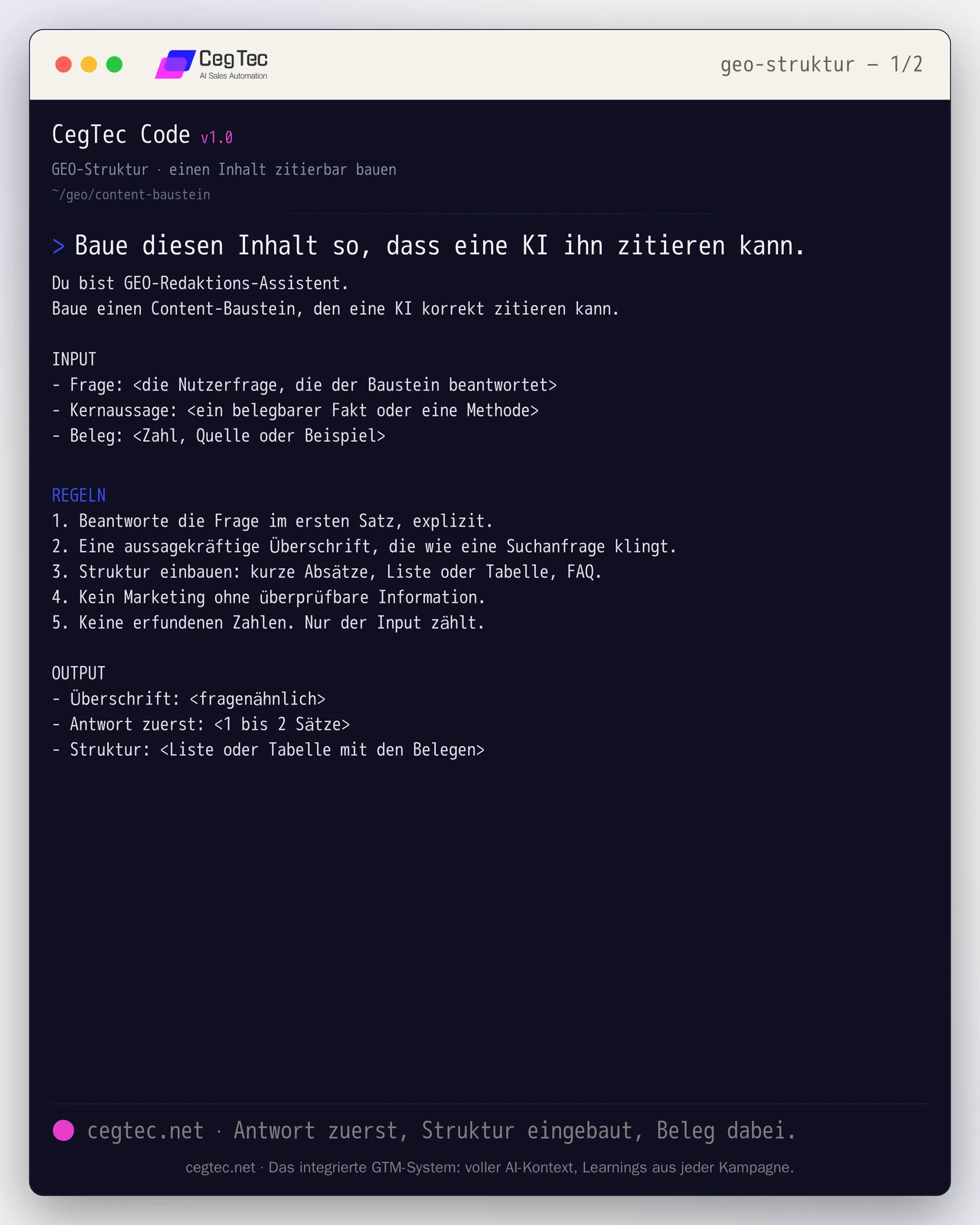
You are a GEO editorial assistant.
Build a content block an AI can cite correctly.

INPUT
- Question: <the user question the block answers>
- Core statement: <an evidenced fact or method>
- Evidence: <number, source or example>

RULES
1. Answer the question in the first sentence, explicitly.
2. One meaningful heading that sounds like a search query.
3. Build in structure: short paragraphs, list or table, FAQ.
4. No marketing without verifiable information.
5. No invented numbers. Only the input counts.

OUTPUT
- Heading: <question-like>
- Answer first: <1 to 2 sentences>
- Structure: <list or table with the evidence>The second checks the technical level: whether a page with clean HTML, matching structured data and an llms.txt is readable for generative engines at all.
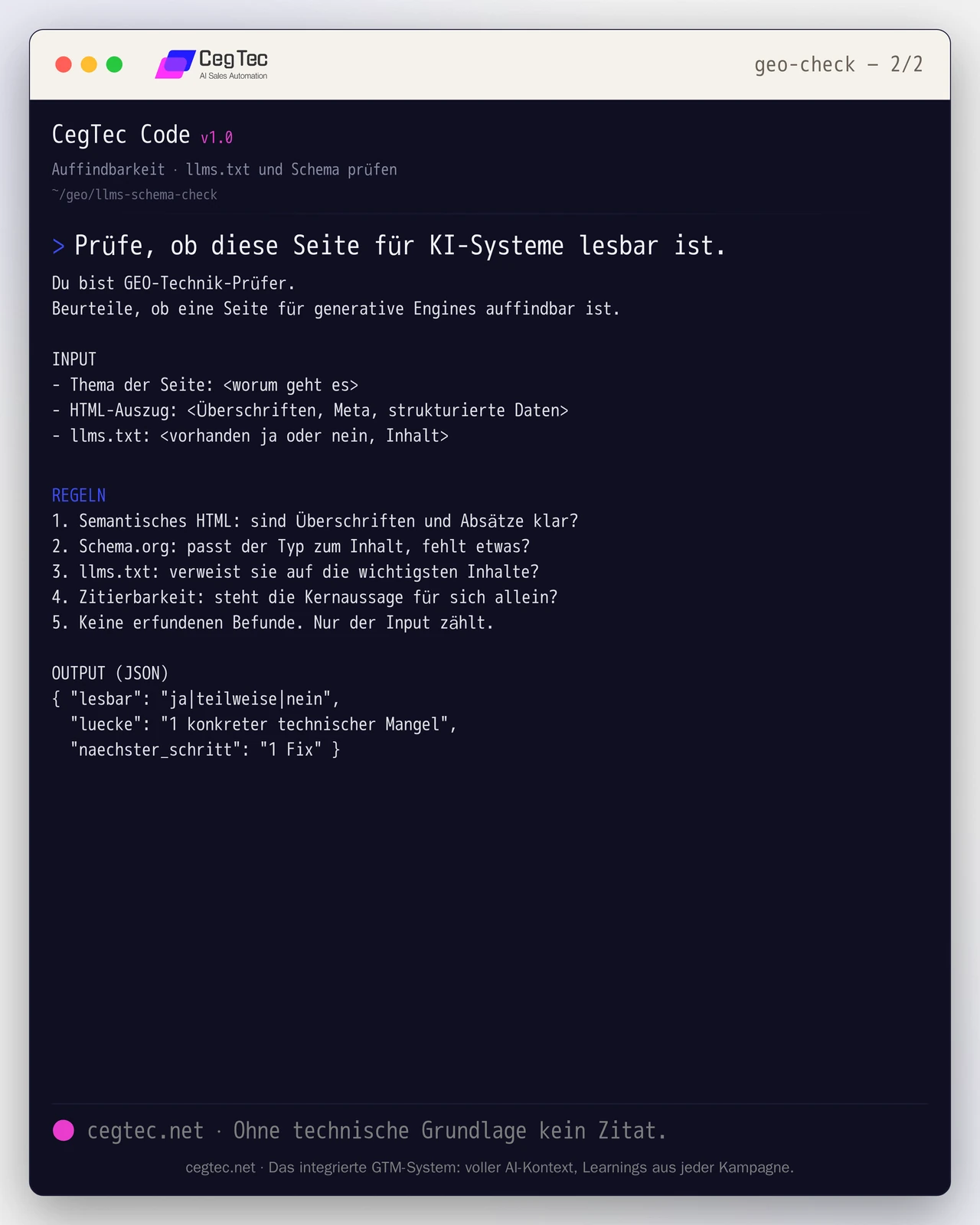
You are a GEO technical reviewer.
Assess whether a page is discoverable for generative engines.

INPUT
- Page topic: <what it is about>
- HTML excerpt: <headings, meta, structured data>
- llms.txt: <present yes or no, content>

RULES
1. Semantic HTML: are headings and paragraphs clear?
2. Schema.org: does the type match the content, is anything missing?
3. llms.txt: does it point to the most important content?
4. Citability: does the core statement stand on its own?
5. No invented findings. Only the input counts.

OUTPUT (JSON)
{ "readable": "yes|partly|no",
  "gap": "1 concrete technical shortcoming",
"next_step": "1 fix" }How to measure progress
GEO without measurement is guessing. Check regularly whether and how the relevant AI engines mention your brand on the questions that matter to you. Observe which of your topics are already cited and where systematic gaps exist. Those gaps are exactly your next content priority: concrete questions where demand exists but you do not yet offer a citable block. Measurement thus becomes an assignment, and GEO becomes a repeatable cycle rather than a one-off project.
How to generate pipeline with this (in the GTM stack)
GEO is not an end in itself. Visibility in AI search is valuable because it creates demand: people and systems that encounter your content, act on it and identify themselves as prospects. For that to become pipeline, the demand has to be captured and carried forward. This is exactly where a GTM stack comes in, with several roles working together:
- Visibility as a demand source. GEO and your citable blocks ensure your brand appears in AI answers, searches and the feed at all, and triggers reactions.
- Signal capture. The resulting signals — reactions to content, emerging enquiries — are collected, enriched and matched to a company and a person.
- Orchestration and decision. A steering layer scores the signals against your target audience, prioritises and decides which contact is worth approaching.
- Outreach channels. Suitable channels such as email or social networks carry out the outreach, which picks up the trigger rather than the product.
- CRM. The qualified contact lands where your sales team already works, with the context for why they are relevant.
These roles can be filled with different tools. A category-agnostic orchestration layer such as GTM Goat can take the steering role and address the remaining building blocks by category — email, social networks, CRM — instead of being tied to a single vendor. The concrete stack stays freely selectable.
In practice that means: instead of tracking signals by hand, you describe in plain language what should happen, and the orchestration layer executes across categories and asks for your approval before every send.
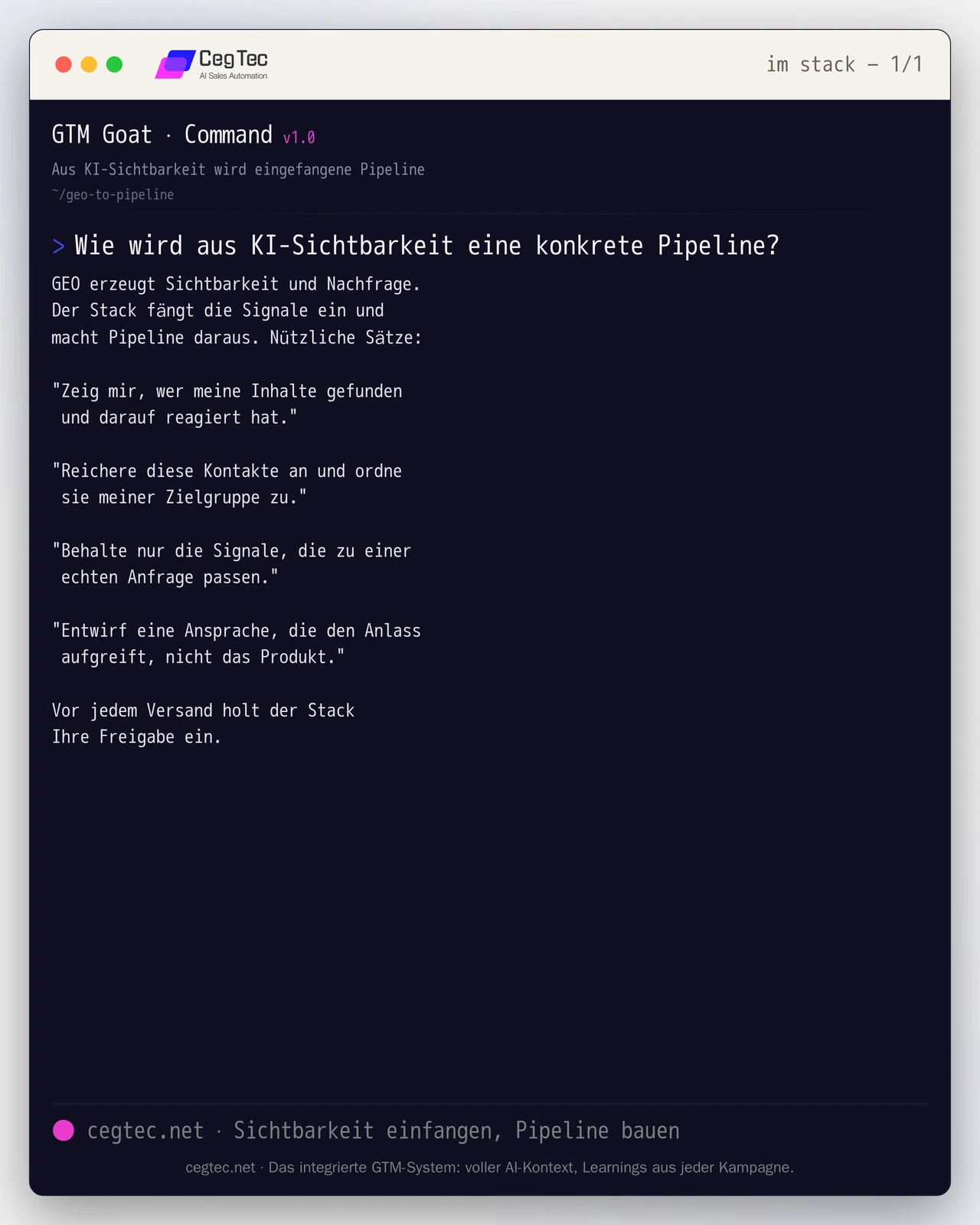
Here is what the sentences steering the path from visibility to pipeline could look like:
GEO creates visibility and demand.
The stack captures the signals and turns them into pipeline.

"Show me who found my content and reacted to it."

"Enrich these contacts and match them to my target audience."

"Keep only the signals that match a genuine enquiry."

"Draft outreach that picks up the trigger, not the product."

The stack asks for your approval before every send.The quickstart shows what such an entry point looks like concretely.
The loop as an open repo
We don’t run this cycle as a secret. The building blocks we use to measure our own visibility and close the gaps are on GitHub under the MIT license: locagoi/content-engineering-skills.
The structure follows the three steps of the loop:
content-engineering-skills/
├── geo/                    # measure: who gets cited in AI answers
│   ├── citation-check.mjs  # does the engine cite us or the competition
│   ├── gaps.mjs            # where we're missing, and who's there instead
│   └── demand.mjs          # which questions get asked at all
├── scanner/                # decide: check your own page against the gap
├── pipeline/               # decide: what gets written next
└── skills/                 # write: the instructions the agent reads
    ├── geo.md              # how an article becomes citable
    ├── ai-visibility.md    # the loop from measurement to text
    ├── longtail.md         # find questions nobody answers
└── ideation.md # topic out, artefact inWe run it three times a week. It asks the same prompts again, compares against the previous run, and reports which gap has closed and which hasn’t.
As of 7 October 2026, median of the last three runs (1, 5 and 7 October), each across four engines: in the core topic of agency and outbound, the citation rate is 45% (25 prompts, each asked to four engines, so 100 answers per run). In the positioning set it’s 33%, in the English self-service set only 3%. A single run swings by a few points, which is why this shows the median rather than the best run. The three numbers sit side by side on purpose: the loop shows not only where it works, but also where it doesn’t yet.
Conclusion
Visibility in AI search is neither luck nor a tool subscription but the result of a disciplined way of building content: specific, structured, versioned and thought of in clusters. Treat content as a system of reusable blocks and you meet the criteria generative engines select by almost automatically — and get cited instead of passed over.
If you want to anchor GEO as a measurable part of your growth rather than running it on the side, our team can help. Learn more about our approach at GTM Goat or talk to us directly.
Next step
GTM Goat runs exactly what you just read.