
M&A deal flow: sourcing off-market targets with AI
How buy-side teams build proprietary deal flow: an AI pipeline that finds validated off-market targets and owners from public sources.
The best targets are on no platform
Buy-side mandates live on proprietary deal flow. A private equity fund, family office or strategic buyer that looks only at what brokers and platforms offer competes with everyone else for the same overpriced processes.
The most interesting targets never appear there: owner-managed mid-market companies close to succession. These businesses rarely maintain a meaningful website, and many are not cleanly listed in any company database. But almost all of them are publicly findable if you look in the right place.
Market context makes this relevant: a large succession wave is building in the DACH region. Market estimates put around 190,000 companies as looking for a successor by 2027. That is not a side issue but the biggest structural deal-flow driver of the coming years. The only question is who approaches those owners first, and cleanly.
This guide shows the method behind a pipeline that turns publicly available signals into a validated, personalised contact list of owners. No broker intermediation, no mass list, but a reproducible process.
Why off-market is the actual advantage
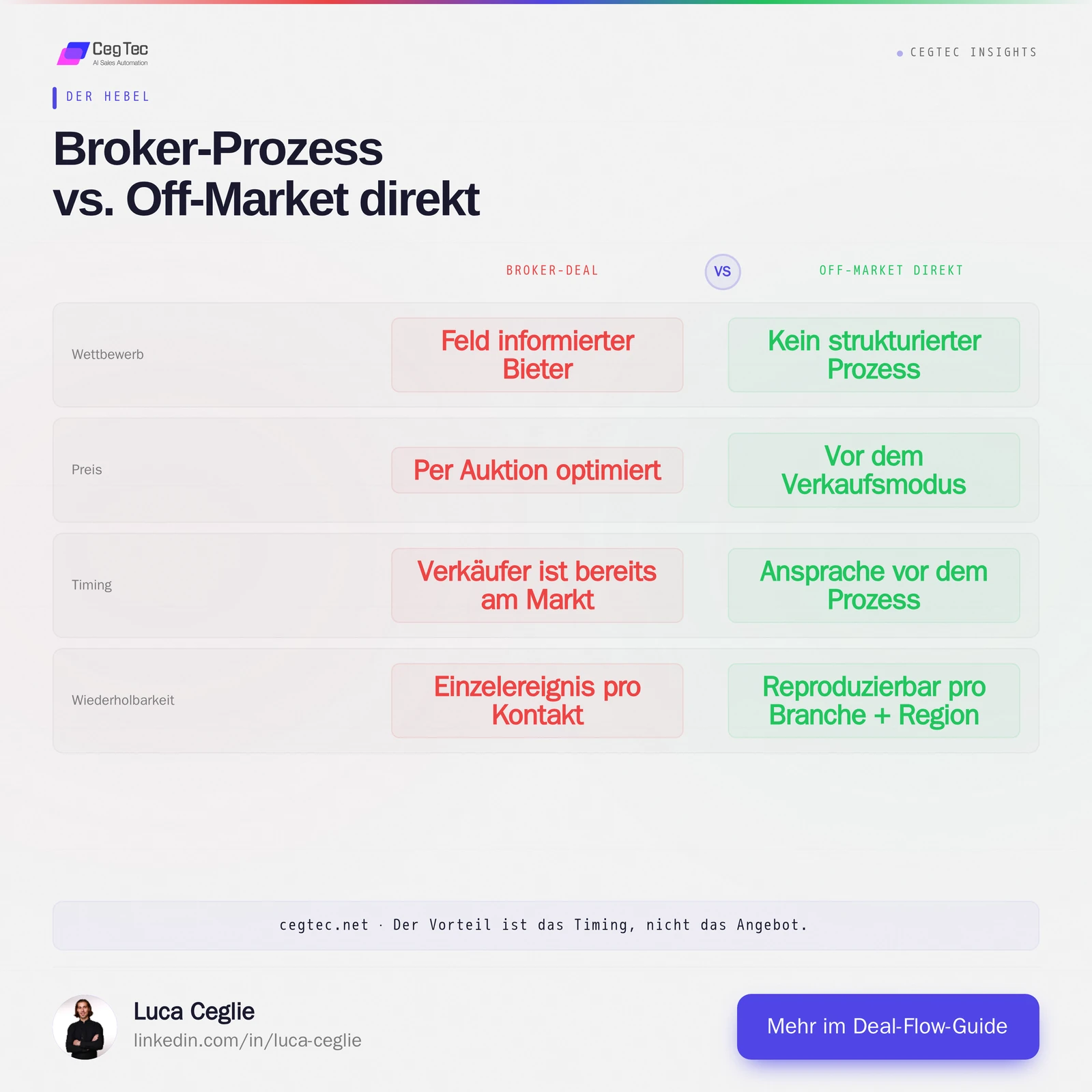
A process that lands in an auction market is expensive by definition. As soon as a target company sits with an M&A adviser, you compete with a field of informed bidders, the price is optimised, and the seller is already emotionally in selling mode. Off-market inverts that starting position: you approach an owner before a structured process exists, often before the owner actively wants to sell at all.
That requires a different rhythm. It is not about fast closes but about being present as a relevant, discreet counterpart when succession becomes real. That is exactly why the ability to detect the timing signal early and systematically is worth more than any purchased list.
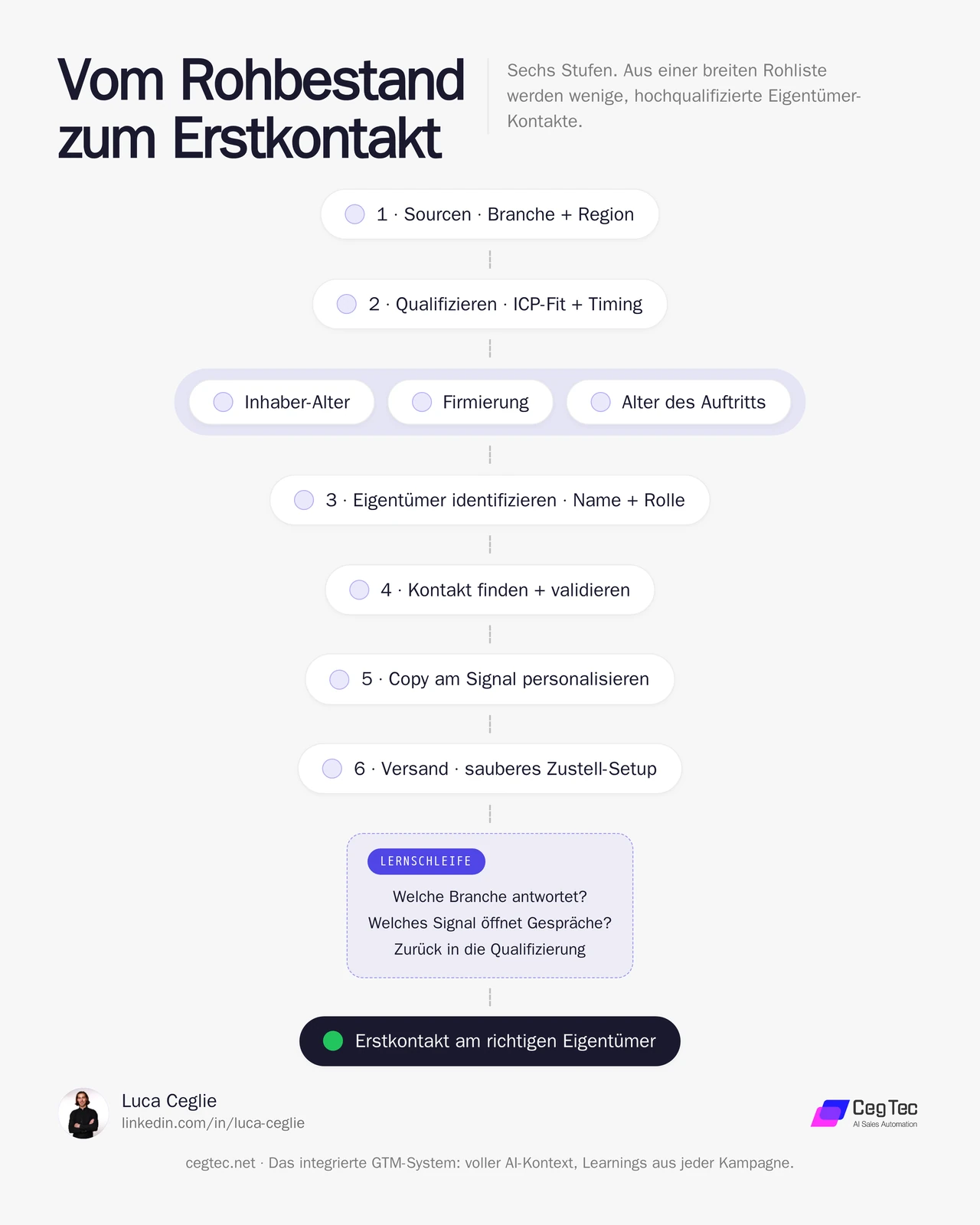
The approach: six stages from raw list to first contact
Instead of cold-calling a purchased list, the pipeline turns a broad raw set step by step into a few highly qualified contacts. Every stage filters and enriches, so only targets that fit the mandate and have a real trigger remain at the end.
- Source from public data on industry and region
- Qualify by ICP fit and succession signals
- Identify the owner by name and role
- Find and validate contact details
- Personalise the copy to the concrete signal per target
- Send with a clean deliverability setup
Step 1: Source broadly, do not buy narrowly
The entry point is deliberately broad. Publicly accessible industry and location data produces a raw list of all businesses in a defined segment, for instance mechanical engineering in a particular region. These sources also cover micro-SMEs without any notable web presence and are usually more current than classic company databases, because closed businesses drop out. Rough first signals of establishment — founding year, history at the location — can already be derived here.
Step 2: Qualify on fit and timing
Every business on the raw list goes through a structured assessment following a fixed schema. Two dimensions decide:
- ICP fit: industry, estimated headcount, region, specialisation
- Succession signals: owner age, company naming (family name as company name, legal forms or owner designations), age of the market presence, phrasings like “since 19xx”
Disqualifiers are removed consistently: group subsidiaries, insolvency cases, already-sold businesses. From a scoring model with a clear threshold, a manageable set of qualified targets remains. This step is the real lever, because it separates deal flow from data waste.
It is important to fix the scoring schema explicitly and in writing rather than leaving it to gut feeling. Only that keeps qualification consistent across hundreds of businesses, traceable later and deliberately sharpenable. Set the threshold too low and you drown the team in weak contacts. Set it too high and you lose borderline cases that turn out on closer inspection to be the best targets. That threshold is a deliberate steering decision, not a technical detail.
Step 3: Identify the owner
Only for the qualified businesses does a second, deeper research step follow. The aim is the decision-maker by name and role: managing director or owner, determined from publicly accessible sources such as the imprint, the commercial register and professional networks. In succession matters it is decisive to address the right person directly and not an anonymous company mailbox.
Step 4: Find and validate contact details
For the identified person a reliable contact address is determined and then verified. Where no direct hit is possible, the public market presence often provides the only — but working — route for very small businesses, combined with a personal salutation.
One hard rule applies without exception: unverified addresses never go into sending. The difference is measurable. In our own campaigns the bounce rate was 0.4 per cent for validated lists and 7.7 per cent for unvalidated ones. The latter damages the sender domain lastingly and makes any further outreach worthless.
Step 5: Copy that targets the signal
Outreach is individualised per owner, hung on the concrete signal that qualification produced — a round company anniversary, for example. The guardrails:
- Keep it short, roughly 90 words, without links and without tracking
- The hook is the concrete succession signal, not the generic pitch
- Tone discreet and on equal footing, no broker-speak
- The next step is a non-binding conversation, not sweeping valuation promises
Step 6: Send with a clean setup
The best deal flow evaporates if the emails land in spam. So sending runs on a dedicated deliverability setup: separate sending domains, conservative daily volumes per mailbox (in the order of 15 emails), a warmup phase and rotation, no open tracking. With this audience, deliverability is not a side stage but a precondition.
What the pipeline actually delivered
Numbers from our own buy-side campaign, as of June 2026:
| Metric | Value |
|---|---|
| Emails sent | 1,756 |
| Leads contacted | 690 |
| Unique replies | 11 (1.6 %) |
| Opportunities | 5 |
| Bounce rate | 3.1 % |
The most important learning is not in the reply rate. The pure buy side — funds and family offices — reacts sluggishly to cold email. The more interesting lever of this pipeline is the sell side: the owners themselves. There the succession timing signal provides the natural hook, and that signal can be detected systematically.
And the maths works even at seemingly low rates. Five opportunities from 690 contacts sounds small, but a single buy-side mandate carries such a pipeline for years. In deal sourcing what counts is not the volume of replies but the value of the few right ones.
Prompts: the two decisions at the start of the pipeline
Two reusable prompts do the work that determines the quality of the whole deal flow: does a business fit the mandate, and who is the right owner with which trigger. Both are deliberately generic. Copy them, enter your mandate and your sources, done.
1. Target qualification by signal
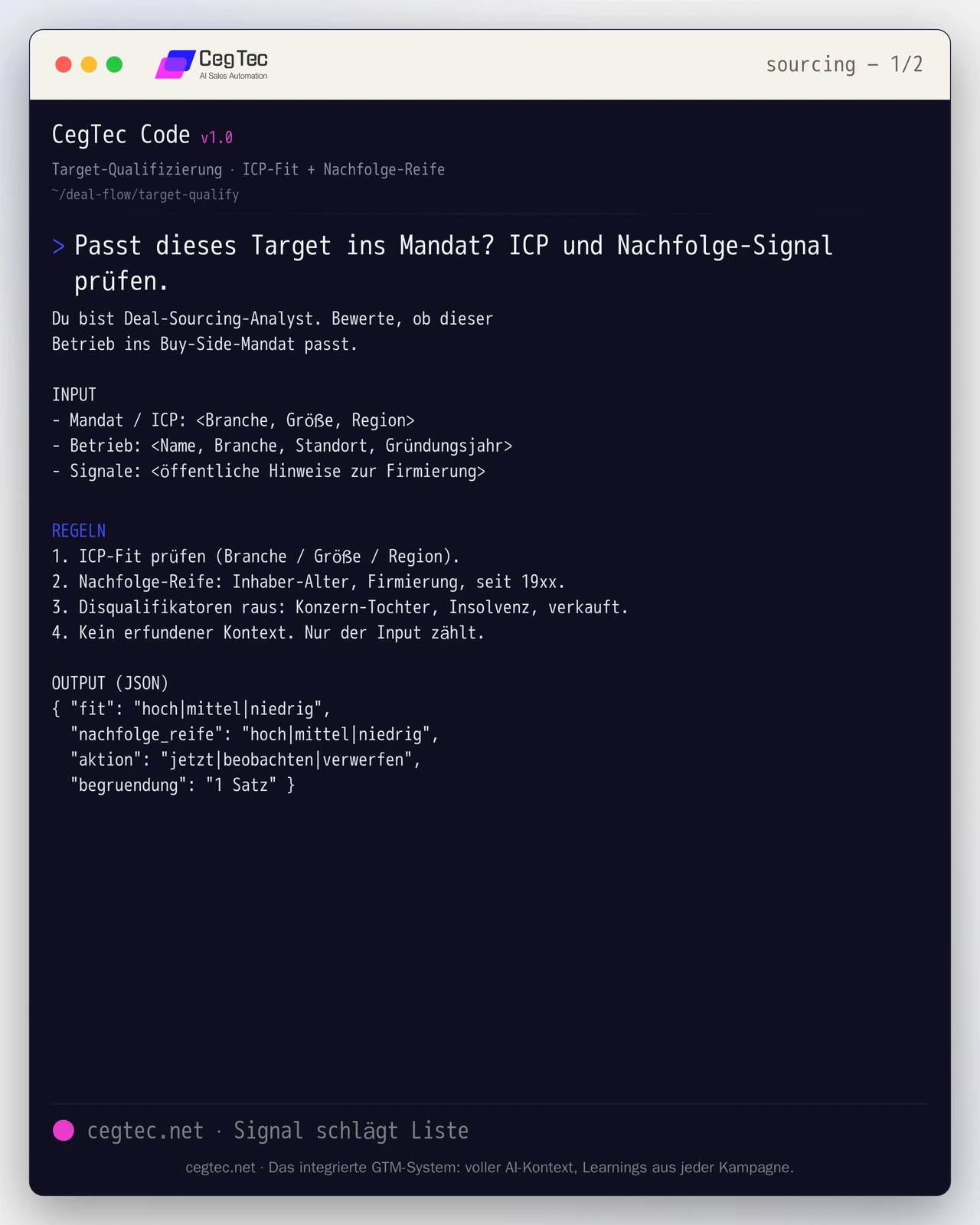
Takes mandate, business and public signals and returns a clear decision (now, watch or discard) with a reason. Disqualifiers such as group subsidiaries or insolvency cases drop out consistently; invented context is forbidden.
You are a deal sourcing analyst. Assess whether this business fits the buy-side mandate.

INPUT
- Mandate / ICP: <industry, size, region>
- Business: <name, industry, location, founding year>
- Signals: <public indications from naming>

RULES
1. Check ICP fit (industry / size / region).
2. Succession readiness: owner age, naming, since 19xx.
3. Remove disqualifiers: group subsidiary, insolvency, sold.
4. No invented context. Only the input counts.

OUTPUT (JSON)
{ "fit": "high|medium|low",
  "succession_readiness": "high|medium|low",
  "action": "now|watch|discard",
"reason": "1 sentence" }2. Succession signal research
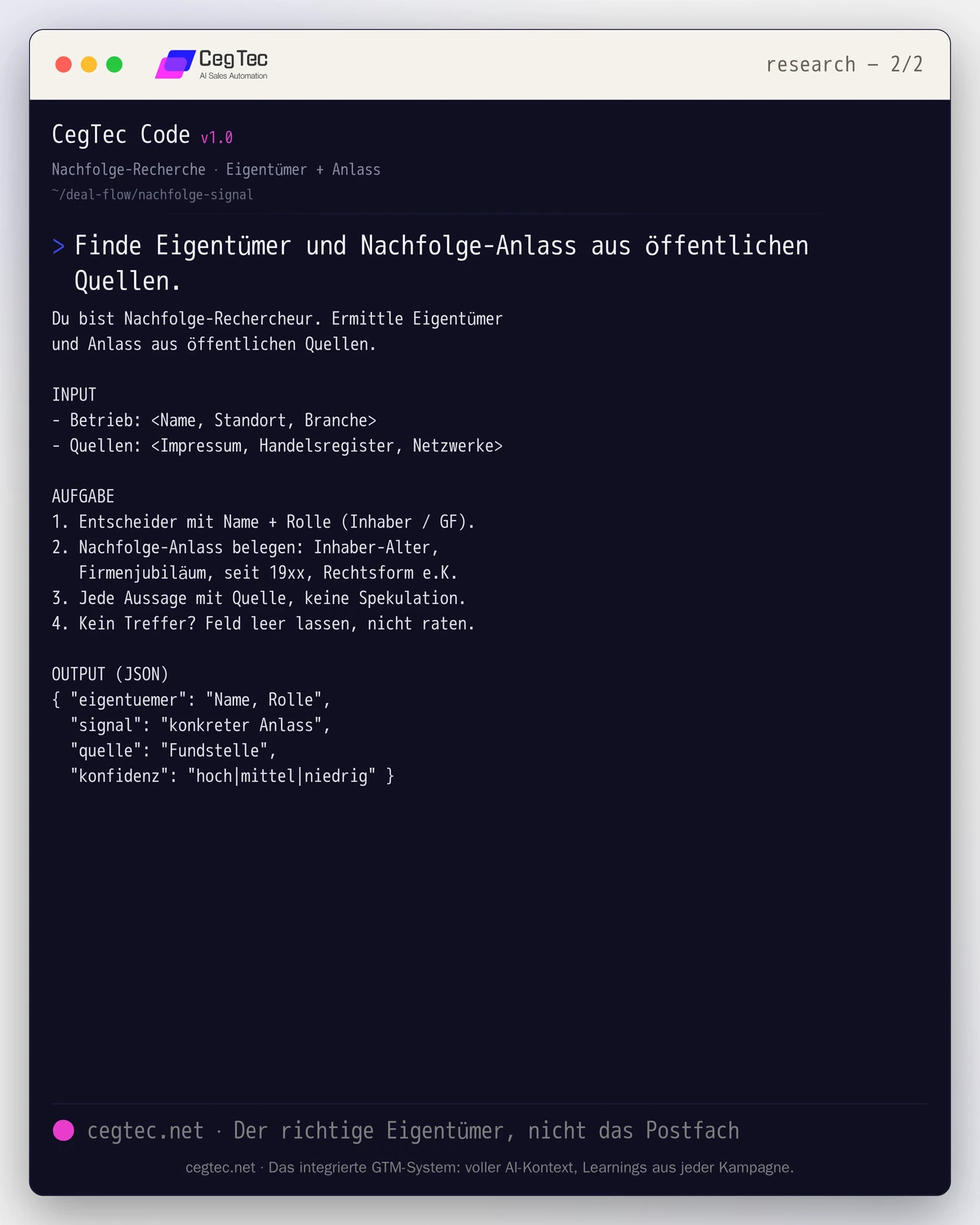
For a qualified business, determines the decision-maker by name and role plus the concrete succession trigger, every statement with a source. Where no hit is possible, the field stays empty rather than guessed.
You are a succession researcher. Determine owner and trigger from public sources.

INPUT
- Business: <name, location, industry>
- Sources: <imprint, commercial register, networks>

TASK
1. Decision-maker with name + role (owner / MD).
2. Evidence the succession trigger: owner age, company anniversary, since 19xx, legal form.
3. Every statement with a source, no speculation.
4. No hit? Leave the field empty, do not guess.

OUTPUT (JSON)
{ "owner": "name, role",
  "signal": "concrete trigger",
  "source": "where found",
"confidence": "high|medium|low" }How to generate pipeline with this (in the GTM stack)
The method above is deliberately tool-agnostic. In practice it runs as a GTM stack of interchangeable roles: signal and research sources supply the public raw data and succession indications, an enrichment layer adds owners and verified contact details, an orchestration and decision layer brings together qualification, thresholds and approvals, outreach channels handle the personalised sending, and a CRM records the history. A category-agnostic orchestration layer such as GTM Goat can take that role and address the remaining building blocks by category; the stack stays freely selectable, no rip-and-replace. You swap individual sources or channels without rebuilding the process.
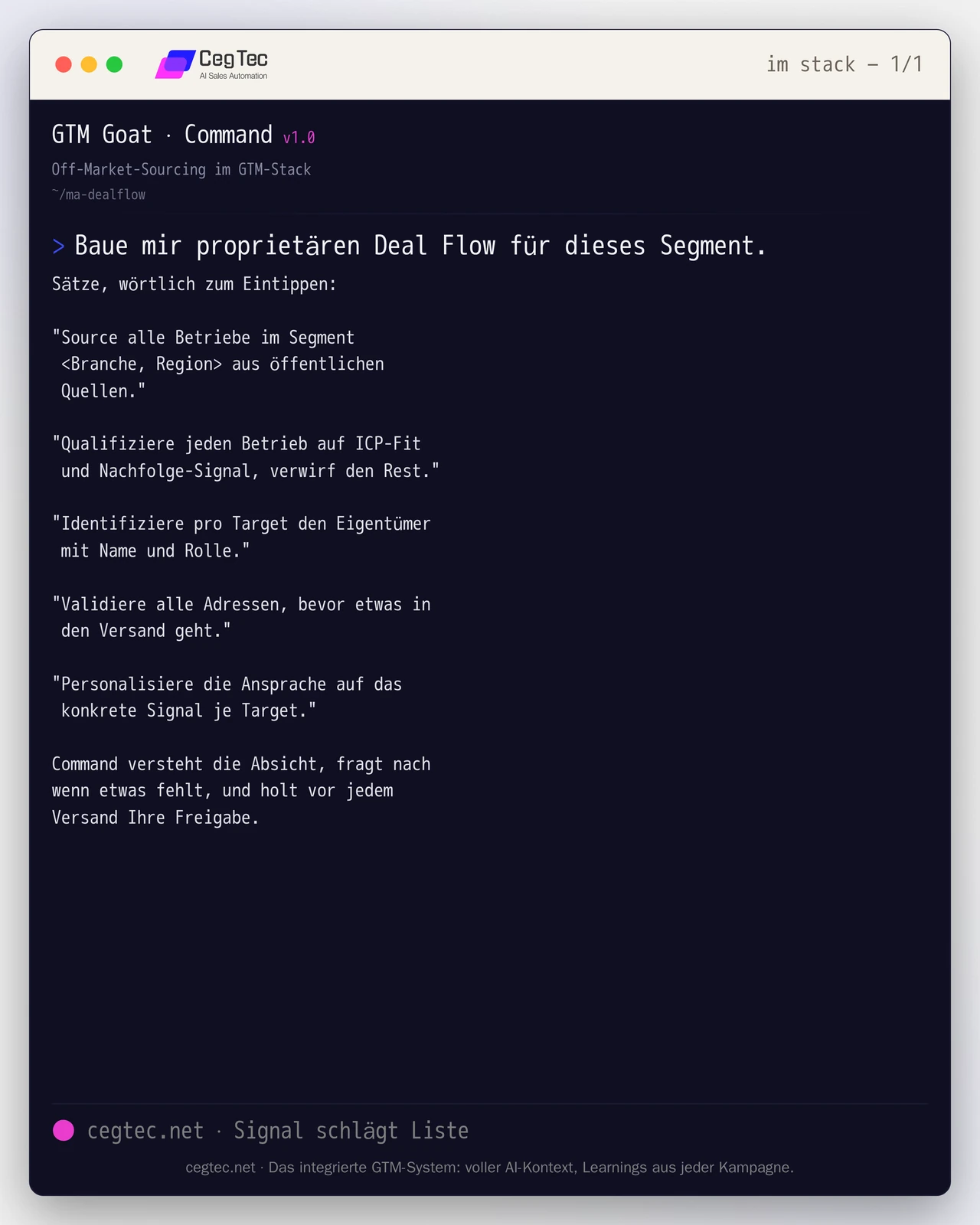
Concretely you steer the six stages through simple command sentences. The lines below can be typed verbatim and cover sourcing, qualification, owner identification, validation and outreach:
Sentences, ready to type:

"Source all businesses in the segment
 <industry, region> from public sources."

"Qualify every business on ICP fit
 and succession signal, discard the rest."

"Identify the owner per target
 with name and role."

"Validate all addresses before anything
 goes into sending."

"Personalise the outreach to the
 concrete signal per target."

Command understands the intent, asks when
something is missing, and obtains your
approval before every send.A step-by-step guide to setting up the stack is in the quickstart.
Why a system beats what chance finds
The advantage of this method lies in repeatability. A broker contact is a one-off event. A cleanly built deal-flow process can be re-applied to any industry and region, measures its own hit rate, and gets sharper with every run. Luck becomes pipeline.
Just as important: every run generates its own data. Which industry replies, which signal opens conversations, which region has already been worked. That feedback flows into the next qualification and makes the process more precise over time, while purchased lists start ageing the day you receive them. Your own deal-flow process is therefore not a one-off project but an asset that gains value across mandates.
That is exactly what we build at CegTec: GTM systems that turn publicly available signals into reliable, proprietary deal flow instead of competing expensively for the same processes.
If you want to build proprietary deal flow for your mandate, we will work through it concretely on your segment. More on the approach at GTM Goat or directly via contact.
Next step
GTM Goat runs exactly what you just read.