
Skills instead of SOPs: the sales operating system
Why versioned, modular instructions beat classic static SOPs in sales: reusable, auditable, composable and alive.
The problem with the SOP folder
Almost every sales team has one: the collection of standard operating procedures. An onboarding document, a qualification guide, an objection handling sheet, a process for sending quotes. Written by someone who left the team long ago. Last updated three quarters back. Filed on a drive half the people never open.
SOPs are not wrong. They are just static. They describe a state that was correct at the time of writing and start ageing from the first line. That is exactly why nobody looks inside in practice: a document you cannot trust gets ignored faster than it gets maintained.
The alternative is not a better document. It is a different format. We treat sales knowledge like software: as versioned, modular instructions that are invoked, combined and developed further. Call them skills. The difference sounds technical but is mostly organisational.
What separates a skill from an SOP
An SOP is text to read. A skill is an instruction to execute. The core of the difference lies in four properties.
- Modular instead of monolithic. An SOP often tries to capture an entire process in one document. A skill does exactly one thing: qualify a company, classify a reply, produce a meeting briefing. Small blocks are easier to understand, test and replace.
- Versioned instead of dated. Every change to a skill is traceable. Who changed what, when and why, and what it was before. An SOP has a change date in the footer at best. A skill has a history.
- Composable instead of isolated. Skills call each other. A qualification skill can use a research skill, which in turn calls a skill for signal scoring. Many processes emerge from a few blocks without anything being written twice.
- Auditable instead of trust-based. Because every step is named and versioned, you can check afterwards which instruction a decision was based on. That is the difference between “we believe this is how we do it” and “this is demonstrably how we did it”.
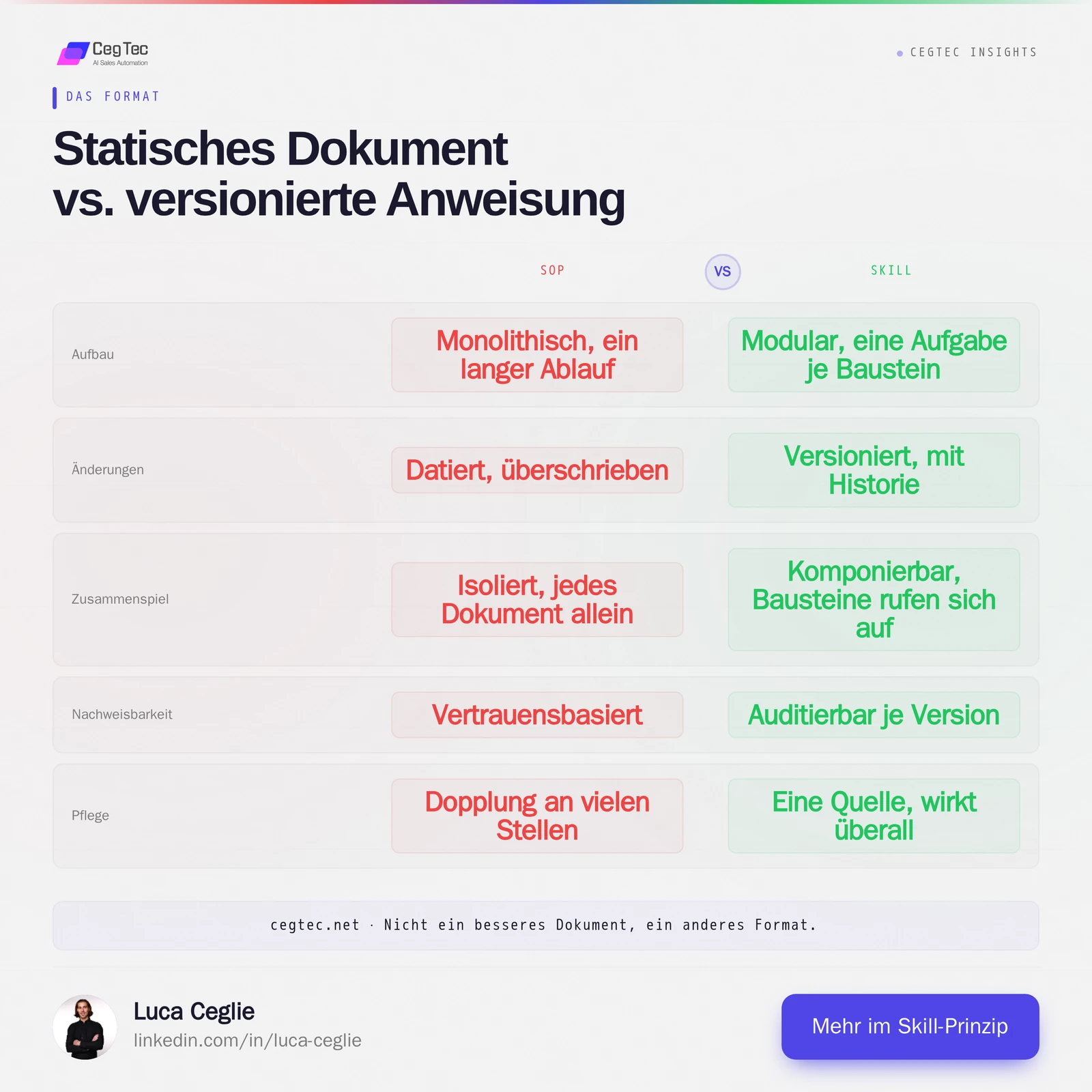
Reusability: write once, use everywhere
The most expensive mistake in the SOP model is duplication. The rules for clean objection handling sit in the email guide, again slightly differently in the LinkedIn guide, and a third time in the discovery call script. When positioning changes, you have to find three places and touch three of them. In reality you find two and forget the third.
A skill is written once and referenced from everywhere. Objection handling is one block that email, LinkedIn and the call all use. A change takes effect everywhere immediately because there is only one place. That reduces not only effort but also the silent divergence in which three channels slowly start sending three different messages.
Versioning: knowledge that is allowed to improve
A static document has a fundamental problem: improving it is risky. Whoever changes it takes responsibility for a change nobody can undo without finding the old version somewhere. So nobody changes anything.
Versioned instructions invert that. A change is cheap because it is reversible. You can introduce a new variant of a sequence, measure it against the old one and roll back if the result is worse. Knowledge becomes something allowed to evolve instead of something frozen out of fear of mistakes.
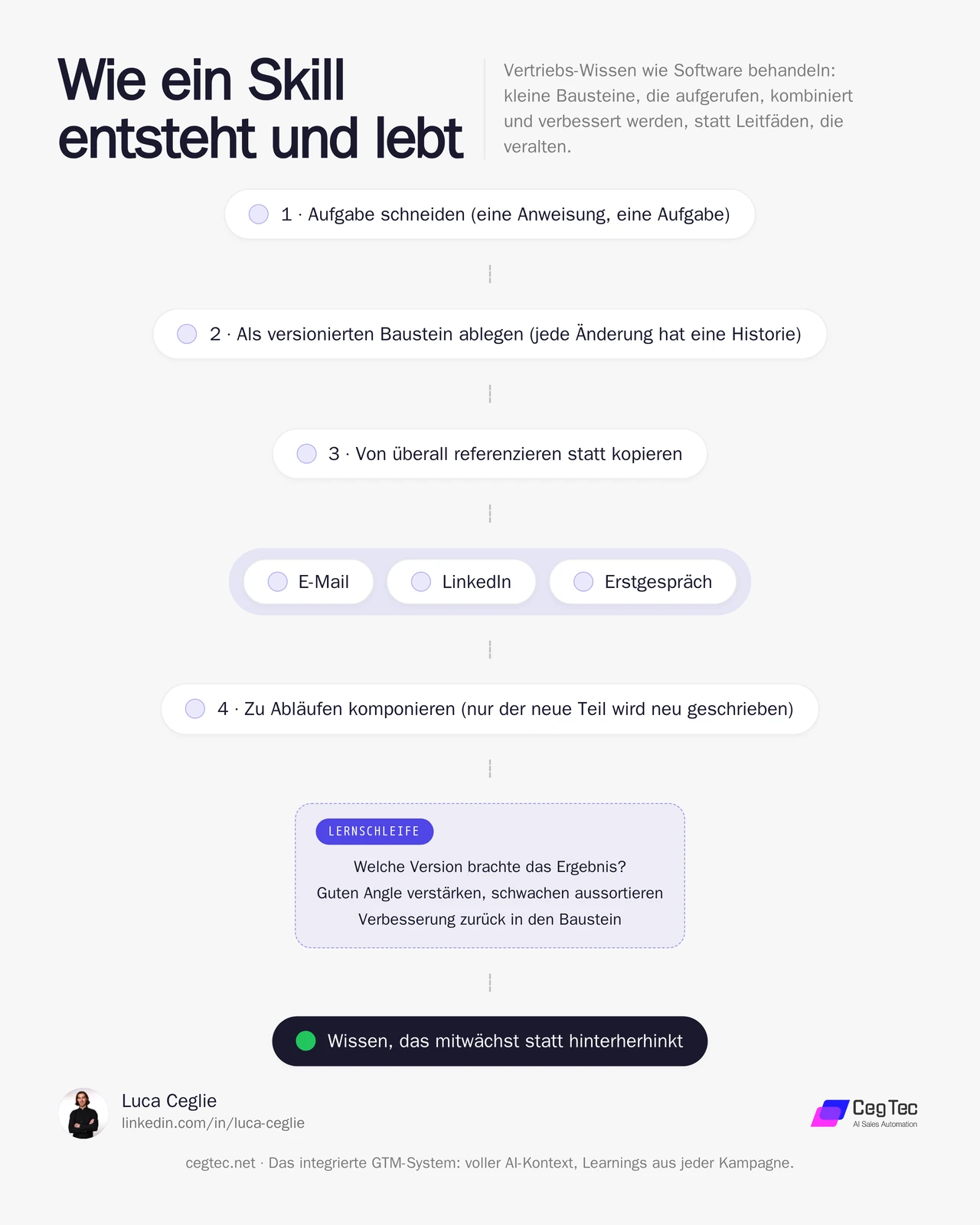
This is exactly where the real leverage appears. When every rule has a history, learnings from real outcomes can be fed back. A winning angle is reinforced, a weak one retired, and both are documented. The SOP folder never learns. A skill system learns with every version.
Composability: blocks become processes
The biggest conceptual leap is composition. In the SOP world every process is its own long document that explains many things from scratch again. In the skill world, processes are combinations of small blocks.
A new process — say, approaching a new vertical — then does not start as an empty document but by plugging together existing skills: sharpen the audience, define signals, adapt the message, classify replies. Only the genuinely new part is written fresh. The rest is inherited and already proven.
This has an underrated side effect on quality. When all processes use the same tested blocks, the floor of execution is equally high everywhere. A new process does not start at zero but at the level of the best existing block.
Auditability: understanding why something happened
The more sales work is automated or delegated to agents, the more important the question becomes: by which rule was this decision made? With an SOP the answer is a shrug and the hope that someone remembers the right version.
With versioned instructions the answer is verifiable. For any action you can look up the exact version of the skill behind it. That creates trust internally, because the team understands why the system acts as it does. And it creates control, because a wrong instruction is not just noticed but deliberately corrected — with the correction itself documented.
The methodological core
You do not need to build software for this. The principle can be implemented with simple means as soon as you accept three rules.
- One instruction, one task. Cut your sales knowledge into small, clearly named blocks instead of long guides.
- Every change has a history. Store the blocks where changes are traceable, not in an overwritable document.
- There is only one source per block. Reference instead of copying, so an improvement takes effect everywhere at once.
The gain is not order for its own sake. It is a sales operating system that does not lag behind the team but grows with it. Knowledge that gets used because it can be trusted. Processes that can be improved because change is cheap. And execution that starts everywhere at the same demonstrable level.
Two prompts for practice
The two prompts below show how the principle applies concretely. Both are deliberately generic and illustrative: they describe the decision, not a finished recipe. Copy them and fill in your own context.
The first helps break an existing static guide into small, clearly named blocks that can be versioned individually and referenced from anywhere.
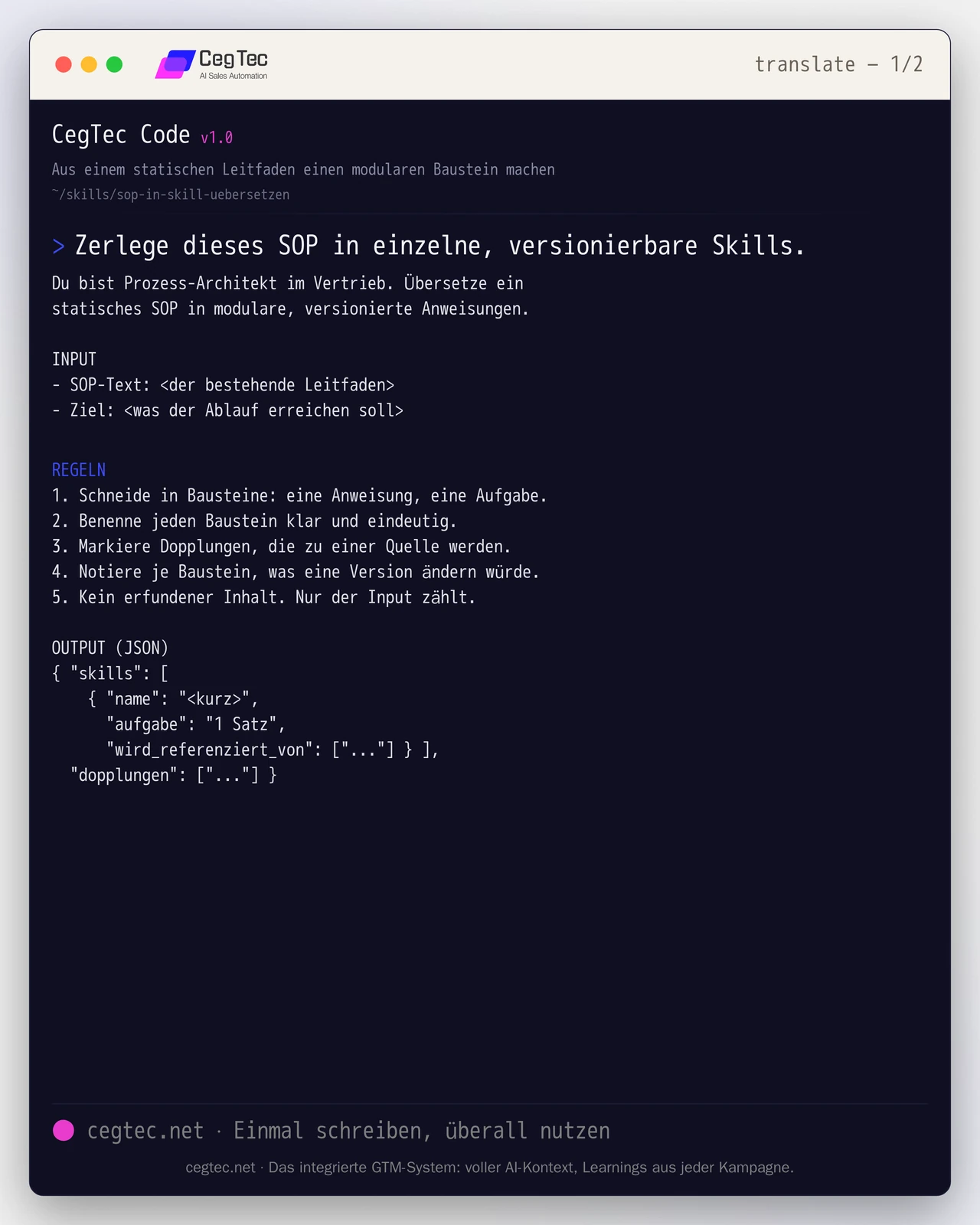
You are a sales process architect.
Translate a static SOP into modular, versioned instructions.

INPUT
- SOP text: <the existing guide>
- Goal: <what the process should achieve>

RULES
1. Cut into blocks: one instruction, one task.
2. Name every block clearly and unambiguously.
3. Mark duplicates that become one source.
4. Note per block what a version would change.
5. No invented content. Only the input counts.

OUTPUT (JSON)
{ "skills": [
    { "name": "<short>",
      "task": "1 sentence",
      "referenced_by": ["..."] } ],
"duplicates": ["..."] }The second closes the loop: it runs a block on a real case, records which version was used, and derives exactly one reversible improvement from it.
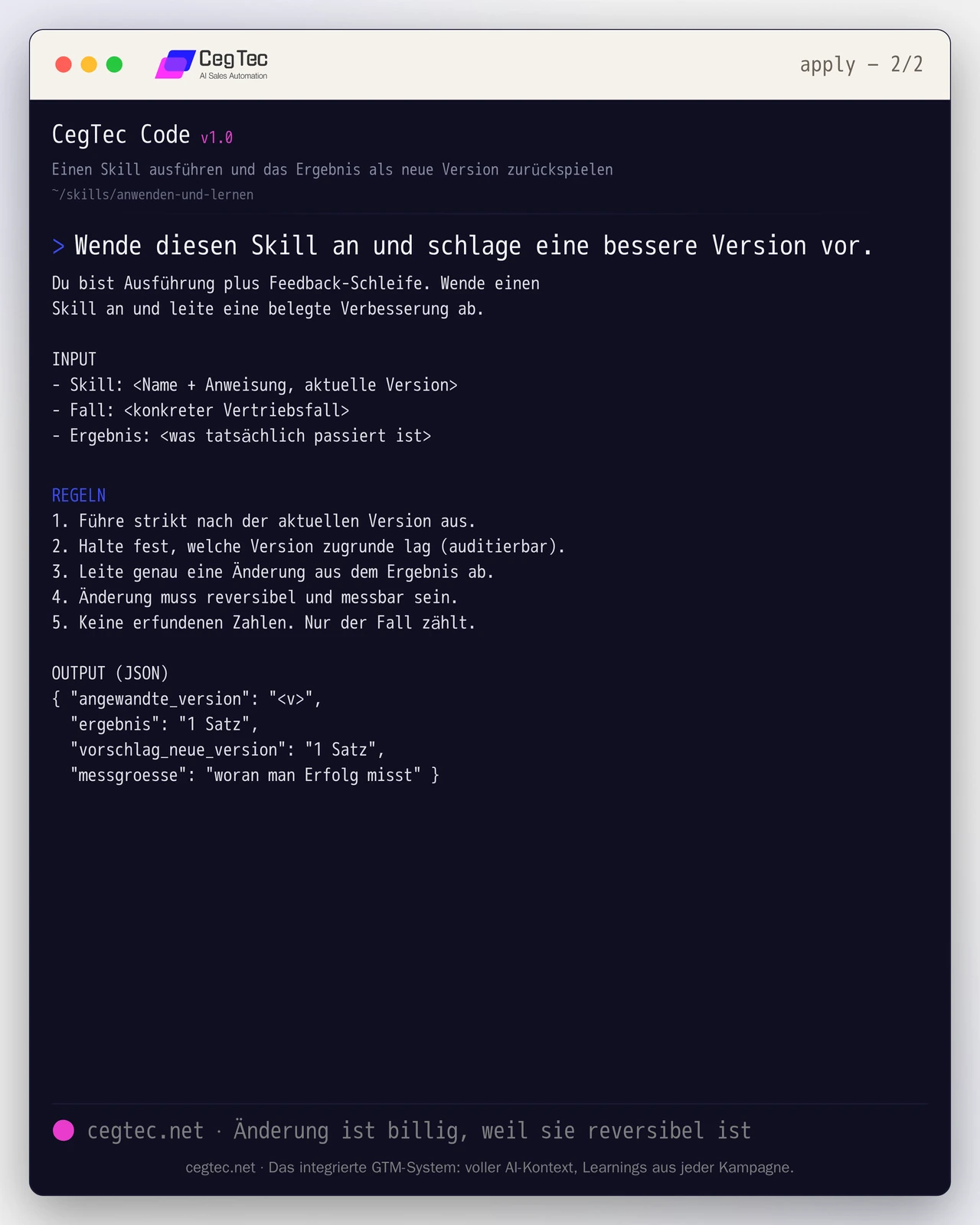
You are execution plus feedback loop.
Apply a skill and derive an evidenced improvement.

INPUT
- Skill: <name + instruction, current version>
- Case: <concrete sales case>
- Outcome: <what actually happened>

RULES
1. Execute strictly according to the current version.
2. Record which version was used (auditable).
3. Derive exactly one change from the outcome.
4. The change must be reversible and measurable.
5. No invented numbers. Only the case counts.

OUTPUT (JSON)
{ "applied_version": "<v>",
  "outcome": "1 sentence",
  "proposed_new_version": "1 sentence",
"metric": "how success is measured" }How to generate pipeline with this (in the GTM stack)
The principle stays the same when a team runs it inside a GTM stack. The work then distributes across clearly separated roles that interlock.
- Knowledge and instructions exist as versioned blocks: audience, signals, message, classification. Every block has a history and exactly one source.
- Orchestration and decision select the right blocks for a case, execute them in a sensible order, and put consequential steps to a human for approval.
- Execution across channels carries out the approved instruction where the contact happens, for instance by email or through a professional network.
- CRM records which block in which version underpinned an action, so every decision stays traceable.
- The learning loop feeds real outcomes back and proposes the next version of a block.
How these roles come together technically is open. A category-agnostic orchestration layer such as GTM Goat can execute versioned instructions and address the remaining roles by category rather than being tied to a fixed vendor. The stack underneath stays freely selectable.
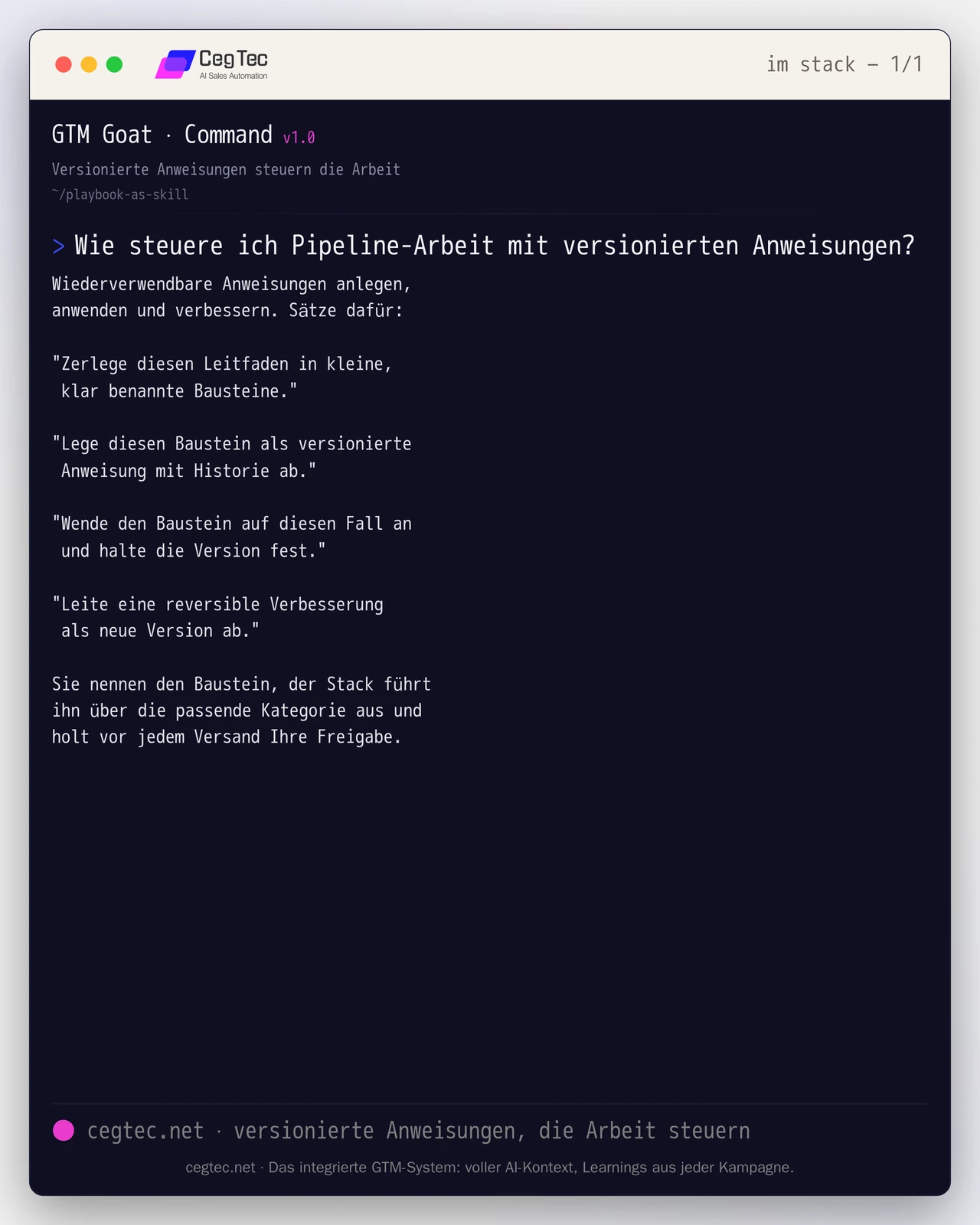
In practice you steer this with a few clearly phrased sentences. You name the block, the orchestration layer executes it through the right category and asks for your approval before every send.
Create, apply and improve reusable instructions. Sentences for that:

"Break this guide into small, clearly named blocks."

"Store this block as a versioned instruction with history."

"Apply the block to this case and record the version."

"Derive a reversible improvement as a new version."

You name the block, the stack executes it through the right category and asks for your approval before every send.The quickstart shows what such a process looks like step by step.
Next step
If you want to see what such a system looks like in a real sales organisation instead of assembling it yourself from blocks: book an intro call or look at the GTM Goat system.
Next step
GTM Goat runs exactly what you just read.