
WhatsApp outreach for local businesses 2026
WhatsApp reaches local businesses where email fails. How to build a GDPR-aware channel with Google Maps signals and copy that fits.
Local businesses do not read emails. But they read every WhatsApp.
Trades, solar installers, hospitality, local service providers: these businesses respond poorly to email and are reluctant to take calls from unknown numbers. Their actual working channel sits in their pocket. WhatsApp gets read between two appointments, on the building site, in the shop.
In our own outbound data the reply rate on WhatsApp is around 25 per cent (240 replies to 939 messages sent, 71 of them clearly positive). On cold email we measure roughly 4 per cent in the same system. Per message, WhatsApp is therefore about six times stronger. But that lead only holds while volume stays small and relevance stays high. The channel punishes scaling greed immediately: with an account ban rather than a full spam folder.
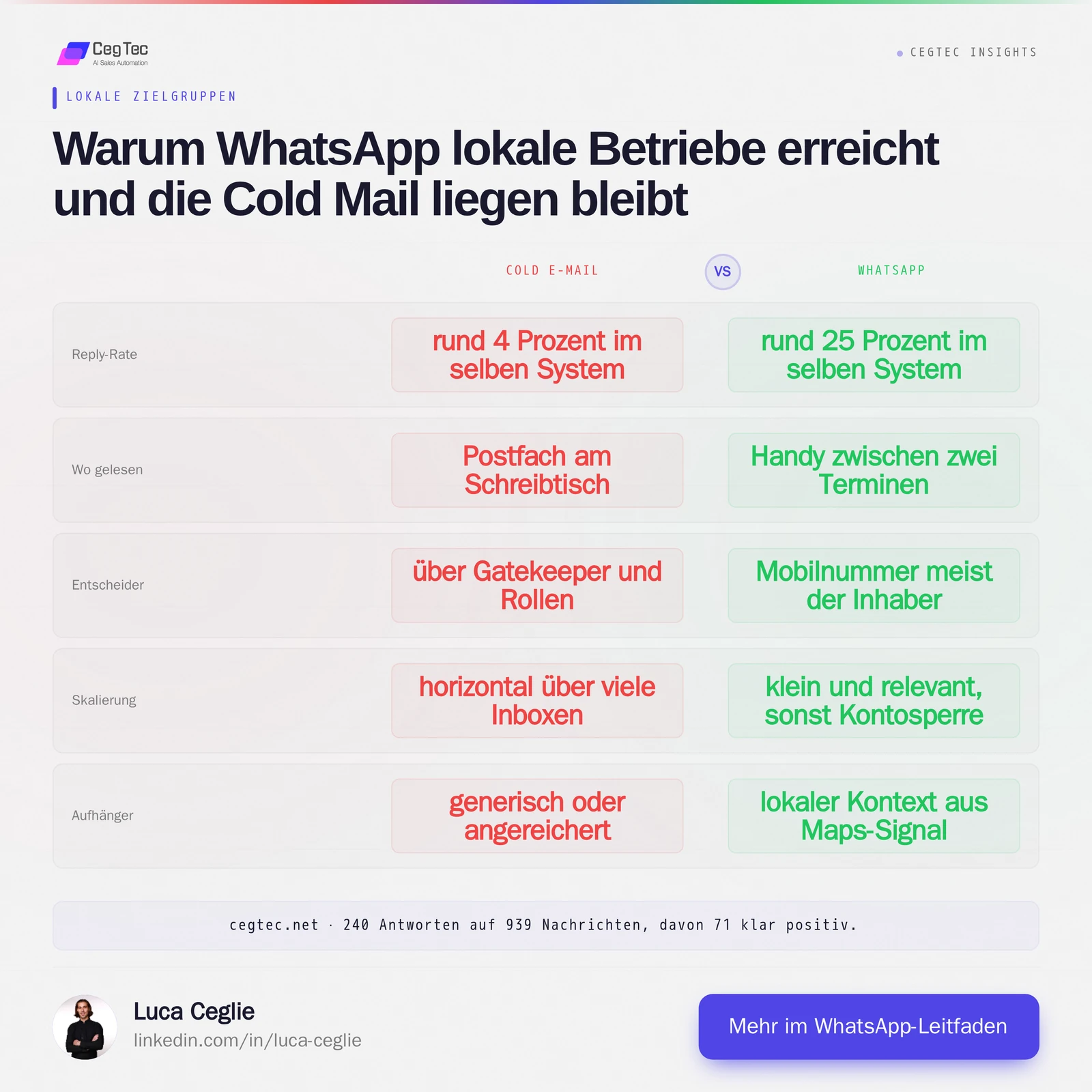
The difference is not a wording effect but a channel effect: the same audience, a different place of reading, and a different route to the decision-maker. That explains the reply advantage.
This guide shows the method: from the playbook via the signal source Google Maps to the first message. And it covers the point where most projects in the DACH region fail: compliance and consent.
Step 0: The playbook comes before the first scrape
Without this foundation, any channel becomes spam. Four building blocks decide between success and an account ban:
- Cut the ICP narrowly. Not “trades” but “PV installation businesses with 1 to 50 employees”. The sharper the cut, the more relevant the outreach.
- Keep the region small. City plus surrounding area. Locality is the channel’s promise, not a side effect.
- Prefer owner-managed businesses. In small, owner-managed companies the mobile number listed in the entry usually belongs to the decision-maker themselves.
- Value proposition in one sentence. A measurable result, locally anchored, plus a lead magnet with no barrier to entry. The call to action is “try it”, not “let’s get on a call”.
The actual chain runs on this foundation. It reads top to bottom and filters out waste at every stage, long before the first message is written.
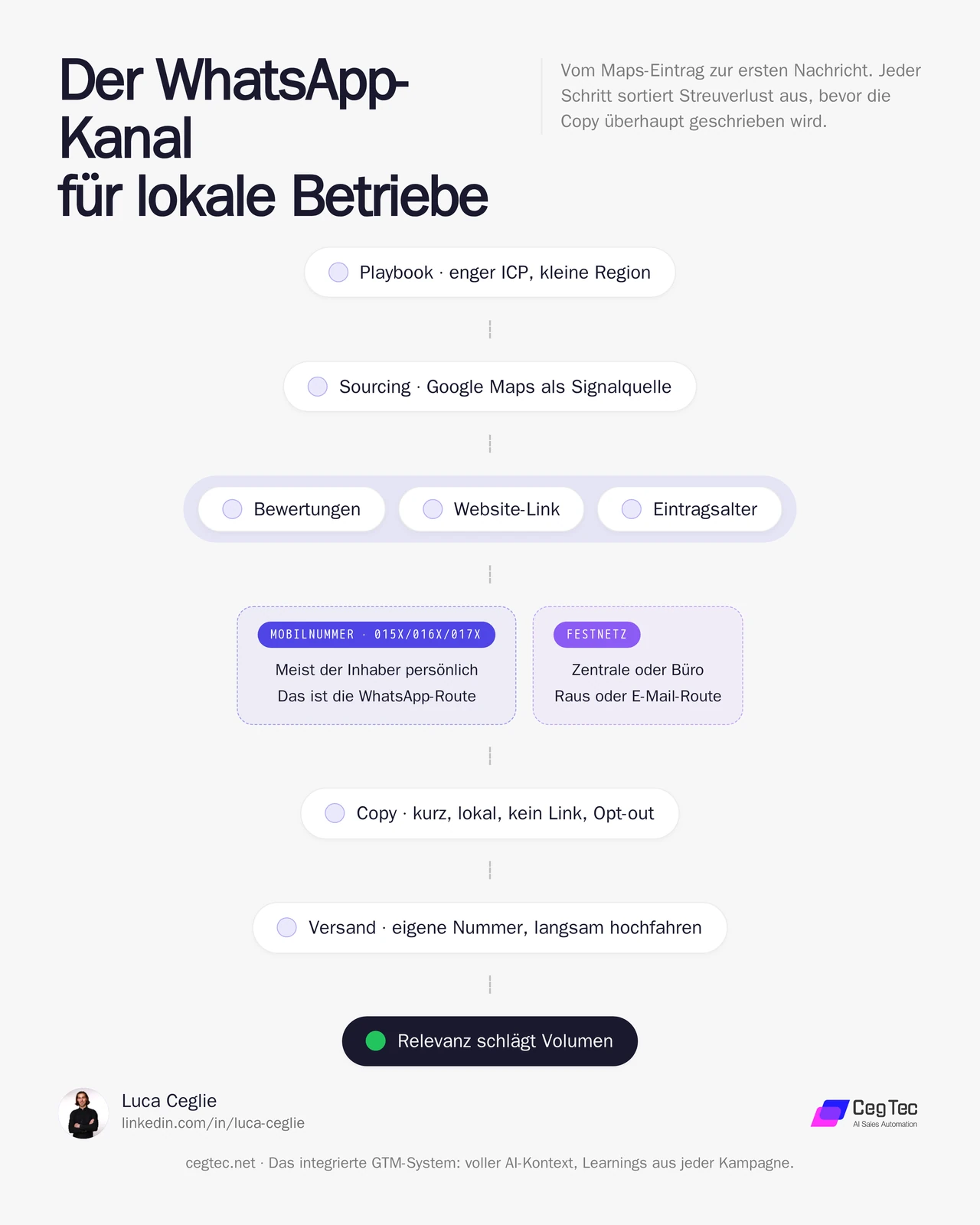
The decisive node sits in the middle: the mobile number filter splits every entry into a WhatsApp route and an email route. The steps below walk the chain one by one.
Step 1: Sourcing via Google Maps
For local audiences, Google Maps is the densest open data source. Every business entry supplies company name, category, location, reviews and, where listed, a phone number.
What is interesting is not just the contact details but the signals in the entry itself:
- Few or old reviews indicate a utilisation or visibility problem.
- No website link shows a digitalisation gap.
- A very new entry often marks a fresh founding.
These signals give your first message a genuine hook. You are not speaking into a void but into a concrete context.
Step 2: The most important filter is the mobile number
This is the decisive quality step. German mobile numbers begin with the prefixes 015x, 016x or 017x (internationally +49 15x/16x/17x). That is exactly what you filter for:
- Mobile number in the entry: almost always the owner personally. That is your WhatsApp route.
- Landline number: switchboard or office. Drops out of WhatsApp or moves to the email route.
This single filter replaces an entire enrichment stage. The question “will I even reach the decision-maker?” is already answered by the number range. You filter out waste before writing the first message.
Sourcing and filter can be captured as one reusable prompt. It is deliberately generic and derives route, number type and a local hook from a single Maps entry.
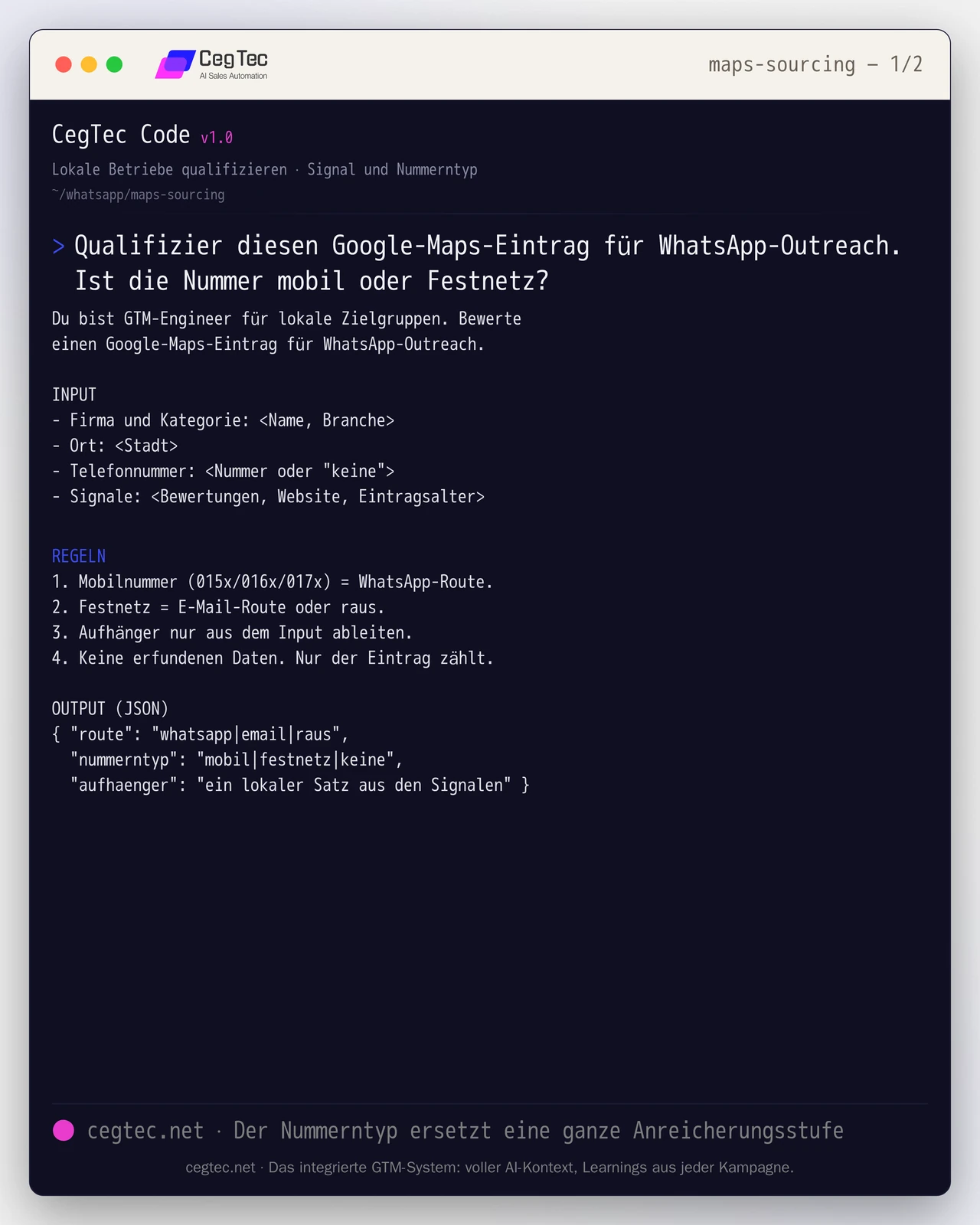
How to use it: enter the fields of an entry, give the prompt to a language model, and route only the entries with route: whatsapp into outreach. The prompt invents no data; it only assesses what the entry contains.
You are a GTM engineer for local audiences. Assess a Google Maps entry for WhatsApp outreach.

INPUT
- Company and category: <name, industry>
- Location: <city>
- Phone number: <number or "none">
- Signals: <reviews, website, age of entry>

RULES
1. Mobile number (015x/016x/017x) = WhatsApp route.
2. Landline = email route or out.
3. Derive the hook only from the input.
4. No invented data. Only the entry counts.

OUTPUT (JSON)
{ "route": "whatsapp|email|out",
  "number_type": "mobile|landline|none",
"hook": "one local sentence from the signals" }Step 3: Copy is its own discipline
WhatsApp copy is not a shortened email template. It follows its own rules:
- Keep it short. At most two to three sentences, the first message under 300 characters. It has to work on the lock screen.
- Hang it locally. The opening uses the context from the Maps data, such as the location or the category.
- No links in the first message. Links trigger spam heuristics and cost trust.
- Offer an opt-out. A line like “a short no is enough” reduces complaints that would endanger your account.
- Lead magnet later. The offer comes in message two, after a reaction.
AI-supported personalisation scales this approach: from name, city, category and review signal, a distinct variant is written per contact, while a negative list of spam phrases and emoji excess is filtered automatically. The human tone stays, the manual work falls away.
The first message can likewise be captured as a generic prompt that hard-wires the copy rules above: short, local, no link and a clear opt-out.
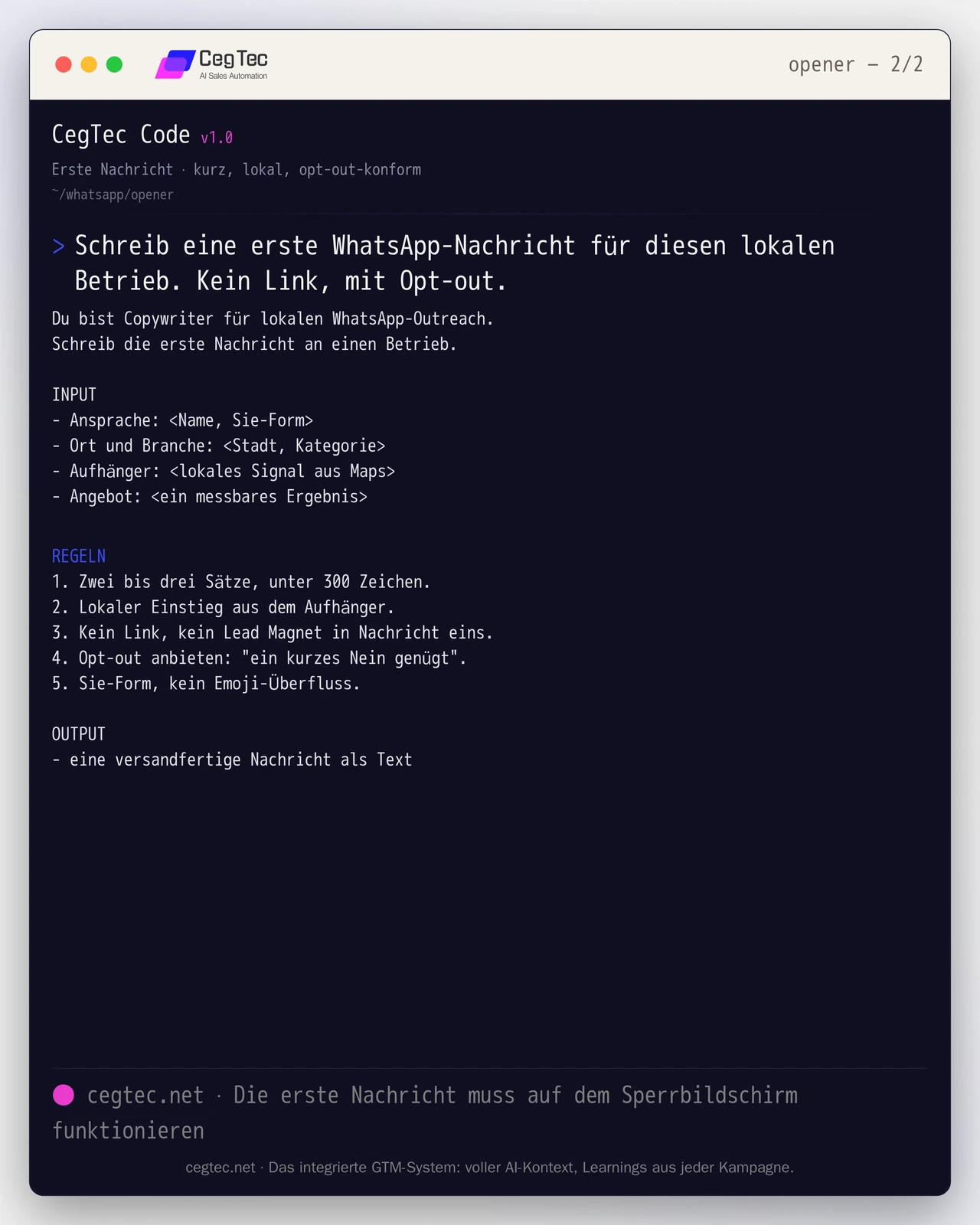
How to use it: pass salutation, location, industry, the hook from the sourcing prompt, and a measurable result. The prompt keeps the message under 300 characters, avoids links and the lead magnet, and builds in the opt-out. Read the result before sending.
You are a copywriter for local WhatsApp outreach. Write the first message to a business.

INPUT
- Salutation: <name>
- Location and industry: <city, category>
- Hook: <local signal from Maps>
- Offer: <one measurable result>

RULES
1. Two to three sentences, under 300 characters.
2. Local opening from the hook.
3. No link, no lead magnet in message one.
4. Offer an opt-out: "a short no is enough".
5. No emoji excess.

OUTPUT
- one ready-to-send message as textStep 4: Sending with judgement
For sending you use an official WhatsApp Business provider that connects a real phone number as a channel. What matters is less the tool than the operational discipline behind it:
- A dedicated number per campaign. Never use the private or main business number.
- Ramp up slowly. Start with 10 to 20 new conversations per day and number, then increase carefully.
- Classify replies. Incoming replies go into an orderly classification (positive, objection, no interest). Every reply is approved by a human before it goes out.
- Short sequence. At most one follow-up after three to four days, then stop. WhatsApp does not forgive persistence.
The result of this discipline is the reply advantage above. It does not come from more messages but from fewer, more relevant ones.
Compliance and consent in the DACH region
The channel is strong but legally demanding. Anyone running WhatsApp outreach in DACH market context must cleanly separate two levels: WhatsApp’s terms of use and the GDPR.
The platform level. WhatsApp requires documented opt-in for many message types, in particular for template-based, initiated messages. Violations do not lead to a warning letter but directly to the number being banned. Check the current business policies before setting up a campaign.
The GDPR level. A business mobile number is personal data. You need a legal basis for making contact. In a B2B context legitimate interest may apply, but it must be weighed against the recipient’s interests and documented. That includes transparent information about the origin and purpose of the data, a simple objection route (the opt-out mentioned) and deletion on request.
In practice this means: cleanly documented data provenance, a clear opt-out in every first message, no mass sending to private individuals, and deliberate handling of the limits of legitimate interest. This guide does not replace legal advice. Clarify the specific case with your data protection officer or legal department.
How to generate pipeline with this (in the GTM stack)
The four steps above can be run as a coherent GTM stack. What matters is not a particular product but that five roles are cleanly filled:
- Local data source. A map or directory source supplies the raw data on businesses in the chosen radius, including the signals from the entry.
- Number and channel filter. A stage separates every contact by number type and decides on the WhatsApp or the email route.
- Orchestration and decision. A layer coordinates the order of steps, holds the playbook rules and puts approvals to a human.
- Sending. A channel provider delivers the approved messages via WhatsApp or email.
- CRM. Replies and status flow into your existing CRM so nothing is worked twice.
These roles can consist of different tools. A category-agnostic orchestration layer such as GTM Goat can take the orchestration role and address the remaining roles by category rather than being tied to specific vendors. The stack stays freely selectable and no rip-and-replace is needed: your existing data source, sending and CRM can be connected without rebuilding everything.
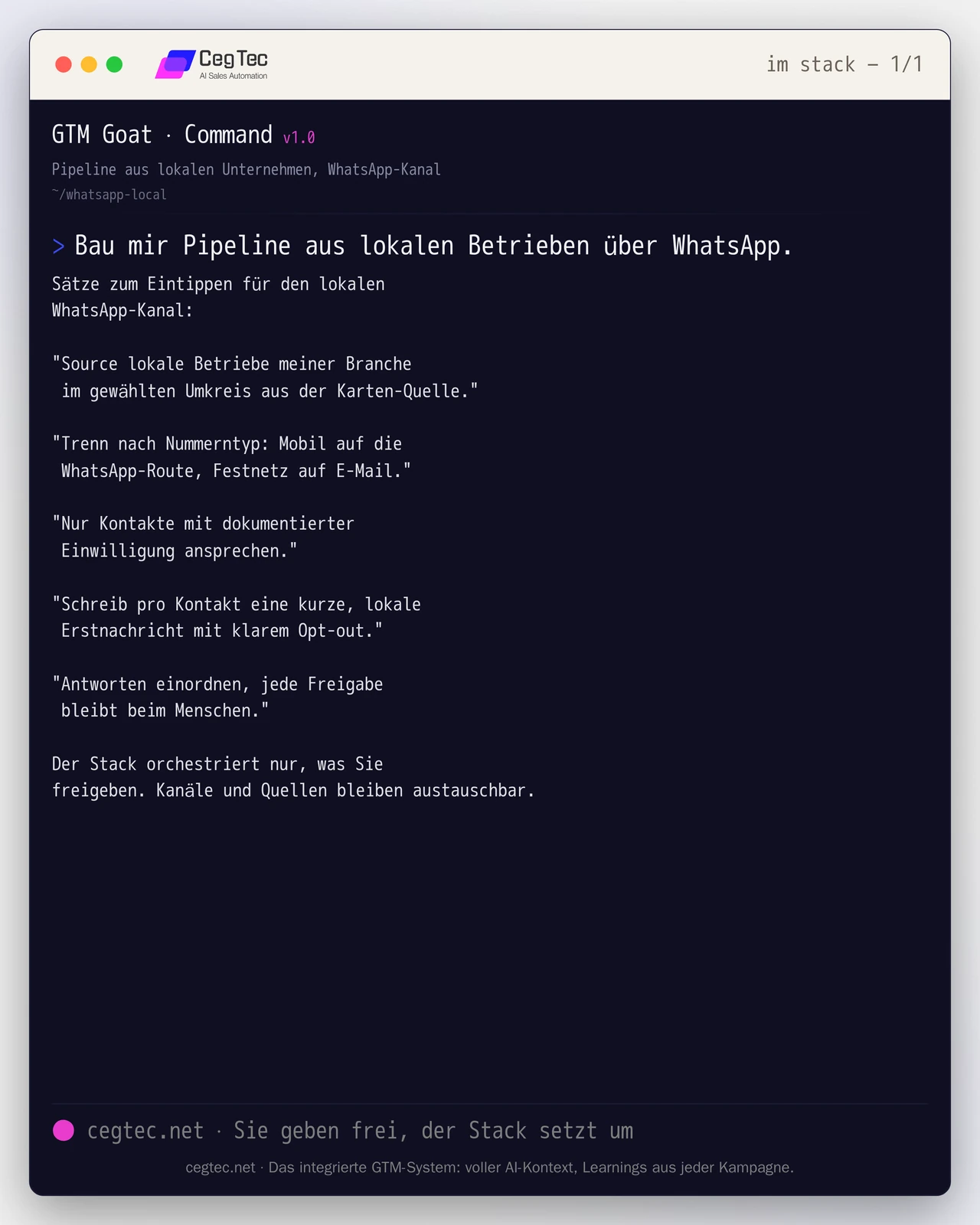
How to use it: you describe the goal in one sentence and the orchestration layer proposes the steps. Every consequential step, especially sending, stays bound to your approval. The sentences below are deliberately generic and can be typed directly. Opt-in remains a precondition: only contacts with documented consent go into outreach, and every first message carries a clear opt-out. That does not relieve you of the GDPR assessment described in the compliance section.
"Source local businesses in my industry within the chosen radius from the map source."

"Split by number type: mobile to the WhatsApp route, landline to email."

"Only pass contacts with documented consent into outreach."

"Write a short, local first message per contact with a clear opt-out."

"Classify replies, every approval stays with a human."The quickstart shows how such a process starts concretely.
Where WhatsApp converts most strongly
In our own data the channel converts particularly well with owner-managed and C-level contacts in solar technology, renewable energy, and agriculture and forestry. That fits the pattern: industries with a lot of field and appointment work, where decision-makers rarely sit at a desk but are always reachable on their phone.
The through-line stays the same. WhatsApp is not a volume channel but a relevance channel. A narrow ICP, a clean mobile number filter, short and local copy, few messages, clean compliance. In that order, a banned account becomes a channel that beats the email reply rate several times over.
CegTec builds exactly this process as a system: detect signals from local data sources, choose the right channel, reach out in a personalised and compliant way, classify replies with human approval. If you want to test WhatsApp seriously as a channel for local audiences, take a look at CegTec GTM Goat or talk to us.
Next step
GTM Goat runs exactly what you just read.