
10 lessons from 6 years of DACH outbound sales
Ten methodological lessons from six years of B2B outbound in the DACH market: what really produces replies and meetings, and what only produces activity.
Six years of outbound are above all six years of errors you sorted out
Outbound in the DACH market forgives superficiality less than most other markets. Decision-makers are sceptical, data protection is not a side issue, and generic outreach is recognised as such immediately. What follows are ten lessons that emerged in practice. Not a collection of tactics but principles with a clear practical consequence. Where a benchmark helps, it is marked as DACH market context and not as a result figure from a single project.
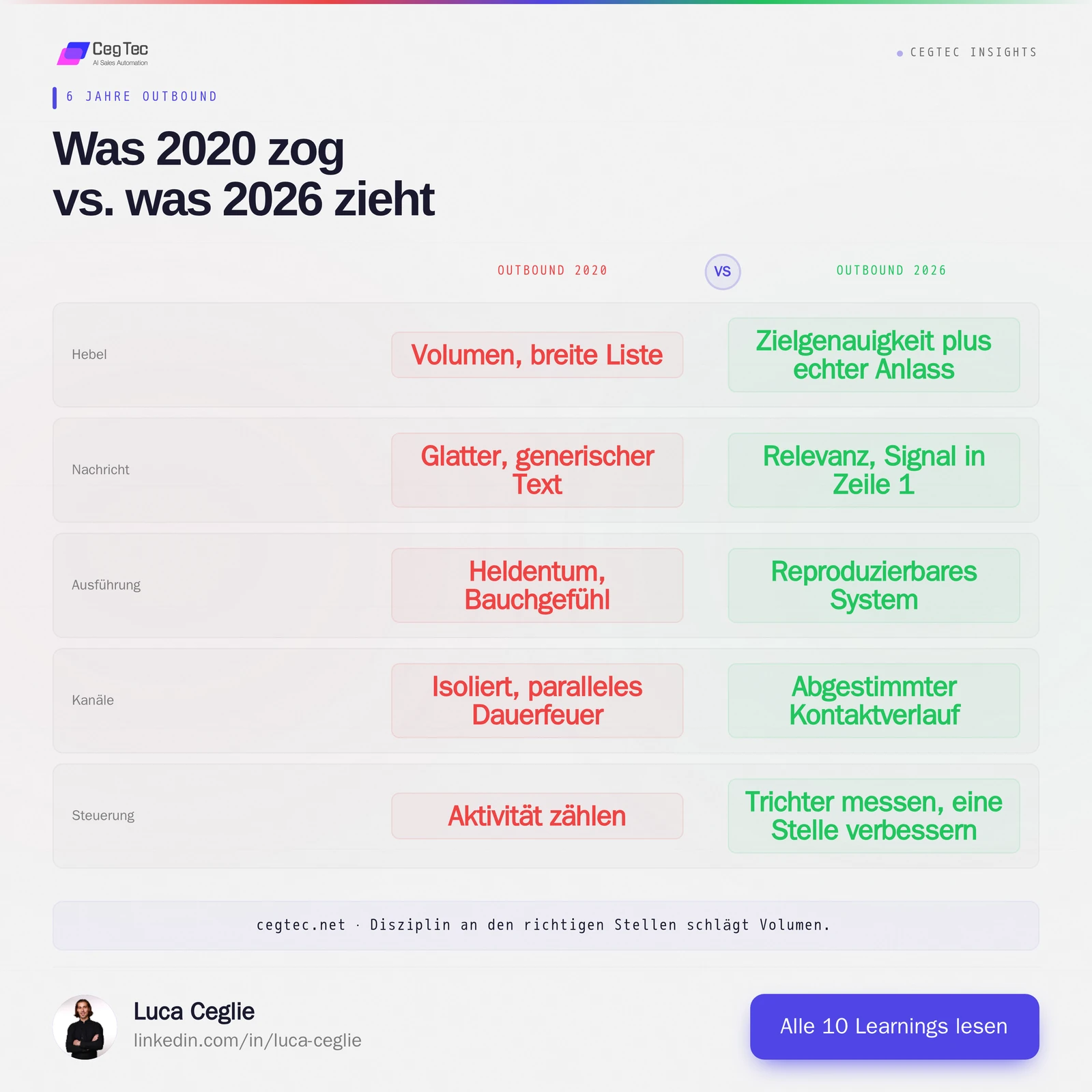
What has shifted in six years can be summed up in one comparison: the market now rewards precision, trigger and system where it used to let pure volume pass.
1. Precision beats volume
The most expensive mistake in outbound is writing to the wrong people. Every message to a company without genuine need burns delivery reputation, time and the market’s patience. In DACH market context: reply rates depend more on the precision of the list than on the quality of the text. A good text to the wrong list stays ineffective.
Practical consequence: define your ideal customer profile so narrowly that you can anchor it in concrete, checkable attributes (industry, size, role, trigger). Better 200 genuinely matching contacts than 2,000 roughly filtered ones. Regularly check which segments actually produce meetings and cut the rest decisively.
2. A credible trigger matters more than a polished text
People reply when a message arrives at the right moment. A recognisable trigger (a new role, an expansion, a visible initiative) turns cold outreach into plausible outreach. Without that trigger, even the best phrasing remains an interruption.
Practical consequence: research real signals before sending and tie your first line to them. If you cannot find a trigger, the contact may not be ready yet.
3. Personalisation means relevance, not name-dropping
The first name in the subject line and the mentioned city are not personalisation but text modules. Real personalisation shows you have understood the recipient’s problem. In the DACH market the difference between researched and automatically assembled stands out especially fast.
Practical consequence: test every first line with the question of whether it would also fit a competitor of the recipient. If yes, it is not specific enough.
4. A system beats heroics
One thing has become clear over the years: results that depend on one person’s daily form are not predictable. Reproducibility emerges when research, outreach, follow-up and evaluation exist as a repeatable process rather than as gut decisions. The leverage lies in the method, not in the individual brilliant move.
Practical consequence: document your outbound process so a new colleague can follow and repeat it. What is not documented cannot be improved, and what depends on a single head leaves with that head. A system makes good results transferable and bad ones diagnosable.
5. Following up is not applying pressure but adding value
Most replies do not come from the first message. Nevertheless the majority of senders stop after one or two attempts. The point is not to say the same thing more often but to deliver a new, small piece of value with every contact (an observation, an example, a relevant question).
Practical consequence: plan your follow-up chain so every message also gives a reason to reply when read on its own. Repeated reminders without new content do more harm than good.
6. Deliverability is the silent precondition
You can spend months polishing texts while a technical problem means the messages never arrive. Domain reputation, clean authentication and a measured sending volume decide whether your work becomes visible at all. That is unspectacular, but it is the basis of everything.
Practical consequence: treat deliverability as its own discipline with its own controls. Check regularly that your messages land in the inbox and not in spam.
7. Tone decides: respect for the recipient’s time
DACH decision-makers react sensitively to exaggerated sales language and empty superlatives. What works is a factual, clear tone that gets to the point quickly and leaves the decision to the other person. Pressure creates resistance; clarity creates trust.
Practical consequence: write more briefly than initially feels right. Cut every adjective that proves nothing and every phrase you would skip yourself.
8. The first call qualifies, it does not yet sell
A common mistake is filling the first conversation with a product presentation. Its actual purpose is to find out whether a real problem, budget and timeframe exist. Pitch too early and you lose the chance to understand whether it fits at all.
Practical consequence: go into the first conversation with a list of questions rather than slides. An honestly disqualified contact is worth more than one artificially kept alive.
9. Channels work together, not against each other
Email, LinkedIn and phone are not competing options but building blocks of the same contact sequence. A contact who has already seen one message reacts differently to the next touchpoint. The mistake is running each channel in isolation and losing the thread.
Practical consequence: think in contact sequences across channels, not in separate campaigns per channel. A coordinated rhythm feels more attentive and less intrusive than parallel constant fire.
10. Without measurement, everything is opinion
If you do not measure which step moves how many contacts into the next, you are optimising blind. Only when you see exactly where contacts are lost (at the list, the first line, the follow-up or the call) do you know what to work on. Activity is not a result, and a full calendar of tasks is not progress.
Practical consequence: keep a simple funnel view with clear handoffs between stages. Always improve the one place where proportionally the most is lost, instead of turning many dials at once. That turns a diffuse gut feeling into a testable hypothesis you can check week by week.
Prompts: turning lessons into repeatable steps
Two principles from the ten lessons translate directly into reusable prompts: turning a lesson into a reproducible playbook step, and checking every message before sending. Both are deliberately generic. Copy them, insert your ideal customer profile, your channel and your offer, done.
1. Translate a lesson into a playbook step
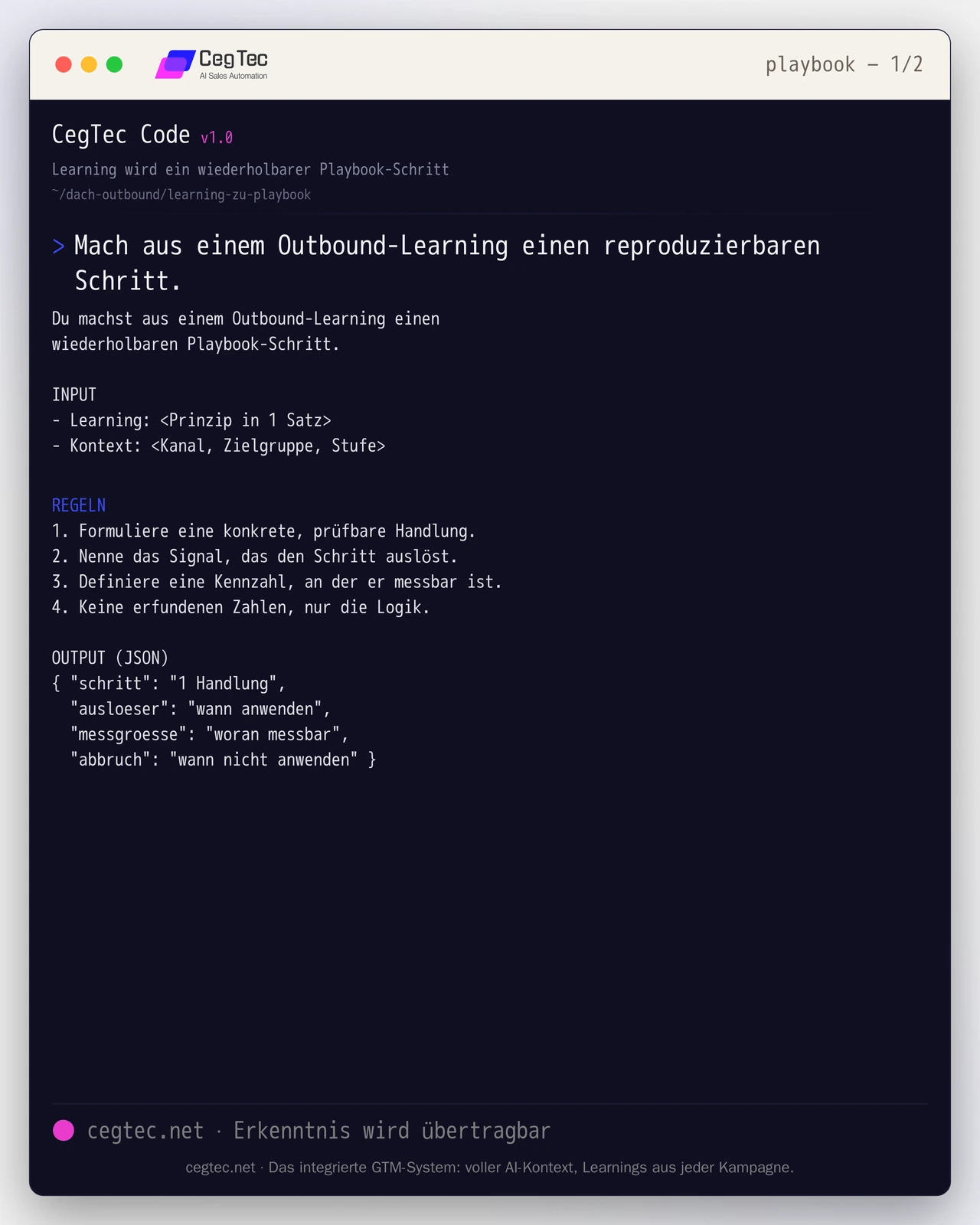
Takes a principle and turns it into a concrete, checkable action with a trigger and a metric. That turns an insight into a step a new colleague can follow and repeat.
You turn an outbound lesson into a repeatable playbook step.

INPUT
- Lesson: <principle in 1 sentence>
- Context: <channel, audience, stage>

RULES
1. Formulate a concrete, checkable action.
2. Name the signal that triggers the step.
3. Define a metric by which it is measurable.
4. No invented numbers, just the logic.

OUTPUT (JSON)
{ "step": "1 action",
  "trigger": "when to apply",
  "metric": "how it is measured",
"stop": "when not to apply" }2. Pre-send QA
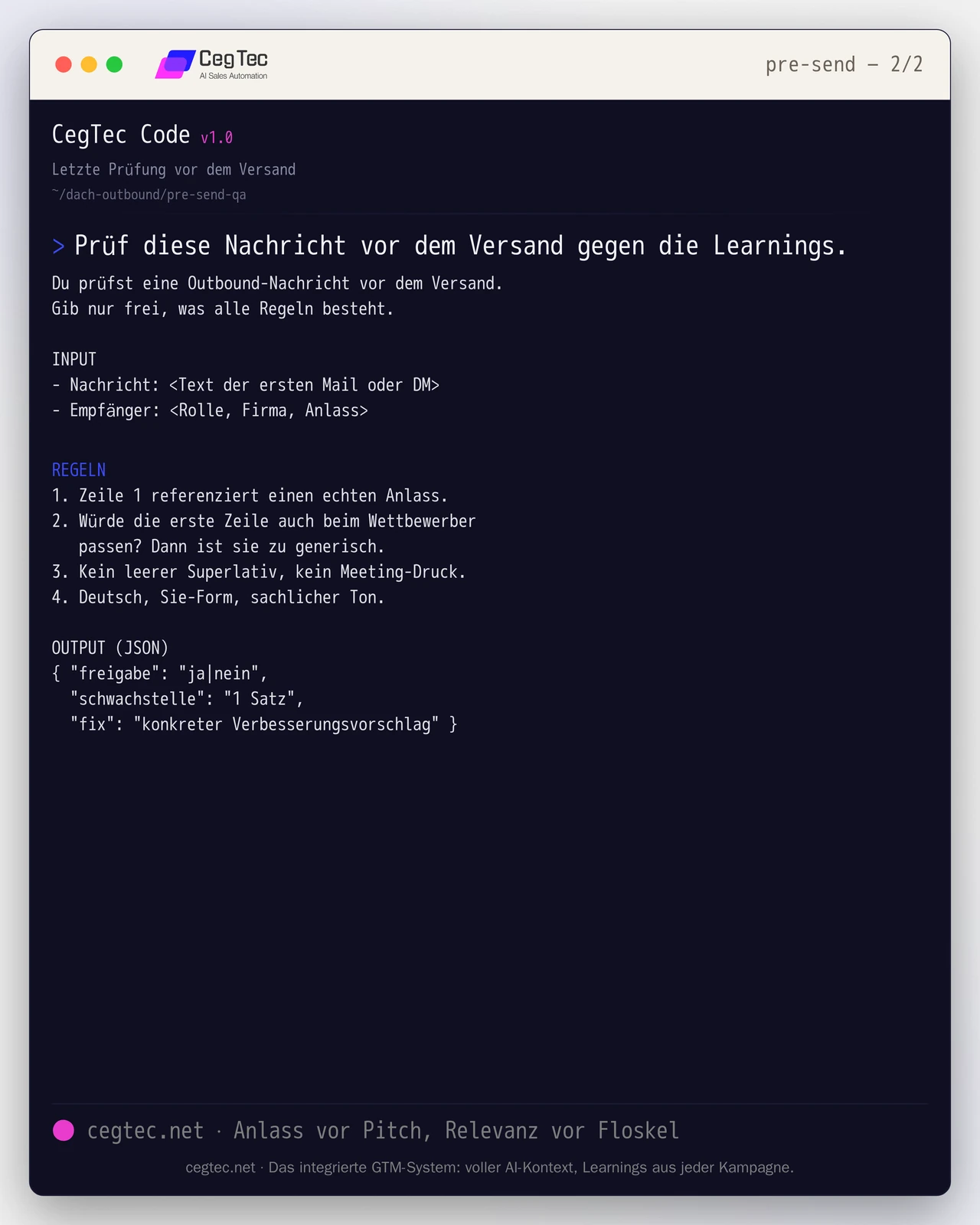
Checks a finished message against the hardest rules from the lessons: a real trigger in line 1, no interchangeable phrasing, no empty superlative. Approves only what passes.
You check an outbound message before sending. Approve only what passes all rules.

INPUT
- Message: <text of the first email or DM>
- Recipient: <role, company, trigger>

RULES
1. Line 1 references a real trigger.
2. Would the first line also fit their competitor? Then it is too generic.
3. No empty superlative, no meeting pressure.
4. Factual tone.

OUTPUT (JSON)
{ "approval": "yes|no",
  "weakness": "1 sentence",
"fix": "concrete improvement" }How to generate pipeline with this (in the GTM stack)
Pipeline does not come from a single tool but from several roles in the stack working together. The ten lessons describe exactly those roles: a precise audience, a real trigger, a repeatable system and consistent measurement. In a running setup they distribute across clearly separated tasks that interlock:
- Signal and data: which accounts get contacted at all, including trigger and priority (lessons 1 and 2).
- Enrichment and validation: check addresses and clean lists so precision and deliverability do not fail on bad data (lessons 3 and 6).
- Orchestration and decision: when which step fires, how the follow-up chain is paced, and where in the funnel to adjust (lessons 4, 5 and 10).
- Sending via email and LinkedIn: the channel where the contact sequence actually happens (lessons 7 and 9).
- CRM: replies, qualification and history in one place (lesson 8).
- Learning loop: what produces meetings flows back into audience and outreach instead of being lost as gut feeling.
What matters is less the individual tool than a layer connecting these roles into one process with one metric. A category-agnostic orchestration layer such as GTM Goat can take that role and address the others by category: you connect your sender, your enrichment and your CRM instead of replacing them. The stack stays freely selectable, there is no rip-and-replace, and the funnel stays singular.
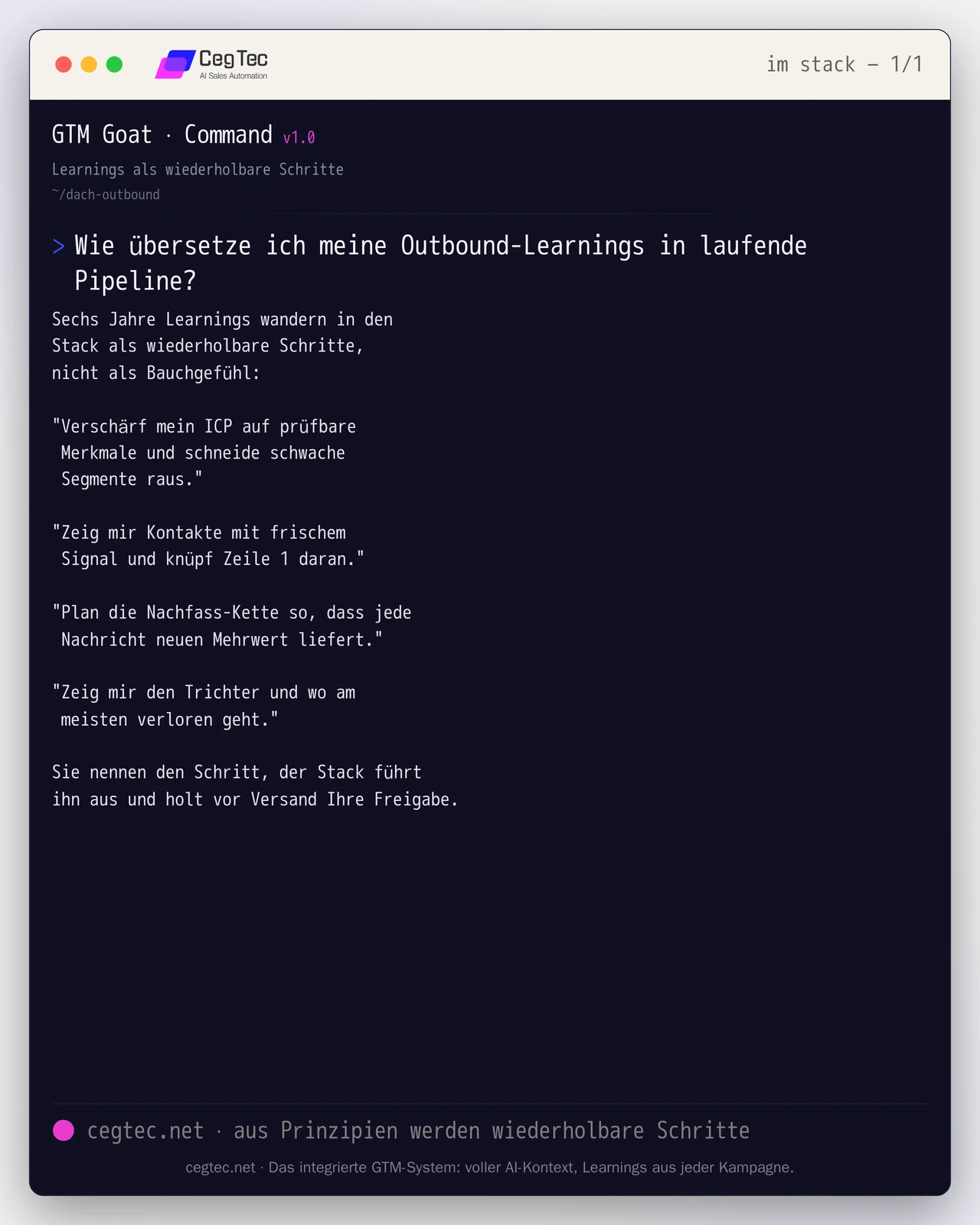
Here is how you run it in the stack: you steer the steps through the Command interface and translate the lessons into repeatable actions. A few sentences, ready to type:
"Tighten my ICP to checkable attributes and cut out weak segments."
"Show me contacts with a fresh signal and tie line 1 to it."
"Plan the follow-up chain so every message delivers new value."
"Show me the funnel and where the most is lost."The quickstart shows how to get started.
The common pattern behind all ten points
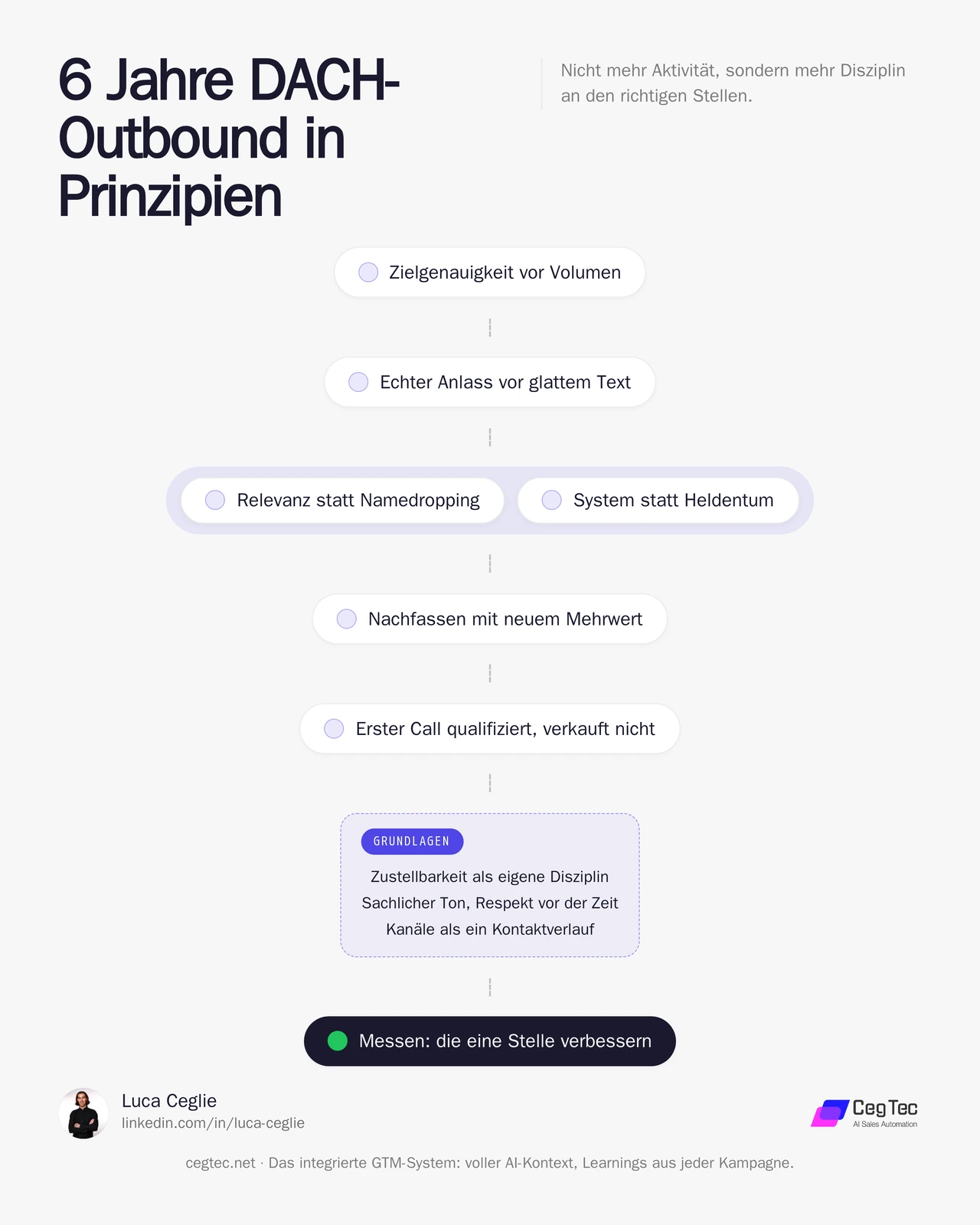
Compress six years and one insight remains: outbound does not get better through more activity but through more discipline in the right places. A precise audience, a real trigger, honest relevance, a repeatable system and consistent measurement beat any volume game. The lessons are unspectacular, and that is precisely the point: the reliable wins against the spectacular.
If you want to turn these principles into a reproducible, measurable system, see how we implement it with GTM Goat, or talk to us directly.
Next step
GTM Goat runs exactly what you just read.